
Research System of the Collaborative Research Centre 814 – Additive Manufacturing (Self-construction in cooperation with LSS Europe GmbH)
Model: Research System of the Collaborative Research Centre 814 – Additive Manufacturing
Manufacturer: Self-construction in cooperation with LSS Europe GmbH (2012)
Location: Erlangen
Usage: FAU internal
Pictures
Debug: Alles
name_de: Forschungsanlage des Sonderforschungsbereichs 814 – Additive Fertigungname_en: Research System of the Collaborative Research Centre 814 – Additive Manufacturing
model: Research System of the Collaborative Research Centre 814 – Additive Manufacturing
url:
manufacturer: Self-construction in cooperation with LSS Europe GmbH
year: 2012
location: 202160667
location_de: Erlangen
location_en: Erlangen
usage: 21197
usage_de: FAU intern
usage_en: FAU internal
description_de:
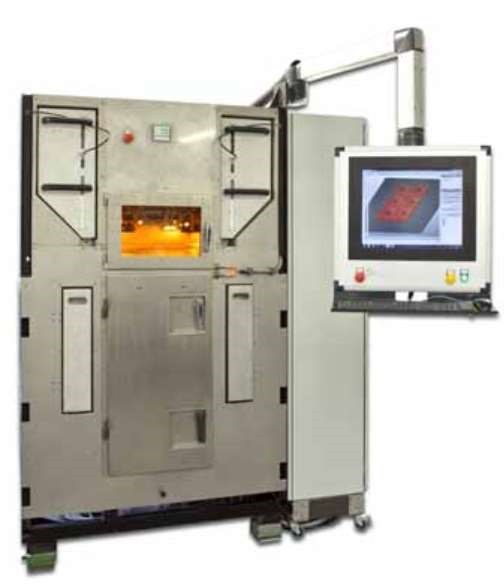
description_en: The research system of the Collaborative Research Centre 814 – Additive Manufacturing is a self-established and almost freely parameterizable and temperature-stabilized laser beam melting system.<br /><br />It allows for a homogeneous temperature distribution on the building space, which is a basic requirement for the fabrication process guaranteed by an eight-zone IR surface heating system. The maximum build chamber temperature is 230°C, which enables the processing of plastics with higher melting temperatures. The scanning system is state of the art and guarantees short acceleration times as well as high precision in beam guiding. The integrated f-theta lens of the laser system enables constant intensity distributions almost over the entire build chamber surface of 350 x 350 mm2. The maximum build height is 500 mm. The focus diameter of the CO2 laser is 400 µm and the maximum nominal power is 50 W.<br /><br />The research system has a wide range of additional equipment, which is used especially for process analysis and processing of new powder materials in small quantities. Thus, different setups can be integrated into the system, which make it possible to reduce the installation space and to control the temperature. In addition, a reduction of the powder storage container is available, too. Different recoating geometries are available for powder application, e.g. different blade geometries or a counter rotating roller. Furthermore, for the observation of the thermal boundary conditions and the exposure process as well as the melt pool formation an infrared camera system can be integrated into the research system.<br /><br />This high-end adaptable research system is used to answer the most complex questions regarding laser sintering of polymers.
feature_de:
feature_en:
pictures: <QuerySet [<Picture: 244197143>]>
cards: <QuerySet [<Card: Card of Andreas, Jaksch: (True)>]>
funding_sources: <QuerySet [<FundingSource: FundingSource: cris_id: 139455596, name: DFG / Sonderforschungsbereich (SFB), abbreviation: SFB>]>
projects: <QuerySet [<Project: New process strategies for laser beam melting of polymers (B3) (SFB 814 (B3)), SFB 814 (B3), https://www.crc814.research.fau.eu, CRC 814 - Additive Manufacturing (SFB 814), <p> </p><p>Within sub-project B3, the basic influences of the process control of selective laser beam melting of polymers on the resulting part properties are analyzed. Therefore, the sub-processes powder coating, laser exposure and consolidation as well as the temperature control are scientifically investigated. Innovative process strategies, which fulfill the material specific requirements of semi-crystalline thermoplastics, are studied to produce parts with reproducible and defined properties.</p>, <p> </p><p>Within sub-project B3, the basic influences of the process control of selective laser beam melting of polymers on the resulting part properties are analyzed. Therefore, the sub-processes powder coating, laser exposure and consolidation as well as the temperature control are scientifically investigated. Innovative process strategies, which fulfill the material specific requirements of semi-crystalline thermoplastics, are studied to produce parts with reproducible and defined properties.</p>, 2011-07-01, 2023-06-30, , 2023-06-30, Third Party Funds Group - Sub project, True>]>
publications: <QuerySet [<Publication: Referencing of powder bed for in situ detection of lateral layer displacements in additive manufacturing>, <Publication: Methods and procedure of referenced in situ control of lateral contour displacements in additive manufacturing>, <Publication: Thermographic investigation of laser-induced temperature fields in selective laser beam melting of polymers>, <Publication: A new approach for getting more homegeneous temperature fields in selective laser sintering of polymers>, <Publication: Influence of powder coating on part density as a function of coating parameters>]>
fobes: <QuerySet []>
orgas: <QuerySet [<Organisation: Lehrstuhl für Kunststofftechnik (LKT), , Erlangen, 91058, Am Weichselgarten, 2999-12-31, Department Maschinenbau, True>]>
dfg_keys: <QuerySet [<DFGKey: 2110 Maschinen zur Formen- und Modellherstellung und gießereitechnische>]>