
Linux based throughput computer / High performance computer Woody (diverse)
Model: Durchsatz-HPC-Cluster
Manufacturer: diverse
URL: https://www.hpc.fau.de/systems-services/systems-documentation-instructions/clusters/woody-cluster/
Location: Erlangen
Usage: FAU internal
Pictures
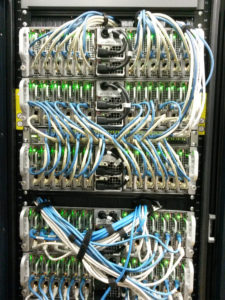
Deep-Learning-Informed Glacio-Hydrological Threat (DELIGHT Framework)
Sept. 1, 2024 - Aug. 31, 2030
International Doctoral Program: Measuring and Modelling Mountain glaciers and ice caps in a Changing Climate (M³OCCA) (MOCCA)
June 1, 2022 - May 31, 2026
Climate sensitivity of ice shelves on the western Antarctic Peninsula (CSAPIS)
Nov. 1, 2022 - Oct. 31, 2025
Ice thickness, remote sensing and sensitivity experiments using an ice dynamic model for main outlet glaciers of the southern Patagonian icefield (ITERATE)
Dec. 1, 2021 - Nov. 30, 2024
Video-based Re-Identification for Animals (Team VERA)
Jan. 1, 2021 - Jan. 1, 2024
Measurements of height and mass changes of glaciers and ice caps outside the large ice sheets using TanDEM-X (SATELLITE-2)
DFG SPP 1889: Regionaler Meeresspiegelanstieg & Gesellschaft
March 1, 2020 - June 30, 2022
Tapping the potential of Earth Observations (TAPE)
April 1, 2019 - March 31, 2022
Development of an interactive platform for processing and distribution of data sets with glaciological variables based on Sentinel-1 data (for glaciers and ice caps outside the large ice sheets) (RETREAT)
Jan. 1, 2018 - Dec. 30, 2020
A stochastic estimate of sea level contribution from glaciers and ice caps using satellite
remote sensing (SATELLITE)
DFG Schwerpunktprogramm "Regional Sea Level Change & Society"
Jan. 1, 2017 - Feb. 29, 2020
Study of the dynamic state of ice shelves on the south-western Antarctic Peninsula by an interdisciplinary approach of remote sensing, fracture mechanics and modelling of ice dynamics
SPP 1158: Bereich Infrastruktur - Antarktisforschung mit vergleichenden Untersuchungen in arktischen Eisgebieten
Aug. 1, 2009 - Aug. 30, 2012
Debug: Alles
name_de: Linux-basierter Durchsatzrechner / HPC-Cluster Woodyname_en: Linux based throughput computer / High performance computer Woody
model: Durchsatz-HPC-Cluster
url: https://www.hpc.fau.de/systems-services/systems-documentation-instructions/clusters/woody-cluster/
manufacturer: diverse
year: 0
location: 202160667
location_de: Erlangen
location_en: Erlangen
usage: 21197
usage_de: FAU intern
usage_en: FAU internal
description_de:
description_en: The RRZE’s "Woody" is the preferred cluster for serial/single-node throughput jobs.<br /><br /><div>The cluster has changed significantly over time. You can find more about the history in the <a href="https://hpc.fau.de/systems-services/systems-documentation-instructions/clusters/woody-cluster/#hist">section about history</a>. The current hardware configuration looks like this:</div><ul><li>70 compute nodes (w11xx nodes) with Xeon E3-1240 v3 CPUs („Haswell“, 4 cores, HT disabled, 3,4 GHz base frequency), 8 GB RAM, 1 TB HDD – from 09/2013</li><li>64 compute nodes (w12xx/w13xx nodes) with Xeon E3-1240 v5 CPUs („Skylake“, 4 cores, HT disabled, 3,5 GHz base frequency), 32 GB RAM, 1 TB HDD – from 04/2016 and 01/2017</li><li>112 compute nodes (w14xx/w15xx nodes) with Xeon E3-1240 v6 CPUs („Kaby Lake“, 4 cores, HT disabled, 3,7 GHz base frequency), 32 GB RAM, 960 GB SDD – from Q3/2019<br /></li></ul>
feature_de:
feature_en:
pictures: <QuerySet [<Picture: 234687135>]>
cards: <QuerySet [<Card: Card of Gerhard, Wellein: (True)>, <Card: Card of Thomas, Zeiser: (True)>]>
funding_sources: <QuerySet []>
projects: <QuerySet [<Project: Deep-Learning-Informed Glacio-Hydrological Threat (DELIGHT Framework), DELIGHT Framework, , , , , 2024-09-01, 2030-08-31, , 2030-08-31, Third party funded individual grant, True>, <Project: International Doctoral Program: Measuring and Modelling Mountain glaciers and ice caps in a Changing Climate (M³OCCA) (MOCCA), MOCCA, , , <p>Mountain glaciers and ice caps outside the large ice sheets of Greenland and Antarctica contribute about 41% to the global sea level rise between 1901 to 2018 (IPCC 2021). While the Arctic ice masses are and will remain the main contributors to sea level rise, glacier ice in other mountain regions can be critical for water supply (e.g. irrigation, energy generation, drinking water, but also river transport during dry periods). Furthermore, retreating glaciers also can cause risks and hazards by floods, landslides and rock falls in recently ice-free areas. As a consequence, the Intergovernmental Panel of Climate Change (IPCC) dedicates special attention to the cryosphere (IPCC 2019; IPCC 2021). WMO and UN have defined Essential Climate Variables (ECV) for assessing the status of the cryosphere and its changes. These ECVs should be measured regularly on large scale and are essential to constrain subsequent modelling efforts and predictions.<br />The proposed International Doctorate Program (IDP) “Measuring and Modelling Mountain glaciers and ice caps in a Changing ClimAte (M3OCCA)” will substantially contribute to improving our observation and measurement capabilities by creating a unique inter- and transdisciplinary research platform. We will address main uncertainties of current measurements of the cryosphere by developing new instruments and future analysis techniques as well as by considerably advancing geophysical models in glaciology and natural hazard research. The IDP will have a strong component of evolving techniques in the field of deep learning and artificial intelligence (AI) as the data flow from Earth Observation (EO) into modelling increases exponentially. IDP M3OCCA will become the primary focal point for mountain glacier research in Germany and educate emerging<br />talents with an interdisciplinary vision as well as excellent technical and soft skills. Within the IDP we combine cutting edge technologies with climate research. We will develop future technologies and transfer knowledge from other disciplines into climate and glacier research to place Bavaria at the forefront in the field of mountain cryosphere research. IDP M3OCCA fully fits into FAU strategic goals and it will leverage on Bavaria’s existing long-term commitment via the super test site Vernagtferner in the Ötztal Alps run by Bavarian Academy of Sciences (BAdW). In addition, we cooperate with the University of Innsbruck and its long-term observatory at Hintereisferner. At those super test sites, we will perform joint measurements, equipment tests, flight campaigns and cross-disciplinary trainings and exercises for our doctoral researchers. We leverage on existing<br />instrumentation, measurements and time series. Each of the nine doctoral candidates will be guided by interdisciplinary, international teams comprising university professors, senior scientists and emerging talents from the participating universities and external research organisations.<br /></p>, , 2022-06-01, 2026-05-31, , 2026-05-31, Third party funded individual grant, True>, <Project: Climate sensitivity of ice shelves on the western Antarctic Peninsula (CSAPIS), CSAPIS, , , , , 2022-11-01, 2025-10-31, , 2025-10-31, Third Party Funds Group - Overall project, True>, <Project: Ice thickness, remote sensing and sensitivity experiments using an ice dynamic model for main outlet glaciers of the southern Patagonian icefield (ITERATE), ITERATE, , , , , 2021-12-01, 2024-11-30, , 2024-11-30, Third party funded individual grant, True>, <Project: Video-based Re-Identification for Animals (Team VERA), Team VERA, https://team-vera.github.io/, , <p>Digitization is advancing at a high pace in all areas of our lives. The development of algorithms based on artificial intelligence and more extensive and better data sets are creating new opportunities in many areas of science.<br /></p><p>Nevertheless, it is common for many biologists, veterinarians, and animal caretakers to observe the animals manually, which is very time- and labor-expensive and comes with severe limitations. The development of an automated camera-based system seems to be self-evident.<br /><br />The automated analysis of video footage from surveillance cameras is a possibility to evaluate activity/inactivity and stereotypy of the animals as well as their enclosure use over long periods of time and thus allows an objective assessment. In the project's next phase, further behavior analysis will be added (for example, secondary behavior such as feeding, playful behavior, or interaction). The most challenging step for such a system is the re-identification (reID) of individual animals in every camera perspective</p>, , 2021-01-01, , , 2024-01-01, Internally funded project, True>, <Project: Measurements of height and mass changes of glaciers and ice caps outside the large ice sheets using TanDEM-X (SATELLITE-2), SATELLITE-2, , DFG SPP 1889: Regionaler Meeresspiegelanstieg & Gesellschaft, <p>Glaciers and ice caps outside the large ice sheets show considerable elevation and mass changes and are strong contributors to sea level change. However, to date only few regional assessments exist that provide a glacier-specific analysis over entire region or on global scale. This information is relevant for global glacier models, the reconstruction of ice thickness as well as for sustainable water management. In the current project phase, we analyse elevation changes for all glaciers covered by the Shuttle Radar Topography Mission (SRTM) between 56°S and 60°N using data from the SRTM (2000) and the German TanDEM-X mission (2010 to 2015). We apply differential SAR interferometry and a state-of-the-art post-processing procedures to generate a near global assessments of glaciers mass changes outside the polar regions. In this follow-up proposal, we aim at spatially expanding, at updating with a new time slice using new observations and at improving our measurements from the first phase. We will compare TanDEM-X (2010-2015) to TanDEM-X acquisitions (2017+). Those data sets will enable an improved spatial resolution of 10 m, less observation voids and cover also regions beyond 60°N. For some of the proposed regions we will provide for the first time glacier-specific measurements. We will use the recently available global TanDEM-X DEM and the ArcticDEM as reference for our processing. Technical and methodological developments will comprise adaptation of the processing chain, parallelisation and transfer to high performance computing, improved gap filling approaches and improved penetration depth correction by integrating concurrent laser altimetry. We will analyse the results in regard to changes potential causes and processes leading to the changes as well as to accelerated or decelerated change rates. </p>, , 2020-03-01, 2022-06-30, , 2022-06-30, Third Party Funds Group - Sub project, True>, <Project: Tapping the potential of Earth Observations (TAPE), TAPE, , , , , 2019-04-01, 2021-03-31, 2022-03-31, 2022-03-31, FAU own research funding: EFI / IZKF / EAM ..., True>, <Project: Development of an interactive platform for processing and distribution of data sets with glaciological variables based on Sentinel-1 data (for glaciers and ice caps outside the large ice sheets) (RETREAT), RETREAT, , , , , 2018-01-01, 2020-12-30, , 2020-12-30, Third party funded individual grant, True>, <Project: A stochastic estimate of sea level contribution from glaciers and ice caps using satellite remote sensing (SATELLITE), SATELLITE, https://www.spp-sealevel.de/index.php?id=3130, DFG Schwerpunktprogramm "Regional Sea Level Change & Society", , <div> Glaciers and ice caps outside the large ice sheets show considerable elevation and mass changes and are strong contributors to sea level change. However, to date only few regional assessments exist that provide a glacier-specific analysis over entire region or on global scale. This information is relevant for global glacier models, the reconstruction of ice thickness as well as for sustainable water management. In the current project phase, we analyse elevation changes for all glaciers covered by the Shuttle Radar Topography Mission (SRTM) between 56°S and 60°N using data from the SRTM (2000) and the German TanDEM-X mission (2010 to 2015). We apply differential SAR interferometry and a state-of-the-art post-processing procedures to generate a near global assessments of glaciers mass changes outside the polar regions. In this follow-up proposal, we aim at spatially expanding, at updating with a new time slice using new observations and at improving our measurements from the first phase. We will compare TanDEM-X (2010-2015) to TanDEM-X acquisitions (2017+). Those data sets will enable an improved spatial resolution of 10 m, less observation voids and cover also regions beyond 60°N. For some of the proposed regions we will provide for the first time glacier-specific measurements. We will use the recently available global TanDEM-X DEM and the ArcticDEM as reference for our processing. Technical and methodological developments will comprise adaptation of the processing chain, parallelisation and transfer to high performance computing, improved gap filling approaches and improved penetration depth correction by integrating concurrent laser altimetry. We will analyse the results in regard to changes potential causes and processes leading to the changes as well as to accelerated or decelerated change rates. </div>, 2017-01-01, 2020-02-29, , 2020-02-29, Third Party Funds Group - Sub project, True>, <Project: Study of the dynamic state of ice shelves on the south-western Antarctic Peninsula by an interdisciplinary approach of remote sensing, fracture mechanics and modelling of ice dynamics, , , SPP 1158: Bereich Infrastruktur - Antarktisforschung mit vergleichenden Untersuchungen in arktischen Eisgebieten, , , 2009-08-01, 2012-08-30, , 2012-08-30, Third Party Funds Group - Sub project, True>]>
publications: <QuerySet [<Publication: The state and fate of Glaciar Perito Moreno Patagonia>, <Publication: Community estimate of global glacier mass changes from 2000 to 2023>, <Publication: A Gradient-Based Method for Joint Chance-Constrained Optimization with Continuous Distributions>, <Publication: Highly efficient encoding for job-shop scheduling problems and its application on quantum computers>, <Publication: Large-scale simulations of Floquet physics on near-term quantum computers>, <Publication: Towards quantum gravity with neural networks: solving the quantum Hamilton constraint of U(1) BF theory>, <Publication: Towards quantum gravity with neural networks: solving quantum Hamilton constraints of 3d Euclidean gravity in the weak coupling limit>, <Publication: Investigation of iron oxide nanoparticle formation in a spray-flame synthesis process using laser-induced incandescence>, <Publication: Observing glacier elevation changes from spaceborne optical and radar sensors - an inter-comparison experiment using ASTER and TanDEM-X data>, <Publication: Tomographic single-shot time-resolved laser-induced incandescence for soot characterization in turbulent flames>, <Publication: Estimating 3D kinematics and kinetics from virtual inertial sensor data through musculoskeletal movement simulations>, <Publication: Comprehensive numerical investigation of laser powder bed fusion process conditions for bulk metallic glasses>, <Publication: Mass changes of the northern Antarctic Peninsula Ice Sheet derived from repeat bi-static synthetic aperture radar acquisitions for the period 2013–2017>, <Publication: Adaptive Region Selection for Active Learning in Whole Slide Image Semantic Segmentation>, <Publication: Revealing bulk metallic glass crystallization kinetics during laser powder bed fusion by a combination of experimental and numerical methods>, <Publication: Data-driven Distributionally Robust Optimization over Time>, <Publication: Variational Hamiltonian simulation for translational invariant systems via classical pre-processing>, <Publication: Change the direction: 3D optimal control simulation by directly tracking marker and ground reaction force data>, <Publication: Solving AC Optimal Power Flow with Discrete Decisions to Global Optimality>, <Publication: Unexpected dipole instabilities in small molecules after ultrafast XUV irradiation>, '...(remaining elements truncated)...']>
fobes: <QuerySet [<ResearchArea: Research Area: Title: A3 Multiscale Modeling and Simulation | A3 Multiscale Modeling and Simulation, Description: <div><p><b>New methods for multiscale and multiphysical modeling for the optimization of structures, properties, and processes</b> </p> <p><b>The research concept connects quantum-mechanical approaches on the molecular scale to discrete approaches for particle systems and to methods of continuum mechanics</b> </p> <p>The cross-sectional Research Area A3 is concerned with modeling, simulating and optimizing macroscopic material and structural properties based on their constituent components such as particles, molecules and atoms. A guiding principle of A3 is that simulation is used as a new paradigm in gaining qualitative knowledge and quantitative data alongside theoretical and experimental facts. </p><ul><li>On the qualitative side, molecules that have not yet been synthesized can e.g. be anticipated via modeling and simulation. Similarly, new materials and in particular meta-materials (or utopia-materials) can be designed optimally, given their desired functionality. </li><li>On the quantitative side, data-driven model-based simulation and optimization in the context of the application areas can be used directly in the process chain.</li></ul><p>Understanding matter and designing materials, interfaces, and processes from their nano-structural constitution necessitates both algorithms that scale almost linearly in order to cope with the vast number of variables, and hierarchical, multi-scale modeling, analysis and mathematical optimization in order to bridge the gap between the scales in space, time, and constitutive models. <br /><br />The Center for Multiscale Modeling and Simulation (CMMS) works on multiscale approaches and methods for structure, property, and process optimization. The research concept connects quantum mechanical approaches on the molecular scale to discrete approaches for particle systems and to methods of continuum mechanics. </p></div> | <div><p><b>New methods for multiscale and multiphysical modeling for the optimization of structures, properties, and processes</b> </p> <p><b>The research concept connects quantum-mechanical approaches on the molecular scale to discrete approaches for particle systems and to methods of continuum mechanics</b> </p> <p>The cross-sectional Research Area A3 is concerned with modeling, simulating and optimizing macroscopic material and structural properties based on their constituent components such as particles, molecules and atoms. A guiding principle of A3 is that simulation is used as a new paradigm in gaining qualitative knowledge and quantitative data alongside theoretical and experimental facts. </p><ul><li>On the qualitative side, molecules that have not yet been synthesized can e.g. be anticipated via modeling and simulation. Similarly, new materials and in particular meta-materials (or utopia-materials) can be designed optimally, given their desired functionality. </li><li>On the quantitative side, data-driven model-based simulation and optimization in the context of the application areas can be used directly in the process chain.</li></ul><p>Understanding matter and designing materials, interfaces, and processes from their nano-structural constitution necessitates both algorithms that scale almost linearly in order to cope with the vast number of variables, and hierarchical, multi-scale modeling, analysis and mathematical optimization in order to bridge the gap between the scales in space, time, and constitutive models. <br /><br />The Center for Multiscale Modeling and Simulation (CMMS) works on multiscale approaches and methods for structure, property, and process optimization. The research concept connects quantum mechanical approaches on the molecular scale to discrete approaches for particle systems and to methods of continuum mechanics. </p></div>, Classification: Field of Research | Forschungsbereich >]>
orgas: <QuerySet [<Organisation: Regionales Rechenzentrum Erlangen (RRZE), Regionales Rechenzentrum Erlangen (RRZE), Erlangen, 91058, Martensstraße, 2999-12-31, Zentrale Einrichtungen, True>, <Organisation: Professur für Höchstleistungsrechnen, The research activities of the HPC professorship are located at the interface between numerical applications and modern parallel, heterogeneous high-performance computers.<br /><br />The application focus is on the development and implementation of hardware- and energy-efficient numerical methods and application programs. The foundation of all activities is a structured performance engineering (PE) process based on analytic performance models. Such models describe the interaction between software and hardware and are thus able to systematically identify efficient implementation, optimization and parallelization strategies. The PE process is applied to stencil-based schemes as well as basic operations and eigenvalue solvers for large sparse problems.<br /><br />In the computer science-oriented research focus, performance models, PE methods and easy-to-use open source tools are developed that support the process of performance engineering and performance modeling on the compute node level. We focus on the continuous development of the ECM performance model and the LIKWID tool collection.<br /><br />In teaching and training, the working group consistently relies on a model-based approach to teach optimization and parallelization techniques. The courses are integrated into the computer science and computational engineering curriculum at FAU. Furthermore, the group offers an internationally successful tutorial program on performance engineering and hybrid programming.<br /><br />Prof. Wellein is director of the Erlangen National Center for High-Performance Computing (NHR@FAU) and is the spokesman of the Competence Network for Scientific High Performance Computing in Bavaria (KONWIHR)., Erlangen, 91058, Martensstraße, 2999-12-31, Department Informatik, True>]>
dfg_keys: <QuerySet [<DFGKey: 7000 Datenverarbeitungsanlagen, zentrale Rechenanlagen>]>