
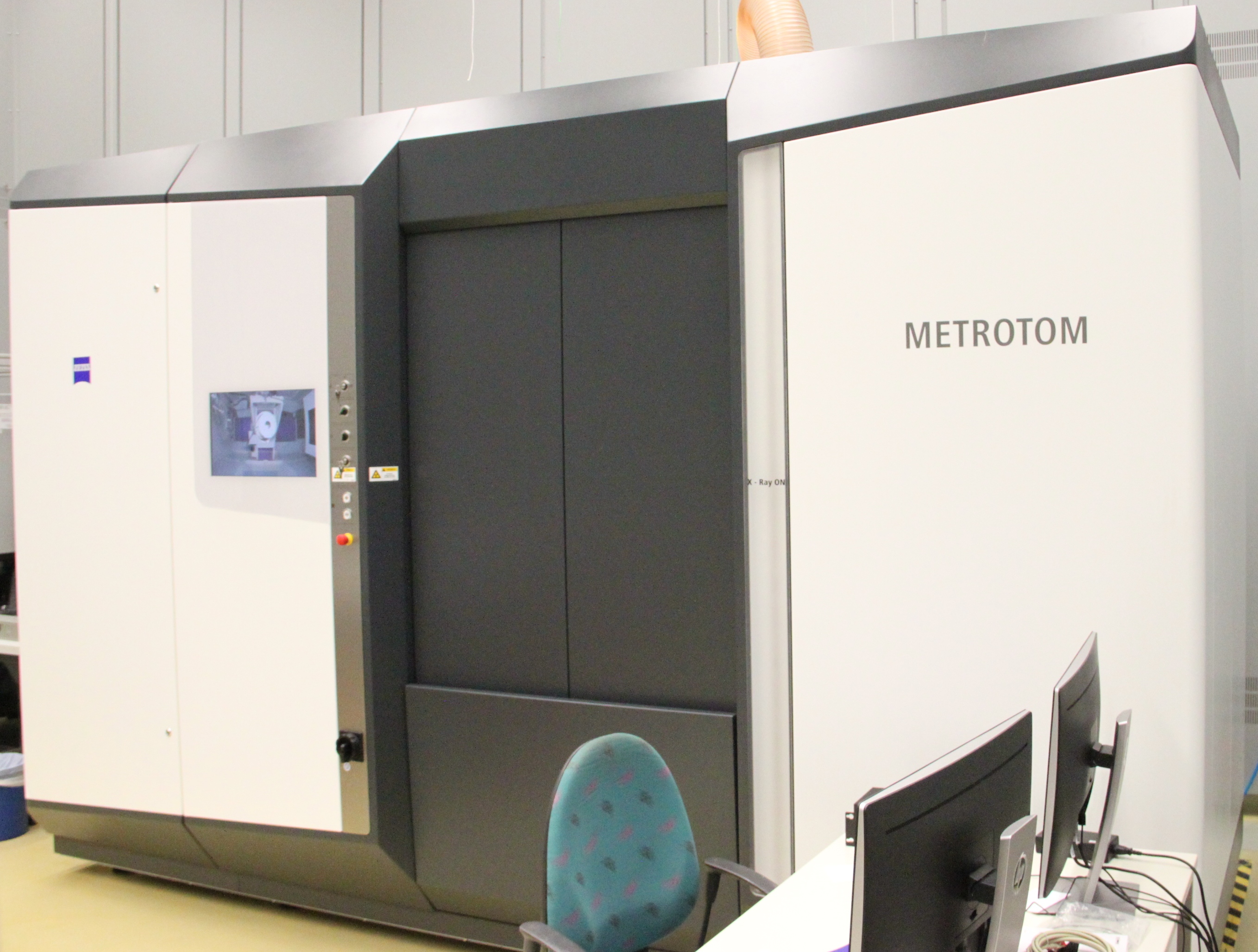
Industrial CT scanner Zeiss Metrotom 1500 (Carl Zeiss Industrielle Messtechnik GmbH)
Model: Metrotom 1500 225 kV
Manufacturer: Carl Zeiss Industrielle Messtechnik GmbH (2017)
Location: Erlangen
Usage: For external users too
Pictures
Metrologische Strukturauflösung für dimensionelle Röntgencomputertomografiemessungen (CTMeSA)
Nov. 1, 2025 - Oct. 31, 2027
Advanced detail sensitivity monitoring by new concepts to improve the reliability of safety relevant products using industrial computed tomography (SensMonCT II)
Advanced detail sensitivity monitoring by new concepts to improve the reliability of safety relevant products using industrial computed tomography
July 1, 2024 - June 30, 2027
Realistische Simulation realer Röntgencomputertomografie-Systeme mit basisqualifizierter Simulationssoftware - CTSimU2 (CTSimU2)
Oct. 1, 2022 - March 31, 2025
Geometric measuring and testing technologies for Additive Manufacturing (C4) (SFB 814 (C4))
CRC 814 - Additive Manufacturing (SFB 814)
July 1, 2011 - June 30, 2023
Entwicklung eines Leitfadens zur dreidimensionalen zerstörungsfreien Erfassung von Manuskripten
May 1, 2020 - April 30, 2022
Advanced Computed Tomography for dimensional and surface measurements in industry (AdvanCT)
Advanced Computed Tomography for dimensional and surface measurements in industry
June 1, 2018 - May 31, 2021
X-ray simulation for the determination of measurement uncertainty while measuring geometric features using X-ray computed tomography (CTSimU)
April 1, 2019 - March 31, 2021
Determination of the measurement uncertainty and systematic form deviations for a function-oriented tolerance assignment (FORTol)
FOR 2271: Prozessorientiertes Toleranzmanagement mit virtuellen Absicherungsmethoden (FORTol)
June 1, 2016 - Dec. 31, 2019
European Training for Coordinate Metrology 4.0 (CoMeT 4.0)
European Training for Coordinate Metrology 4.0
Sept. 1, 2016 - Aug. 31, 2019
Metrology for additively manufactured medical implants (MetAMMI)
Metrology for additively manufactured medical implants
June 1, 2016 - May 31, 2019
Debug: Alles
name_de: Industrieller Computertomograf Zeiss Metrotom 1500name_en: Industrial CT scanner Zeiss Metrotom 1500
model: Metrotom 1500 225 kV
url:
manufacturer: Carl Zeiss Industrielle Messtechnik GmbH
year: 2017
location: 202160667
location_de: Erlangen
location_en: Erlangen
usage: 21198
usage_de: Auch für externe Nutzer
usage_en: For external users too
description_de:
Dimensionelle Messungen und Materialanalyse
Der industrielle Röntgen-Computertomograf METROTOM 1500 der Firma Carl Zeiss Industrielle Messtechnik GmbH ermöglicht die Durchführung von komplexen Mess- und Prüfaufgaben an Kunststoff- und Metallbauteilen. Durch das große realisierbare Messvolumen und die leistungsstarke Röntgenquelle können auch größer dimensionierte Bauteile komplett erfasst werden. Gleichzeitig können auch innenliegende Strukturen, welche taktil oder optisch nicht zugänglich sind, gemessen werden. Ein in Sonderanfertigung implementierter Hexapod erlaubt neue innovative Messstrategien.
Maximaler Messbereich:
D = 305 mm; H = 260 mm (ohne Bildfelderweiterung)
D = 570 mm; H = 550 mm (mit Bildfelderweiterung)
Röhrenspannung, -leistung:
225 kV max., 500 W
Quelle-Detektor-Abstand:
1375 mm
Detektorauflösung:
2048 Pixel x 2048 Pixel
Systemgenauigkeit MPE entsprechend VDI/VDE 2630 Blatt 1.3:
Längenmessabweichung: E (TS) = (9+L/50) µm. (L in mm)
Antastabweichung: PS (TS) = 3 µm
Kugelmittelpunktabstandsabweichung: SD (TS) = (4,5+L/50) µm. (L in mm)
description_en: <p>Dimensional measurements and nondestructive testing<br /></p>
feature_de:
feature_en: <p>The industrial X-ray CT device METROTOM 1500 from Carl Zeiss Industrielle Messtechnik GmbH allows for performing complex measurement tasks and nondestructive testing of metal and plastic parts. The high measuring volume and the powerful X-ray tube enable the measurement of larger parts up to around 0.5 m. As an advantage in comparison to tactile or optical measuring instruments, inner structures can be measured nondestructively. An unique feature is an implemented Hexapod robot which allows innovative measuring strategies.</p>
pictures: <QuerySet [<Picture: 227667841>]>
cards: <QuerySet [<Card: Card of Lorenz, Butzhammer: (True)>, <Card: Card of Matthias, Braun: (True)>]>
funding_sources: <QuerySet [<FundingSource: FundingSource: cris_id: 139453943, name: Deutsche Forschungsgemeinschaft (DFG), abbreviation: DFG>]>
projects: <QuerySet [<Project: Metrologische Strukturauflösung für dimensionelle Röntgencomputertomografiemessungen (CTMeSA), CTMeSA, https://www.fmt.tf.fau.de/ctmesa/, , , <p>Die metrologische Strukturauflösung (MSR) ist im informativen Anhang der Richtlinie VDI/VDE 2630 Blatt<br />1.3 als „kleinste messbare Struktur“ erstmalig definiert. Das Alleinstellungsmerkmal der MSR im Vergleich<br />zu anderen Strukturauflösungsdefinitionen in der industriellen Computertomografie ist die Charakterisierung<br />der vollständigen Messkette. Im Gegensatz zur Antastabweichung für die Annahme- und<br />Bestätigungsprüfung der im Entwurf befindlichen ISO/TS 24312 ist eine potenziell wettbewerbsverzerrende<br />Filterung der erfassten Oberflächendaten bei der MSR nicht ohne weiteres möglich. Das in der VDIRichtlinie<br />vorgeschlagene Bestimmungsverfahren für die MSR hat sich für eine breite Anwendung als zu<br />kosten- und aufwandsintensiv erwiesen. Da auf unabsehbare Zeit diese Lücke durch die internationale<br />Normung nicht geschlossen werden kann, ist es das technologische Ziel dieses Projektes, wissenschaftlich<br />untersuchte und industriell einsetzbare MSR-Bestimmungsverfahren bereitzustellen. Als Grundlage werden<br />die umfänglichen Vorarbeiten der beteiligten Forschungspartner verwendet und in Kooperation mit<br />führenden Industriepartnern aus der deutschen Wirtschaft für eine praktikable und wirtschaftliche<br />Umsetzung zusammengeführt. Hierzu werden die wichtigsten Einflussgrößen auf die MSR für eine breite<br />Anwendung ermittelt und mit alternativen Kenngrößen (z. B. die volumetrische Modulationstransferfunktion<br />nach ASTM E1695-20) verglichen. Neben der Optimierung der Auswertemethodik wird projektbegleitend<br />ein wissenschaftlich fundierter und wirtschaftlich nutzbarer Prüfkörper entstehen. Dieser wird mit<br />konventionellen Messverfahren referenziert und innerhalb des Vorhabens evaluiert. Die Beschreibung der<br />MSR-Bestimmungsverfahren, das Prüfkörperdesign und die Resultate der Evaluation werden abschließend<br />als normatives Ergebnis des Projektes in einen Richtlinienentwurf zur Ergänzung der VDI/VDE 2630 Reihe<br />erstellt und in die Diskussion der internationalen Fachausschüsse aktiv eingebracht.</p>, 2025-11-01, 2027-10-31, , 2027-10-31, Third party funded individual grant, True>, <Project: Advanced detail sensitivity monitoring by new concepts to improve the reliability of safety relevant products using industrial computed tomography (SensMonCT II), SensMonCT II, https://www.ptb.de/epm2023/sensmonct/home, Advanced detail sensitivity monitoring by new concepts to improve the reliability of safety relevant products using industrial computed tomography, <p>Digital applications including Industry 4.0 often use industrial computed tomography (iCT) data for their functions. However, at the moment, detail sensitivity of iCT systems is evaluated by human operators, and therefore unreliable and expensive. There is a metrological need to develop traceable measurement and monitoring methods to assess detail sensitivity of iCT for the minimum detectable defect or flaw sizes without relying on human observers. This is an essential step to support the EU’s aims for the digital transformation in Europe and the United Nation’s sustainability goal for industry, innovation and infrastructure. However, new measurement methods, reference software, and standards need to be developed to fill this meteorological gap.</p><p> </p><p>The project aims to develop new test gauges that will help determine iCT detail sensitivity. Additionally, a new automated evaluation algorithm will be published that can determine the detail sensitivity of iCT data sets. Round Robin Tests will be conducted, and the results will be made available to relevant standard committees to demonstrate the accuracy of the developed measurement systems. The project will prepare a draft standard or EN ISO 15708-5 ‘Radiation methods for computed tomography — Performance Evaluation and Long-Term Stability’. Moreover, the project will publish free reference software with evaluation algorithms that comply with the standard draft, as well as a free data bank with standard reference images that can be used to validate software for conformity. Overall, these advancements will support Industry 4.0 in Europe and guarantee the competitiveness of modern iCT applications.</p>, , 2024-07-01, 2027-06-30, , 2027-06-30, Third Party Funds Group - Sub project, True>, <Project: Realistische Simulation realer Röntgencomputertomografie-Systeme mit basisqualifizierter Simulationssoftware - CTSimU2 (CTSimU2), CTSimU2, https://www.ctsimu.forschung.fau.de/, , Das Förderprojekt „Realistische Simulation realer Röntgencomputertomografie-Systeme mit basisqualifizierter Simulationssoftware - CTSimU2“ baut auf den Ergebnissen des Projektes CTSimU („Durchstrahlungssimulation für die Messunsicherheitsbestimmung beim Messen geometrischer Merkmale mittels Röntgen-Computertomographie“) auf. In diesem Projekt wurde eine objektive und standardisierte Bewertung von Simulationssoftwares zur Anwendung bei der Röntgen-CT für dimensionelle Messungen in Form eines (Basis-)Qualifizierungsframeworks erarbeitet. Dabei stand die ausreichende physikalische Korrektheit der Durchstrahlungssimulation im Vordergrund. Für die realitätsnahe Simulation einer CT-Anlage in einer Simulationssoftware (digitaler Zwilling) ist jedoch nicht nur die Korrektheit der Simulationssoftware selbst, sondern auch die Güte der Parametrisierung des realen CT-Systems in der Simulationssoftware entscheidend – dies stellt den Ausgangspunkt des 2. Projektes CTSimU2 dar. Die Parametrisierung eines CT-Systems in einer Simulationssoftware lässt sich in vier Schritte unterteilen: nach der Datenaufnahme am realen CT-System (Schritt 1) folgt die Auswertung der aufgenommenen Daten für die Generierung allgemeiner Parameterangaben (Schritt 2). Als letztes folgt die Übertragung der Parameter in die spezifischen Simulationssoftwares (Schritt 3) und die Validierung der resultierenden Simulationsparameter durch einen geeigneten Test (Schritt 4). Die Methodik der Datenaufnahme am CT und die Auswertung der Daten sollen in einem Werkzeugkasten allgemein beschrieben werden. Der dritte Schritt, die Übertragung der Parameter, ist softwarespezifisch und wird beispielhaft mit den vorhandenen Simulationssoftwares durchgeführt. Die Validierung der Parameter ist standardisierbar und soll durch einen zu entwickelnden Test geleistet werden, auf dessen Basis die ausreichend korrekte Simulation einer realen Anlage beurteilt werden kann. Endresultat des Projektes ist ein Richtlinienentwurf (z. B. für der Richtlinienreihe VDI/VDE 2630) zu diesem Test, der einen informativen Annex zum Stand der Technik bezüglich der Möglichkeiten zur Parameterbestimmung enthält. Mit einer Simulationssoftware, die die Basisqualifizierung aus CTSimU bestanden hat und einen Parameterdatensatz für ein reales CT-System enthält, der den Test aus CTSimU2 bestanden hat, sollten realistische Simulationen dieses CT-Systems möglich sein. Das Projekt wird in der Förderrichtlinie WIPANO, administriert durch den Projektträger Jülich und finanziert durch das Bundesministerium für Wirtschaft und Klimaschutz aufgrund eines Beschlusses des deutschen Bundestages, unter dem Förderkennzeichen 03TN0049A gefördert.<br />, <p></p><p></p><p> </p><br />, 2022-10-01, 2024-09-30, 2025-03-31, 2025-03-31, Third Party Funds Group - Overall project, True>, <Project: Geometric measuring and testing technologies for Additive Manufacturing (C4) (SFB 814 (C4)), SFB 814 (C4), https://www.crc814.research.fau.eu/projekte/c-bauteile/teilprojekt-c4/, CRC 814 - Additive Manufacturing (SFB 814), <p>The aim of this project is to achieve the metrological traceability of geometric pore measurements with computed tomography (CT) to increase the relevance of CT for nondestructive testing with regard to process failures. While in a first step this will be achieved for transparent measurement standards using high-resolution optical tomography, the transferability to additively manufactured parts will be ensured by experimental and simulation based investigations. In this way, concrete statements regarding measurement uncertainties are enabled.</p>, <p>The aim of this project is to achieve the metrological traceability of geometric pore measurements with computed tomography (CT) to increase the relevance of CT for nondestructive testing with regard to process failures. While in a first step this will be achieved for transparent measurement standards using high-resolution optical tomography, the transferability to additively manufactured parts will be ensured by experimental and simulation based investigations. In this way, concrete statements regarding measurement uncertainties are enabled.</p> <br />, 2011-07-01, 2023-06-30, , 2023-06-30, Third Party Funds Group - Sub project, True>, <Project: Entwicklung eines Leitfadens zur dreidimensionalen zerstörungsfreien Erfassung von Manuskripten, , https://gepris.dfg.de/gepris/projekt/433501541?context=projekt&task=showDetail&id=433501541&, , In the course of massive digitization, a large part of libraries’ archived documents are currently being converted into electronic formats. However, the digitization is also reaching its limits. Scanning robots cannot digitize documents whose condition due to natural ageing or external influences prohibit a conventional, optical based processing. Our own preliminary work has shown that the three imaging techniques X-ray Computed Tomography, Phase Contrast X-ray Computed Tomography and Terahertz Imaging are suitable for providing non-invasive insights into such documents, allow the acquisition of digital imaging information and are capable to re-enable an efficient automated process to digitalize cultural heritage documents.This research project is the first to develop a concrete digitization strategy or method for such documents. This structured evaluation will be based on a quality value that allows statements to be made about the expected result of digitization with one of the mentioned modalities for certain historical materials. From this, the most suitable imaging procedure can be determined. Based on these findings, a guideline for the digitization of fragile documents will be developed to predict the quality, feasibility and possible damage before a scan. In addition, algorithms will be developed that virtually process the generated data and make it readable for the human eye. Three concrete goals will be pursued to carry out the research project. By evaluating the modalities for selected historical materials, the most appropriate procedure for a specific document should then be identified. At the end of the project, a guide will be made available and the possibilities of each modality will be demonstrated by specifying material combinations and relevant parameters. It will be possible to test the variation of the recording parameters and to display exemplary results using the generated database. This also makes it possible to calculate a quality value. The basis for such a guide is the evaluation of the three modalities for relevant materials. For this purpose, realistic test specimen are produced. Both the scan quality and resolution as well as possible damage to the document must be considered. The guide will then be used to identify the most suitable procedure for a specific document. This statement is based on the mentioned quality value, which will also be used to predict the optimal digitization modality and the quality for an unknown document.The evaluation of several modalities as well as the development of algorithms are to be seen as central challenges of the research project. It will be possible to store endangered holdings in a digital format without destroying their structure through manual intervention. In the second funding phase, a multi-modal solution should be investigated in which disadvantages and limitations of individual modalities will be compensated by combining several modalities. <br />, , 2020-05-01, 2022-04-30, , 2022-04-30, Third party funded individual grant, True>, <Project: Advanced Computed Tomography for dimensional and surface measurements in industry (AdvanCT), AdvanCT, https://www.ptb.de/empir2018/advanct/home/, Advanced Computed Tomography for dimensional and surface measurements in industry, <p>Computed tomography (CT) is an aspiring contact-free measurement method which allows to determine the complete geometry of objects (inner and outer geometry including surface texture) typically not fully accessible to other measurement methods.</p> <p>To support dimensional metrology in future advanced manufacturing, the project will develop traceable CT measurement techniques for dimensions and surface texture. Open issues regarding traceability, measurement uncertainty, sufficient precision/accuracy, scanning time, multi-material, surface form and roughness, suitable reference standards, and simulation techniques will be clarified.</p> <p>Therefore the AdvanCT project will face the following objects:</p> <ol><li>To develop traceable and validated methods for absolute CT characterisation including the correction of geometry errors by 9 degrees of freedom (DoF). This will include the development of reference standards, traceable calibration methods and thermal models for instrument geometry correction, as well as the correction of errors originating in the X-ray tube and the detector in order to improve CT accuracy.</li><li>To develop improved and traceable methods for dimensional CT measurements with focus on measurements of sculptured / freeform surfaces, roughness, and multi-material effects including supplementary material characterisation.</li><li>To develop fast CT methods for inline applications based on improved evaluation of noisy, sparse, few, or limited angle X-ray projections, reconstruction methods. This will be done using reduced number of projections from well-known directions and include enhanced post-processing.</li><li>To develop traceable methods for uncertainty estimation using virtual CT models and Monte-Carlo simulations. This will include calibrated reference standards, the determination of accurate model parameters and the development of correction methods for specific CT image forming artefacts.</li><li>To facilitate the take up of the technology and measurement infrastructure developed in the project by the measurement supply chain (accredited laboratories, instrumentation manufacturers), standards developing organisations (e.g. ISO TC213, VDI-GMA 3.33 Technical Committee Computed Tomography in Dimensional Measurements) and end users (e.g. plastic manufacturers, automotive, telecommunication, medical and pharmaceutical industries and metrology service providers).</li></ol> <p>The institute of manufacturing metrology will focus on the following aspects:</p> <ol><li>The investigation of temperature variation within a CT system and its impact on projection stability as well as measurement deviations. The resulting thermal data can improve the characterization of CT systems.</li><li>The systematic determination of model parameters for measurement simulation („digital twin“). The simulation of the measurement process could allow e.g. numerical measurement uncertainty evaluation. A successful parameter determination is a prerequisite for a faithful virtual CT model. Therefore, it is a key element for the simulation based uncertainty evaluation</li></ol>, , 2018-06-01, 2021-05-31, , 2021-05-31, Third Party Funds Group - Sub project, True>, <Project: X-ray simulation for the determination of measurement uncertainty while measuring geometric features using X-ray computed tomography (CTSimU), CTSimU, , , <p> </p><p>Industrial X-ray computed tomography (CT) is the only technology in geometric metrology that can measure both internal and external features of a workpiece non-destructively. However, to specify the measurement uncertainty for a certain measurand, twenty repeated measurements on a calibrated work piece have to be executed according to the state of the art (VDI/VDE 2630 Part 2.1). Since the measurement with real CT systems is time-consuming and cost-intensive, the numerical determination of the task-specific measurement uncertainty with simulation is currently researched. This method will be similar to the state of the art in tactile coordinate metrology (cf. VDI/VDE 2617 Part 7, GUM Supplement 1). Therefore, radiographic simulation softwares to simulate measurement tasks currently receive considerable attention. Simulations offer advantages through time-, cost- and resource-efficiency. However, the reliability of the different available simulation environments is currently not quantifiable. For end users to trust and apply the simulation systems, an evaluation of the simulation system’s accuracy is necessary. A standardized test procedure would also allow for a standard- respectively guideline-conformity in applications.</p> <p>Thus, the result of this project will be a draft for a new VDI/VDE standard VDI/VDE 2630 Part 2.2 “Restricted Qualification of Software for the Simulation of Geometrical Measurements using X-ray Computed Tomography”. On this basis, it will be possible to evaluate the suitability of a simulation environment for determining the task-specific measurement uncertainty. For this purpose, a test framework will be developed with which radiographic simulation software can be restrictedly qualified. A restricted qualification describes a qualification with regard to typical measurement scenarios that are perceived as relevant.</p> <p>Several steps are necessary to create the test framework. First, a requirements analysis defines the requirements for the used simulation software. These requirements are summarized in a specification. For the development of the test framework, it is necessary to convert the requirements of the specification into concrete test scenarios. For this purpose, reference geometries and reference data sets must be developed. Based on the simulation results for the various test scenarios, the corresponding simulation software can be evaluated. For this purpose, an evaluation matrix is developed. The final test framework will be validated by comparing real and simulated measurement data for positively evaluated simulation software based on the dimensional measurement results.</p> <p>In order to retain the normative character of this project, it will be ensured that this basic qualification with the test framework is also possible for other simulation software systems that are not represented in the project.</p> <p>This project is funded in the program <a>WIPANO</a><a>[RT1]</a> . WIPANO projects are financed by the German Federal Ministry for Economic Affairs and Energy and managed by Project Management Jülich. The funding is granted based on a decision by the German parliament.</p> <div> <div> <div><a></a> <p> <a>[RT1]</a><a href="http://www.wipano.de">www.wipano.de</a> als Verlinkung</p> </div> </div> </div>, , 2019-04-01, 2021-03-31, , 2021-03-31, Third party funded individual grant, True>, <Project: Determination of the measurement uncertainty and systematic form deviations for a function-oriented tolerance assignment (FORTol), FORTol, http://gepris.dfg.de/gepris/projekt/260682773?context=projekt&task=showDetail&id=260682773&, FOR 2271: Prozessorientiertes Toleranzmanagement mit virtuellen Absicherungsmethoden (FORTol), <p>Das Ziel dieses Teilprojektes besteht in der Etablierung von Methoden zur Bestimmung und Nutzung der Einzelpunktmessunsicherheiten bei flächenhaften Messungen zur Erfassung der zu erwartenden systematischen Gestaltabweichungen aus der Fertigung. Darauf aufbauend soll eine geeignete Methodik zur Beschreibung bzw. Approximation dieser systematischen Gestaltabweichungen mithilfe adäquater Fusions- und Ausgleichsalgorithmen entwickelt werden. Bei diesen Algorithmen ist eine Gewichtung der Einzelmesspunkte in Abhängigkeit ihrer Unsicherheit vorgesehen. Weiterhin sollen Unsicherheitsangaben für die Approximation auf Basis der Residuen und Einzelpunktunsicherheiten ermittelt werden. Mithilfe dieser Informationen erfolgt anschließend eine Optimierung der Messungen durch an die systematischen Fertigungsabweichungen und die Einzelpunktunsicherheiten angepasste Messstrategien. Dies wird durch Optimierung der Anzahl und Verteilung an Einzelpunkten im Fall taktiler Verfahren, der Anzahl und Ausrichtung der Einzelaufnahmen bei dem zu untersuchenden optisch flächenhaften Verfahren sowie durch die gewichtete Fusion von Datensätzen mit abweichenden Orientierungen des Bauteils bei volumetrisch röntgentomografischen Verfahren ermöglicht. </p>, , 2016-06-01, 2019-05-31, 2019-12-31, 2019-12-31, Third Party Funds Group - Sub project, True>, <Project: European Training for Coordinate Metrology 4.0 (CoMeT 4.0), CoMeT 4.0, , European Training for Coordinate Metrology 4.0, <p>The project will offer new high-quality learning opportunities for lifelong education on innovative measuring technologies (including: Industrial Computed Tomography, Fringe-projection & Reverse Engineering).</p> <p>To enhance access for all, the learning material will be distributed adapting to the individual learning style. Learners will select the preferred tool (tablets, web-based learning platforms or printouts) for the best learning experience.</p> <p>Practical work using measuring equipment will be part of the education: this is vital for successful VET in Coordinate Metrology. A learner-centered approach and industrial case studies will be used to motivate learners and let them understand the industrial relevance of the topic. </p>, <p> <strong>Open and innovative education, training and youth work, embedded in the digital era</strong></p> <p> Manufacturing is today based on multiple suppliers located in different countries and continents, intensively using automation, data exchange and advanced manufacturing technologies embedded in the digital era. New opportunities to advance manufacturing are based on the so-called “Industry 4.0” design principles, including: Interoperability, Virtualisation, Decentralisation, Real-time capability, Service orientation and Modularity. Measuring technologies and in particular Coordinate Metrology are an <strong>essential tool</strong> for the implementation of this concept in modern product engineering and process control; to operate, program and manage the most advanced measuring systems, highly <strong>competent</strong> and <strong>skilled</strong> personnel is required.</p> <p> The project will design, implement and validate a set of tools and learning content to innovate education in Coordinate Metrology, taking advantage of new opportunities of the digital era. An innovative content development and distribution system will be developed, allowing the adaptation to individual preferences and featuring modern tutor-learners interaction by social networks. New interactive tools for the assessment of individual learning needs will enable the identification of customised learning paths and related assessment of learning outcomes. Moreover, the project will include active participation of learners to distance laboratory workshops using in real-time expensive measuring equipment, bridging the worlds of education and work.</p>, 2016-09-01, 2019-08-31, , 2019-08-31, Third Party Funds Group - Sub project, True>, <Project: Metrology for additively manufactured medical implants (MetAMMI), MetAMMI, https://www.euramet.org/research-innovation/search-research-projects/details/project/metrology-for-additively-manufactured-medical-implants, Metrology for additively manufactured medical implants, <p> Additive manufacturing (AM) offers an effective solution in the medical sector. It enables the production, on demand, of customised implants which match the patient’s anatomy, with grafts that promote bone growth, as well as surgical guides that help the surgeons. The objective of this project is to provide a comprehensive basis to enable the safe use of medical AM products. Therefore, within this project off-the-shelf medical devices, patient specific guides and implants manufactured from patient image or numerical model will be qualified. This will guarantee their reliability to notified bodies and facilitate acceptance of AM in the medical sector.</p>, <p> The need for this project is justified by the fact that AM technology for medical applications has advanced at a much faster pace than regulations and quality controls. Patient specific implants (PSIs) and patient specific guides (PSGs) are to be used in highly critical applications governed by strict safety requirements from notified bodies and hence controlling the quality of the parts are of paramount importance. In order for the medical device industry to have confidence in the AM technology they need validated techniques to verify the finished parts and improve the process and reliability of the manufacturing chain.</p> <p> In order to validate these techniques, medical devices and standard objects, manufactured using different AM processes and materials, need to first be fabricated and characterised. Relevant aspects that have to be taken into account for these characterisations are the dimensions of external and internal geometry as well as internal defects, roughness and porosity, which will also influence the mechanical properties of the medical devices. Work is required to a) determine the precision limits of dimensional measurements and the relative sensitivity of industrial and medical XCT, and to b) qualify alternative, faster and cheaper nondestructive characterisation techniques, for routine control.</p> <p> The manufacturing process of patient specific medical devices with AM contains a number of steps, from the prior CT scan of the patient to the final manufacture and clinical use, each of which can introduce errors. The material used also has an influence on the parts as well on the category of processes used. Manufacturers need tools and protocols for the detection and quantification of defects so that the best material and manufacturing process can be reliably selected. It is therefore necessary to characterise the parts at various stages in the production and application process to quantify errors in the chain from medical imaging to clinical use.</p>, 2016-06-01, 2019-05-31, , 2019-05-31, Third Party Funds Group - Sub project, True>]>
publications: <QuerySet [<Publication: Evaluation of digital models for dimensional X-ray computed tomography – analysis of a multi feature check measurement>, <Publication: Higher accuracy with fewer projections? Automated scan angle selection for dimensional Computed Tomography based on a simple data completeness measure for the part surface>, <Publication: Conversion between detector- and rotary-table-related misalignment parameterizations for unified projection-matrix-based geometry calibration in dimensional X-ray computed tomography>, <Publication: Direct assessment of the influence of pose repeatability on the accuracy of dimensional measurements for computed tomography systems with high degrees of freedom>, <Publication: Practical Approaches for Determining the Structural Resolution Capability of X-ray Computed Tomography Measurement Tasks>, <Publication: Task-specific scan trajectory modification for dimensional X-ray computed Tomography with high throughput>, <Publication: Test of conformance or non-conformance with geometrical specifications>, <Publication: Transferring measured X-ray focal spots to virtual CT systems for more realistic simulations of dimensional measurements>, <Publication: Uncalibrated CT Reconstruction for One-Shot Scanning of Arbitrary Trajectories>, <Publication: Measurement-based Detector Characteristics for Digital Twins in aRTist>, <Publication: Preserving Fragile History: Assessing the Feasibility of Segmenting Digitized Historical Documents with Modulation Depth Analysis>, <Publication: Fiber Orientation in continuous fiber reinforced thermoplastics/metal hybrid joining via multi-pin arrays>, <Publication: CT scan trajectory calibration based on projected metal spheres: When and how should errors from elliptical distortion be corrected?>, <Publication: Calibration of 3D scan trajectories for an industrial computed tomography setup with 6-DOF object manipulator system using a single sphere>, <Publication: Herausforderungen bei computertomografischen Untersuchungen von Fügeverbindungen>, <Publication: Einfluss des Bildrauschens innerhalb der Messkette eines industriellen Computertomografen - Propagation of image noise through the measurement chain in industrial X-ray computed tomography>, <Publication: Influence of X-Ray Radiation on Historical Paper>, <Publication: Application of an edge detection algorithm for surface determination in industrial X‑ray computed tomography>, <Publication: Complex 3D scan trajectories for industrial cone-beam computed tomography using a hexapod>, <Publication: Influence of Continuous Scan Mode and Workpiece Positioning on Dimensional Measurements with Computed Tomography>, '...(remaining elements truncated)...']>
fobes: <QuerySet [<ResearchArea: Research Area: Title: | Röntgen-Computertomografie, Description: | <p>Röntgen-Computertomografie mit diversen Forschungsprojekten und Messsystemen<br /></p>, Classification: Field of Research | Forschungsbereich >]>
orgas: <QuerySet [<Organisation: Lehrstuhl für Fertigungsmesstechnik (FMT), <p>Am Lehrstuhl für Fertigungsmesstechnik erforschen, verbessern und validieren wir neue Prinzipien, Methoden, Verfahren, Mittel, Geräte und Systeme, welche im industriellen Entstehungsprozess von Produkten zur Qualitätssicherung erforderlich sind. Mit unseren Forschungs- und Lehraktivitäten schaffen wir die Grundlagen für innovative Messverfahren für die Qualitätssicherung.</p>, Erlangen, 91052, Nägelsbachstraße, 2999-12-31, Department Maschinenbau, True>]>
dfg_keys: <QuerySet [<DFGKey: 3230 Computertomographen>]>