
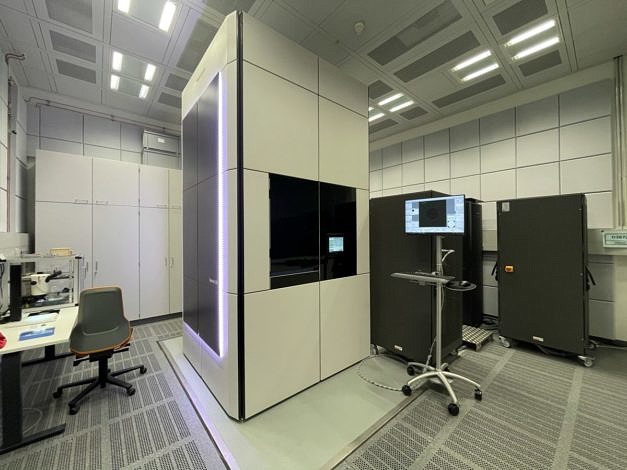
Thermo Fisher Scientific Spectra 200 C-FEG (Thermo Fisher Scientific Messtechnik GmbH)
Model: Analytisches Transmissionsmikroskop 200kV Spectra
Manufacturer: Thermo Fisher Scientific Messtechnik GmbH (2021)
URL: https://www.em.tf.fau.de/research/equipment/#collapse_0
Location: Erlangen
Usage: For external users too
Pictures
DFG Gerätegruppenschlüssel: 5100 Elektronenmikroskope (Transmission)
Feature(s)
The most important specifications of the TFS Spectra 200 are:
- X-CFEG emitter
- High tension: 30-200kV
- Energy resolution < 0.4 eV
- Probe Cs corrector (CEOS S-CORR)
- Point resolution for STEM: 60 pm @ 200 kV, 125 pm @ 30 kV
- Gatan spectrometer (Gatan Continuum S)
- Super-X detector G2 (EDXS)
- BF, ADF STEM and iDPC imaging: 8 segmented BF and ADF detectors (16 segments in total)
- 4k CMOS camera
- Electron tomography functionality (including EDXS)
Description
The Spectra 200 provides high-resolution imaging as well as
high-performance analytical investigation capabilities. This
probe-corrected TEM enables high-resolution imaging in scanning TEM
(STEM) mode for all high tensions between 30 kV and 200 kV. The
ultra-high-brightness cold field emission gun (X-CFEG) with an energy
resolution of < 0.4 eV in combination with a high-sensitivity SDD
X-ray spectrometer (Super-X) and a high-resolution post-column energy
loss spectrometer (Gatan Continuum S) creates a high-performance
analytical instrument perfectly suited for the nanoanalytical
characterization of all kinds of materials and devices. High-resolution
electron energy-loss spectroscopy (EELS) as well as energy-dispersive
X-ray spectroscopy (EDXS) yield chemical, elemental as well as bonding
information even down to the atomic scale. Furthermore, the Spectra with
its Ceta-S 4k high speed CMOS camera (up to 400 fps at binning 512) is
used to perform advanced in situ experiments by making use of special
TEM specimen holders available at CENEM. Moreover, in combination with
simultaneous STEM imaging, the Spectra 200 allows for 4D-STEM
investigations. A further advanced method available at the Spectra 200
is electron tomography enabling the analytical characterization of
materials in three dimensions. This high-end analytical TEM enables to
answer the most complex questions in almost all discipline of materials
science and nanotechnology.
Involved Person(s)
Mingjian Wu
Contact person
Erdmann Spiecker
Responsible person
Benjamin Apeleo Zubiri
Contact person
Organisation(s)
Funding Sources
Debug: Alles
name_de: Thermo Fisher Scientific Spectra 200 C-FEG
name_en: Thermo Fisher Scientific Spectra 200 C-FEG
model: Analytisches Transmissionsmikroskop 200kV Spectra
url: https://www.em.tf.fau.de/research/equipment/#collapse_0
manufacturer: Thermo Fisher Scientific Messtechnik GmbH
year: 2021
location: 202160667
location_de: Erlangen
location_en: Erlangen
usage: 21198
usage_de: Auch für externe Nutzer
usage_en: For external users too
description_de:
The most important specifications of the TFS Spectra 200 are:
- X-CFEG emitter
- High tension: 30-200kV
- Energy resolution < 0.4 eV
- Probe Cs corrector (CEOS S-CORR)
- Point resolution for STEM: 60 pm @ 200 kV, 125 pm @ 30 kV
- Gatan spectrometer (Gatan Continuum S)
- Super-X detector G2 (EDXS)
- BF, ADF STEM and iDPC imaging: 8 segmented BF and ADF detectors (16 segments in total)
- 4k CMOS camera
- Electron tomography functionality (including EDXS)
The Spectra 200 provides high-resolution imaging as well as high-performance analytical investigation capabilities. This probe-corrected TEM enables high-resolution imaging in scanning TEM (STEM) mode for all high tensions between 30 kV and 200 kV. The ultra-high-brightness cold field emission gun (X-CFEG) with an energy resolution of < 0.4 eV in combination with a high-sensitivity SDD X-ray spectrometer (Super-X) and a high-resolution post-column energy loss spectrometer (Gatan Continuum S) creates a high-performance analytical instrument perfectly suited for the nanoanalytical characterization of all kinds of materials and devices. High-resolution electron energy-loss spectroscopy (EELS) as well as energy-dispersive X-ray spectroscopy (EDXS) yield chemical, elemental as well as bonding information even down to the atomic scale. Furthermore, the Spectra with its Ceta-S 4k high speed CMOS camera (up to 400 fps at binning 512) is used to perform advanced in situ experiments by making use of special TEM specimen holders available at CENEM. Moreover, in combination with simultaneous STEM imaging, the Spectra 200 allows for 4D-STEM investigations. A further advanced method available at the Spectra 200 is electron tomography enabling the analytical characterization of materials in three dimensions. This high-end analytical TEM enables to answer the most complex questions in almost all discipline of materials science and nanotechnology.
Involved Person(s)
Mingjian Wu
Contact person
Erdmann Spiecker
Responsible person
Benjamin Apeleo Zubiri
Contact person
Organisation(s)
Funding Sources
Debug: Alles
name_de: Thermo Fisher Scientific Spectra 200 C-FEGname_en: Thermo Fisher Scientific Spectra 200 C-FEG
model: Analytisches Transmissionsmikroskop 200kV Spectra
url: https://www.em.tf.fau.de/research/equipment/#collapse_0
manufacturer: Thermo Fisher Scientific Messtechnik GmbH
year: 2021
location: 202160667
location_de: Erlangen
location_en: Erlangen
usage: 21198
usage_de: Auch für externe Nutzer
usage_en: For external users too
description_de:
The Spectra 200 provides high-resolution imaging as well as high-performance analytical investigation capabilities. This probe-corrected TEM enables high-resolution imaging in scanning TEM (STEM) mode for all high tensions between 30 kV and 200 kV. The ultra-high-brightness cold field emission gun (X-CFEG) with an energy resolution of < 0.4 eV in combination with a high-sensitivity SDD X-ray spectrometer (Super-X) and a high-resolution post-column energy loss spectrometer (Gatan Continuum S) creates a high-performance analytical instrument perfectly suited for the nanoanalytical characterization of all kinds of materials and devices. High-resolution electron energy-loss spectroscopy (EELS) as well as energy-dispersive X-ray spectroscopy (EDXS) yield chemical, elemental as well as bonding information even down to the atomic scale. Furthermore, the Spectra with its Ceta-S 4k high speed CMOS camera (up to 400 fps at binning 512) is used to perform advanced in situ experiments by making use of special TEM specimen holders available at CENEM. Moreover, in combination with simultaneous STEM imaging, the Spectra 200 allows for 4D-STEM investigations. A further advanced method available at the Spectra 200 is electron tomography enabling the analytical characterization of materials in three dimensions. This high-end analytical TEM enables to answer the most complex questions in almost all discipline of materials science and nanotechnology.
description_en: <p>The Spectra 200 provides high-resolution imaging as well as high-performance analytical investigation capabilities. This probe-corrected TEM enables high-resolution imaging in scanning TEM (STEM) mode for all high tensions between 30 kV and 200 kV. The ultra-high-brightness cold field emission gun (X-CFEG) with an energy resolution of < 0.4 eV in combination with a high-sensitivity SDD X-ray spectrometer (Super-X) and a high-resolution post-column energy loss spectrometer (Gatan Continuum S) creates a high-performance analytical instrument perfectly suited for the nanoanalytical characterization of all kinds of materials and devices. High-resolution electron energy-loss spectroscopy (EELS) as well as energy-dispersive X-ray spectroscopy (EDXS) yield chemical, elemental as well as bonding information even down to the atomic scale. Furthermore, the Spectra with its Ceta-S 4k high speed CMOS camera (up to 400 fps at binning 512) is used to perform advanced in situ experiments by making use of special TEM specimen holders available at CENEM. Moreover, in combination with simultaneous STEM imaging, the Spectra 200 allows for 4D-STEM investigations. A further advanced method available at the Spectra 200 is electron tomography enabling the analytical characterization of materials in three dimensions. This high-end analytical TEM enables to answer the most complex questions in almost all discipline of materials science and nanotechnology.</p>
feature_de:
The most important specifications of the TFS Spectra 200 are:
- X-CFEG emitter
- High tension: 30-200kV
- Energy resolution < 0.4 eV
- Probe Cs corrector (CEOS S-CORR)
- Point resolution for STEM: 60 pm @ 200 kV, 125 pm @ 30 kV
- Gatan spectrometer (Gatan Continuum S)
- Super-X detector G2 (EDXS)
- BF, ADF STEM and iDPC imaging: 8 segmented BF and ADF detectors (16 segments in total)
- 4k CMOS camera
- Electron tomography functionality (including EDXS)
feature_en: <p>The most important specifications of the TFS Spectra 200 are:</p> <ul><li>X-CFEG emitter</li><li>High tension: 30-200kV</li><li>Energy resolution < 0.4 eV</li><li>Probe Cs corrector (CEOS S-CORR)</li><li>Point resolution for STEM: 60 pm @ 200 kV, 125 pm @ 30 kV</li><li>Gatan spectrometer (Gatan Continuum S)</li><li>Super-X detector G2 (EDXS)</li><li>BF, ADF STEM and iDPC imaging: 8 segmented BF and ADF detectors (16 segments in total)</li><li>4k CMOS camera</li><li>Electron tomography functionality (including EDXS)</li></ul>
pictures: <QuerySet [<Picture: 263943780>]>
cards: <QuerySet [<Card: Card of Mingjian, Wu: (True)>, <Card: Card of Erdmann, Spiecker: (True)>, <Card: Card of Benjamin, Apeleo Zubiri: (True)>]>
funding_sources: <QuerySet [<FundingSource: FundingSource: cris_id: 139453943, name: Deutsche Forschungsgemeinschaft (DFG), abbreviation: DFG>]>
projects: <QuerySet [<Project: Microscopic 3D characterisation of functional particles and pore structures (SFB 1411 - C01), SFB 1411 - C01, , Design of particulate products (SFB 1411), The objective is the quantitative 3D analysis of particle systems and porous structures synthesised and used in the CRC by advanced electron tomography and X-ray nanotomography techniques. The 3D data will be shared within the CRC for modelling and optimisation of functional particles and separation processes. A workflow for quantitative 3D characterisation will be established for particular particle systems. This will then be extended to correlative and scale-bridging tomography of particle ensembles and stationary phase materials to gain statistically relevant information. Furthermore, a workflow to derive quantitative structure-property-relationships on the single particle level will be developed., , 2020-01-01, 2023-12-31, , 2023-12-31, Third Party Funds Group - Sub project, True>, <Project: In-situ Characterization of Nanomaterials with Electrons, X-rays/Neutrons and Scanning Probes (GRK 1896), GRK 1896, , , <p> Research into innovative nanostructured materials is of fundamental importance for Germanys technological competitiveness and in addressing global challenges, like the development of renewable energy sources. Nanostructured materials are controlled by size and interfaces, which give rise to enhanced mechanical properties and new physical effects leading in turn to new functionalities. The design of novel nanostructured materials and devices such as flexible electronics demands state-of-the-art nanocharacterisation tools. In particular, methods based on short-wave radiation (electrons, X-rays/neutrons) or scanning probes are ideally suited to analyse materials at the nanometer and atomic scale. Recently developed in situ capabilities and the use of complementary characterisation methods allow unique insights into the structure formation, functionality and deformation behaviour of complex nanostructures. These new in situ techniques will be the future key tools for the development of new materials and devices. The doctoral programme combines, for the first time, these three pillars of nanocharacterisation into a structured Research Training Group. The main objective of this programme is to provide the next generation of scientists and engineers with comprehensive, method-spanning and interdisciplinary training in the application of cutting-edge nanocharacterisation tools to materials and device development. Within the programme, the in situ methods will be further developed and used to address fundamental questions regarding the growth, stability and functionality of complex nanostructures and interfaces. Project area A "Functional Nanostructures and Networks" will address the properties of individual nano-objects and how these translate into functionality when assembled to nano-networks. In Project area B "Mechanical Properties of Interfaces" various kinds of interfaces with different bonding characteristics and morphologies will be studied in well-defined loading scenarios. This parallel, complementary study of both functional and mechanical materials properties over several length scales by multiple in situ methods is unprecedented. Our PhD candidates will be well-positioned in a network of international collaborations and highly trained in multiple, complementary techniques, providing them with an essential foundation for a successful career in the field of advanced materials and devices development.</p>, , 2013-10-01, 2022-09-30, , 2022-09-30, Third Party Funds Group - Overall project, True>, <Project: High resolution transmission electron microscopy investigation of the atomic structure of defects and interfaces in single crystal superalloys (A07) (TRR 103), TRR 103, , TRR 103: Vom Atom zur Turbinenschaufel - wissenschaftliche Grundlagen für eine neue Generation einkristalliner Superlegierungen, <p> Das Projekt A7 nutzt die neuen Möglichkeiten der aberrationskorrigierten hochauflösenden TEM für Untersuchungen der atomaren Struktur und Chemie von Grenzflächen und Defekten in der γ/γ’-Mikrostruktur und deren Bedeutung für die Elementarprozesse bei der Hochtemperaturverformung. Die Relevanz der lokalen Analysen wird durch neue Verfahren der Zielpräparation sowie eine enge Zusammenarbeit mit den Projekten, die sich mit komplementären mikroskopischen Verfahren, den mechanischen Eigenschaften und der Modellierung befassen, sichergestellt. Das Projekt übernimmt zudem alle weiteren hochauflösenden TEM-Analysen im SFB.</p>, , 2012-01-01, , , 2015-01-01, Third Party Funds Group - Sub project, True>, <Project: Aberration-Corrected High-Resolution and in situ Transmission Electron Microscopy of Carbon Allotropes and Related Device Structures (Z02) (SFB 953), SFB 953, , SFB 953: Synthetic Carbon Allotropes (SFB 953), <p> Im vorliegenden wissenschaftlichen Zentralprojekt sollen die weitreichenden Möglichkeiten des neuen aberrationskorrigierten Transmissionselektronenmikroskops FEI Titan3 80-300 eingesetzt werden, um in enger Kooperation mit den anderen Projekten einzelne C-Allotrope, C-basierte Kompositstrukturen, sowie abgeleitete dünne Schichten und Bauelemente auf atomarer Skala zu untersuchen. Unter anderem wollen wir die chemische Funktionalisierung von Graphen untersuchen, Querschnitts-analysen an C-basierten Bauelementen durchführen, die 3D-Struktur von BHJFilmen tomographisch charakterisiern sowie in-situ nanomechanische Tests zur Exfoliation von Graphen durchführen.</p>, , 2012-01-01, , , 2015-01-01, Third Party Funds Group - Sub project, True>]>
publications: <QuerySet [<Publication: Cation Vacancies in Ti-Deficient TiO2 Nanosheets Enable Highly Stable Trapping of Pt Single Atoms for Persistent Photocatalytic Hydrogen Evolution>, <Publication: Loading of CAR‐T cells with magnetic nanoparticles for controlled targeting suppresses inflammatory cytokine release and switches tumor cell death mechanism>, <Publication: Influence of substrate polarity on thermal stability, grain growth and atomic interface structure of Au thin films on ZnO surfaces>, <Publication: Pd single atoms on g-C3N4 photocatalysts: minimum loading for maximum activity>, <Publication: Microscopic mechanism of the L12–D019 phase transformation in a Co-base single crystal superalloy>, <Publication: Ultrathin Ti-Deficient TiO2 Nanosheets with Pt Single Atoms Enable Efficient Photocatalytic Nitrate Reduction to Ammonia>, <Publication: p-Type TiO2 Nanotubes: Quantum Confinement and Pt Single Atom Decoration Enable High Selectivity Photocatalytic Nitrate Reduction to Ammonia>, <Publication: Thermally-induced agglomeration tailors the stability of Pt SAs on TiO2 and use in photocatalytic H2 generation>, <Publication: Minuscule Amounts of Pt Single Atoms Selectively Loaded on Minor (101) Facet of Anatase Crystallites Enables Outstanding Utilization Efficiency for Photocatalytic H2 Production>, <Publication: Platinum Single Atoms Strongly Promote Superoxide Formation in Titania-Based Photocatalysis – Platinum Nanoparticles Don't>, <Publication: Unambiguous Stacking Fault Analysis for Unraveling Shearing Mechanisms and Shear-Based Transformations in the L12-Ordered γ′ Phase>, <Publication: Tailoring the Reaction Pathway for Control of Size and Composition of Silver-Gold Alloy Nanoparticles>, <Publication: Mechanistic insights into silver-gold nanoalloy formation by two-dimensional population balance modeling>, <Publication: 2D Metal–Organic Framework Nanosheets based on Pd-TCPP as Photocatalysts for Highly Improved Hydrogen Evolution>, <Publication: Bandgap Engineering of TiO2 for Enhanced Selectivity in Photoelectrochemical Glycerol Oxidation>, <Publication: Photocatalytic H2 Generation: Controlled and Optimized Dispersion of Single Atom Co-Catalysts Based on Pt-TCPP Planar Adsorption on TiO2>, <Publication: Pt Single Atoms Loaded on Thin-Layer TiO2 Electrodes: Electrochemical and Photocatalytic Features>, <Publication: Ultra-low resistance Au-free V/Al/Ti/TiN ohmic contacts for AlGaN/GaN HEMTs>, <Publication: Population balance modeling of InP quantum dots: Experimentally enabled global optimization to identify unknown material parameters>, <Publication: Reliable identification of the complex or superlattice nature of intrinsic and extrinsic stacking faults in the L12 phase by high-resolution imaging>, '...(remaining elements truncated)...']>
fobes: <QuerySet []>
orgas: <QuerySet [<Organisation: Lehrstuhl für Werkstoffwissenschaften (Mikro- und Nanostrukturforschung), , Erlangen, 91058, Cauerstraße, 2999-12-31, Department Werkstoffwissenschaften, True>]>
dfg_keys: <QuerySet [<DFGKey: 5100 Elektronenmikroskope (Transmission)>]>