Linux based GPGPU computer / High performance computer TinyGPU (diverse)
Model: GPGPU-Cluster
Manufacturer: diverse
URL: https://hpc.fau.de/systems-services/systems-documentation-instructions/clusters/tinygpu-cluster/
Location: Erlangen
Usage: FAU internal
Pictures
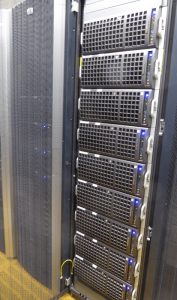
DFG Gerätegruppenschlüssel: 7000 Datenverarbeitungsanlagen, zentrale Rechenanlagen
Description
TinyGPU addresses the increasing demand for GPGPU-accelerated HPC systems and has nodes with six different types of GPUs (mostly of consumer type):- 7 nodes with 2x Intel Xeon E5-2620v4 („Broadwell“, 8 Cores@2.1 GHz); 64 GB main memory; 4x NVIDIA Gefroce GTX 1080 (8 GB memory); 1.8 TB SSD
- 10 nodes with 2x Intel Xeon E5-2620v4 („Broadwell“, 8 Cores@2.1 GHz); 64 GB main memory; 4x NVIDIA Geforce GTX 1080Ti (11 GB memory); 1.8 TB SSD
- 12 nodes with 2x Intel Xeon Gold 6134 („Skylake“, 8 Cores@3.2 GHz); 96 GB main memory; 4x NVIDIA Geforce RTX 2080 Ti (11 GB memory); 1.8 TB SSD
- 4 nodes with 2x Intel Xeon Gold 6134 („Skylake“, 8 Cores@3.2 GHz); 96 GB main memory; 4x NVIDIA Tesla V100 (32 GB memory); 2.9 TB SSD
- 7 nodes with 2x Intel Xeon Gold 6226R („Cascadelake“, 16 Cores@2.9 GHz); 394 GB main memory; 8x NVIDIA Geforce RTX3080 (10 GB memory); 3,8 TB SSD
- 8 nodes with 2x AMD Epyc 7662 („Rome“, 64 Cores@2,0 GHz); 512 GB main memory; 4x NVIDIA A100 SXM4/Nvlink; 6,4 TB SSD
45 out of the 48 nodes have been purchased/financed by specific groups or special projects. These users have priority access and nodes may be reserved exclusively for them.
Involved Person(s)
Organisation(s)
Research Areas
Debug: Alles
name_de: Linux-basierter GPGPU-Cluster / HPC-Cluster TinyGPU
name_en: Linux based GPGPU computer / High performance computer TinyGPU
model: GPGPU-Cluster
url: https://hpc.fau.de/systems-services/systems-documentation-instructions/clusters/tinygpu-cluster/
manufacturer: diverse
year: 0
location: 202160667
location_de: Erlangen
location_en: Erlangen
usage: 21197
usage_de: FAU intern
usage_en: FAU internal
description_de:
description_en: <div>TinyGPU addresses the increasing demand for GPGPU-accelerated HPC systems and has nodes with six different types of GPUs (mostly of consumer type):</div><ul><li>7 nodes with 2x Intel Xeon E5-2620v4 („Broadwell“, 8 Cores@2.1 GHz); 64 GB main memory; 4x NVIDIA Gefroce GTX 1080 (8 GB memory); 1.8 TB SSD</li><li>10 nodes with 2x Intel Xeon E5-2620v4 („Broadwell“, 8 Cores@2.1 GHz); 64 GB main memory; 4x NVIDIA Geforce GTX 1080Ti (11 GB memory); 1.8 TB SSD</li><li>12 nodes with 2x Intel Xeon Gold 6134 („Skylake“, 8 Cores@3.2 GHz); 96 GB main memory; 4x NVIDIA Geforce RTX 2080 Ti (11 GB memory); 1.8 TB SSD</li><li>4 nodes with 2x Intel Xeon Gold 6134 („Skylake“, 8 Cores@3.2 GHz); 96 GB main memory; 4x NVIDIA Tesla V100 (32 GB memory); 2.9 TB SSD</li><li>7 nodes with 2x Intel Xeon Gold 6226R („Cascadelake“, 16 Cores@2.9 GHz); 394 GB main memory; 8x NVIDIA Geforce RTX3080 (10 GB memory); 3,8 TB SSD</li><li>8 nodes with 2x AMD Epyc 7662 („Rome“, 64 Cores@2,0 GHz); 512 GB main memory; 4x NVIDIA A100 SXM4/Nvlink; 6,4 TB SSD<br /></li></ul>45 out of the 48 nodes have been purchased/financed by specific groups or special projects. These users have priority access and nodes may be reserved exclusively for them.<br />
feature_de:
feature_en:
pictures: <QuerySet [<Picture: 234688731>]>
cards: <QuerySet [<Card: Card of Gerhard, Wellein: (True)>, <Card: Card of Thomas, Zeiser: (True)>]>
funding_sources: <QuerySet []>
projects: <QuerySet [<Project: Teilprojekt P12 - Postdoctoral Project: Quantum-to-Continuum Model of Thermoset Fracture (GRK2423 - P12), GRK2423 - P12, https://www.frascal.research.fau.eu/home/research/p-12-postdoctoral-project-quantum-to-continuum-model-of-thermoset-fracture/, Fracture across Scales: Integrating Mechanics, Materials Science, Mathematics, Chemistry, and Physics (FRASCAL) (GRK 2423 FRASCAL), <p></p><p>Fracture is an inherently multiscale process in which processes at all
length- and timescales can contribute to the dissipation of energy and
thus determine the fracture toughness. While the individual processes
can be studied by specifically adapted simulation methods, the interplay
between these processes can only be studied by using concurrent
multiscale modelling methods. While such methods already exist for
inorganic materials as metals or ceramics, no similar methods
have been established for polymers yet.</p><p>The ultimate goal of this postdoc project is to develop a concurrent
multiscale modelling approach to study the interplay and coupling of
process on different length scales (e.g. breaking of covalent bonds,
chain relaxation processes, fibril formation and crazing at
heterogeneities,…) during the fracture of an exemplary thermoset and its
dependence on the (local) degree of cross-linking. In doing so, this
project integrates results as well as the expertise developed in the
other subprojects and complements their information-passing approach.</p><p></p>, <p></p><p>Fracture is an inherently multiscale process in which processes at all
length- and timescales can contribute to the dissipation of energy and
thus determine the fracture toughness. While the individual processes
can be studied by specifically adapted simulation methods, the interplay
between these processes can only be studied by using concurrent
multiscale modelling methods. While such methods already exist for
inorganic materials as metals or ceramics, no similar methods
have been established for polymers yet.</p><p>The ultimate goal of this postdoc project is to develop a concurrent
multiscale modelling approach to study the interplay and coupling of
process on different length scales (e.g. breaking of covalent bonds,
chain relaxation processes, fibril formation and crazing at
heterogeneities,…) during the fracture of an exemplary thermoset and its
dependence on the (local) degree of cross-linking. In doing so, this
project integrates results as well as the expertise developed in the
other subprojects and complements their information-passing approach.</p><p></p>, 2019-01-02, 2023-06-30, 2027-12-31, 2027-12-31, Third Party Funds Group - Sub project, True>, <Project: International Doctoral Program: Measuring and Modelling Mountain glaciers and ice caps in a Changing Climate (M³OCCA) (MOCCA), MOCCA, , , <p>Mountain glaciers and ice caps outside the large ice sheets of Greenland and Antarctica contribute about 41% to the global sea level rise between 1901 to 2018 (IPCC 2021). While the Arctic ice masses are and will remain the main contributors to sea level rise, glacier ice in other mountain regions can be critical for water supply (e.g. irrigation, energy generation, drinking water, but also river transport during dry periods). Furthermore, retreating glaciers also can cause risks and hazards by floods, landslides and rock falls in recently ice-free areas. As a consequence, the Intergovernmental Panel of Climate Change (IPCC) dedicates special attention to the cryosphere (IPCC 2019; IPCC 2021). WMO and UN have defined Essential Climate Variables (ECV) for assessing the status of the cryosphere and its changes. These ECVs should be measured regularly on large scale and are essential to constrain subsequent modelling efforts and predictions.<br />The proposed International Doctorate Program (IDP) “Measuring and Modelling Mountain glaciers and ice caps in a Changing ClimAte (M3OCCA)” will substantially contribute to improving our observation and measurement capabilities by creating a unique inter- and transdisciplinary research platform. We will address main uncertainties of current measurements of the cryosphere by developing new instruments and future analysis techniques as well as by considerably advancing geophysical models in glaciology and natural hazard research. The IDP will have a strong component of evolving techniques in the field of deep learning and artificial intelligence (AI) as the data flow from Earth Observation (EO) into modelling increases exponentially. IDP M3OCCA will become the primary focal point for mountain glacier research in Germany and educate emerging<br />talents with an interdisciplinary vision as well as excellent technical and soft skills. Within the IDP we combine cutting edge technologies with climate research. We will develop future technologies and transfer knowledge from other disciplines into climate and glacier research to place Bavaria at the forefront in the field of mountain cryosphere research. IDP M3OCCA fully fits into FAU strategic goals and it will leverage on Bavaria’s existing long-term commitment via the super test site Vernagtferner in the Ötztal Alps run by Bavarian Academy of Sciences (BAdW). In addition, we cooperate with the University of Innsbruck and its long-term observatory at Hintereisferner. At those super test sites, we will perform joint measurements, equipment tests, flight campaigns and cross-disciplinary trainings and exercises for our doctoral researchers. We leverage on existing<br />instrumentation, measurements and time series. Each of the nine doctoral candidates will be guided by interdisciplinary, international teams comprising university professors, senior scientists and emerging talents from the participating universities and external research organisations.<br /></p>, , 2022-06-01, 2026-05-31, , 2026-05-31, Third party funded individual grant, True>, <Project: Ice dynamics and projections of the Northern Patagonia Icefield, , , , , <p>Das Forschungsvorhaben plant eine detaillierte Modellierung der Eisdynamik des nördlichen<br />Patagonischen Inlandeises. Es sollen zwei der in der Glaziologie meistgenutzten Fließmodelle<br />verglichen werden: Elmer-Ice welches auf finiten Elementen basiert und welches die vollen<br />Stokesgleichung zu lösen vermag und SICOPOLIS ein Kode der Näherungen geschickt kombiniert<br />und auf diese Art die Eisdynamik vieler Eiskörper in ausreichender Auflösung über lange Zeiträume<br />simulieren kann. Die nötigen Inputs (Oberflächenmassenbilanz und Gletscherbetttopographie)<br />wurden von den am Projekt beteiligten Arbeitsgruppen (der meinen und der von Matthias Braun) in<br />vorangegangenen Studien detailliert erarbeitet. Nun geht es darum mittels der Fließmodelle<br />detaillierte Prognosen über die Zukunft des Nördlichen Eisfeldes unten den aktuellen<br />Klimaszenarien zu machen. Business as usual oder Emissionen extrem reduzieren? Für das<br />nördliche Eisfeld wird der Unterschied wohl sehr klar zu fühlen sein: die Patagonischen Gletscher<br />sind temperiert und deshalb sehr empfindlich auf Klimaerwärmungen. Mit einem Fließmodel kann<br />man nicht nur die detaillierte Eisdynamik reproduzieren, sondern auch extrem gut visualisieren. Wir<br />denken, dass eine ansprechende Visualisierung eventuell mehr Menschen beeindrucken kann, als<br />ein Meer von Daten und Berichte von über 1000 Seiten. Ein große Herausforderung des Projektes<br />werden die vereinfachten Modelparametrisierungen des komplizierten Kalbungsprozess sein. Dies<br />ist von Wichtigkeit für die Gletscherzungen, welche in Seen oder im Meer enden. In SICOPOLIS<br />existiert eine einfache Parametrisierung und für Elmer-Ice wird eine solche in einem Partnerprojekt<br />entwickelt. Wie gut diese Modelparametrisierungen fähig sein werden den Gletscherzungenrückzug<br />am nördlichen Eisfeld zu reproduzieren wird sich hoffentlich in diesem Forschungsprojekt zeigen.<br />Und wenn sie hier funktionieren oder optimiert werden können, werden sie auch auf andere<br />Gletscher (gebiete) anwendbar sein.<br /></p>, 2021-04-01, , , 2024-04-01, Third party funded individual grant, True>, <Project: Video-based Re-Identification for Animals (Team VERA), Team VERA, https://team-vera.github.io/, , <p>Digitization is advancing at a high pace in all areas of our lives. The development of algorithms based on artificial intelligence and more extensive and better data sets are creating new opportunities in many areas of science.<br /></p><p>Nevertheless, it is common for many biologists, veterinarians, and animal caretakers to observe the animals manually, which is very time- and labor-expensive and comes with severe limitations. The development of an automated camera-based system seems to be self-evident.<br /><br />The automated analysis of video footage from surveillance cameras is a possibility to evaluate activity/inactivity and stereotypy of the animals as well as their enclosure use over long periods of time and thus allows an objective assessment. In the project's next phase, further behavior analysis will be added (for example, secondary behavior such as feeding, playful behavior, or interaction). The most challenging step for such a system is the re-identification (reID) of individual animals in every camera perspective</p>, , 2021-01-01, , , 2024-01-01, Internally funded project, True>, <Project: Characterization of molecular diffusion in liquids with dissolved gases, , , , <p>
</p><p>The proposed research should further promote the fundamental
understanding of molecular diffusion in binary mixtures consisting of liquids
and dissolved gases. Still ongoing work within the first funding period shows
that dynamic light scattering (DLS) experiments and molecular dynamics
simulations (MDS) are suitable for the characterization of diffusive mass
transport in such systems in macroscopic thermodynamic equilibrium. While DLS analyzes microscopic
statistical concentration fluctuations to get access to the Fick diffusivity D11,
the latter is obtained from equilibrium-MDS by combining kinetic and structural
contributions in form of the Maxwell-Stefan diffusivity and the thermodynamic
factor. It has been shown that D11
data obtained from DLS for various binary mixtures with dissolved gases close
to infinite dilution agree with the self-diffusivities of the gases calculated
by MDS. Newly identified relations between characteristic properties of the
gases and the diffusivity data contributed to the development of a simple
correlation for the tracer diffusivity of the studied gases dissolved in <i>n</i>-alkanes. For the model system <i>n</i>-hexane/CO<sub>2</sub>, D11 data determined for the entire
concentration range give first indications regarding the influence of the
liquid structure on Fickian diffusion. The main aim of the proposed second
funding period is the acquisition of comprehensive knowledge on
diffusion-related structure-property relationships by a systematic expansion of
the studied classes of liquids and gases. While for the selected gases molar
mass, size, and polarity vary over broad ranges, the chosen liquids differ not
only in alkyl chain length, but also in the degrees of branching and
oxygenation for acyclic and of hydrogenation for cyclic compounds having the
same number of carbon atoms. For the additional
systems, the performance of MDS regarding the prediction of D11 should be tested again by comparison with the
experimental results from DLS. Based on all obtained data and further
insights into the liquid structure gained from MDS, the fundamental
understanding how the different characteristics of liquids and dissolved gases
influence Fickian diffusion should be improved. These influences can be
analyzed separately for liquids and gases by investigations close to infinite
dilution. Concentration-dependent studies shed light on the effects of the
liquid structure and kinetic aspects on D11. Information on the liquid
structure will be compared with results from Raman spectroscopy. All experimental
and calculated results should be used to establish quantitative relations
between the different kinds of diffusion coefficients for various ideal and non-ideal binary systems. These findings should
contribute to the further development of more comprehensive prediction schemes
for the Fick diffusivity for binary systems consisting of liquids with dissolved
gases.</p>, <p>
</p><p><br /></p>, 2019-07-01, 2022-03-31, 2023-06-30, 2023-06-30, Third party funded individual grant, True>, <Project: Tapping the potential of Earth Observations (TAPE), TAPE, , , , , 2019-04-01, 2021-03-31, 2022-03-31, 2022-03-31, FAU own research funding: EFI / IZKF / EAM ..., True>, <Project: Metaprogrammierung für Beschleunigerarchitekturen (MeTacca), MeTacca, , , <p>
In Metacca wird das AnyDSL Framework zu einer homogenen Programmierumgebung für<br />
heterogene Ein- und Mehrknoten-Systeme ausgebaut. Hierbei wird die UdS den Compiler und das Typsystem von AnyDSL erweitern, um dem Programmierer das produktive Programmieren von Beschleunigern zu ermöglichen. Darauf aufbauend wird der LSS geeignete Abstraktionen für die Verteilung und Synchronisation auf Ein- und Mehrknoten-Rechnern in Form einer DSL in AnyDSL entwickeln. Alle Komponenten werden durch Performance Modelle (RRZE) unterstützt<br />
Eine Laufzeitumgebung mit eingebautem Performance-Profiling kümmert sich um Resourcenverwaltung und Systemkonfiguration. Das entstandene Framework wird anhand zweier Anwendungen, Ray-Tracing (DFKI) und Bioinformatik (JGU), evaluiert.<br />
Als Zielplattformen dienen Einzelknoten und Cluster mit mehreren Beschleunigern (CPUs, GPUs, Xeon Phi).</p>
<p>
</p>
<p>
Die Universität Erlangen-Nürnberg ist hauptverantwortlich für die Unterstützung von verteilter<br />
Programmierung (LSS) sowie für die Entwicklung und Umsetzung von unterstützenden Performance-Modellen sowie einer integrierten Profiling Komponente (RRZE). In beiden Teilbereichen wird zu Beginn eine Anforderungsanalyse durchgeführt um weitere Schritte zu planen und mit den Partnern abzustimmen.<br />
Der LSS wird im ersten Jahr die Verteilung der Datenstrukturen umsetzen. Im weiteren Verlauf wird sich die Arbeit auf die Umsetzung von Synchronisationsmechanismen konzentrieren. Im letzten Jahr werden Codetransformationen entworfen, um die Konzepte für Verteilung und Synchronisation in AnyDSL auf die gewählten Anwendungen anzupassen. Das RRZE wird in einem ersten Schritt das kerncraft Framework in die partielle Auswertung integrieren. Hierbei wird kerncraft erweitert um aktuelle Beschleunigerarchitekturen sowie Modelle für die Distributed-Memory-Parallelisierung zu unterstützen. In zwei weiteren Paketen wird eine Ressourcenverwaltung und eine auf LIKWID basierende Profiling Komponente umgesetzt</p>, , 2017-01-01, 2019-12-31, , 2019-12-31, Third party funded individual grant, True>]>
publications: <QuerySet [<Publication: Mitochondria-Catalyzed Activation of Anticancer Prodrugs>, <Publication: Mode of Metal Ligation Governs Inhibition of Carboxypeptidase A>, <Publication: Identification of Spared and Proportionally Controllable Hand Motor Dimensions in Motor Complete Spinal Cord Injuries Using Latent Manifold Analysis>, <Publication: Learning a Hand Model from Dynamic Movements Using High-Density EMG and Convolutional Neural Networks>, <Publication: ANALYSIS OF EMBEDDED GPU ARCHITECTURES FOR AI IN NEUROMUSCULAR APPLICATIONS>, <Publication: Influence of spatio-temporal filtering on hand kinematics estimation from high-density EMG signals>, <Publication: In Silico Study of Camptothecin-Based Pro-Drugs Binding to Human Carboxylesterase 2>, <Publication: ArCSEM: Artistic Colorization of SEM Images via Gaussian Splatting>, <Publication: New fluorogenic triacylglycerols as sensors for dynamic measurement of lipid oxidation>, <Publication: Exploring Dataset
Bias and Scaling Techniques in Multi-Source Gait Biomechanics: An Explainable
Machine Learning Approach>, <Publication: A concept of dual-responsive prodrugs based on oligomerization-controlled reactivity of ester groups: an improvement of cancer cells versus neutrophils selectivity of camptothecin>, <Publication: PoseBias: On Dataset Bias and Task Difficulty - Is there an Optimal Camera Position for Facial Image Analysis?>, <Publication: Out-of-the-box Calving Front Detection Method Using Deep Learning>, <Publication: Conditional Random Fields for Improving Deep Learning-based Glacier Calving Front Delineations>, <Publication: Diffusivities in Binary Mixtures of Ammonia Dissolved in n-Hexane, 1-Hexanol, or Cyclohexane Determined by Dynamic Light Scattering and Molecular Dynamics Simulations>, <Publication: Diffusion coefficients in binary electrolyte mixtures by dynamic light scattering and molecular dynamics simulations>, <Publication: Proportional and Simultaneous Real-Time Control of the Full Human Hand From High-Density Electromyography>, <Publication: Mutual and Thermal Diffusivities in Binary Mixtures of n-Hexane or 1-Hexanol with Krypton, R143a, or Sulfur Hexafluoride by Using Dynamic Light Scattering and Molecular Dynamics Simulations>, <Publication: AMD-HookNet for Glacier Front Segmentation>, <Publication: Diffusivities in Binary Mixtures of Cyclohexane or Ethyl Butanoate with Dissolved CH4 or R143a Close to Infinite Dilution>, '...(remaining elements truncated)...']>
fobes: <QuerySet [<ResearchArea: Research Area:
Title: A3 Multiscale Modeling and Simulation | A3 Multiscale Modeling and Simulation,
Description: <div><p><b>New methods for multiscale and multiphysical modeling for the optimization of structures, properties, and processes</b>
</p>
<p><b>The research concept connects quantum-mechanical approaches on the
molecular scale to discrete approaches for particle systems and to
methods of continuum mechanics</b>
</p>
<p>The cross-sectional Research Area A3 is concerned with modeling,
simulating and optimizing macroscopic material and structural properties
based on their constituent components such as particles, molecules and
atoms. A guiding principle of A3 is that simulation is used as a new
paradigm in gaining qualitative knowledge and quantitative data
alongside theoretical and experimental facts. </p><ul><li>On
the qualitative side, molecules that have not yet been synthesized can
e.g. be anticipated via modeling and simulation. Similarly, new
materials and in particular meta-materials (or utopia-materials) can be
designed optimally, given their desired functionality. </li><li>On the
quantitative side, data-driven model-based simulation and optimization
in the context of the application areas can be used directly in the
process chain.</li></ul><p>Understanding matter and designing materials,
interfaces, and processes from their nano-structural constitution
necessitates both algorithms that scale almost linearly in order to cope
with the vast number of variables, and hierarchical, multi-scale
modeling, analysis and mathematical optimization in order to bridge the
gap between the scales in space, time, and constitutive models. <br /><br />The
Center for Multiscale Modeling and Simulation (CMMS) works on
multiscale approaches and methods for structure, property, and process
optimization. The research concept connects quantum mechanical
approaches on the molecular scale to discrete approaches for particle
systems and to methods of continuum mechanics. </p></div> | <div><p><b>New methods for multiscale and multiphysical modeling for the optimization of structures, properties, and processes</b>
</p>
<p><b>The research concept connects quantum-mechanical approaches on the
molecular scale to discrete approaches for particle systems and to
methods of continuum mechanics</b>
</p>
<p>The cross-sectional Research Area A3 is concerned with modeling,
simulating and optimizing macroscopic material and structural properties
based on their constituent components such as particles, molecules and
atoms. A guiding principle of A3 is that simulation is used as a new
paradigm in gaining qualitative knowledge and quantitative data
alongside theoretical and experimental facts. </p><ul><li>On
the qualitative side, molecules that have not yet been synthesized can
e.g. be anticipated via modeling and simulation. Similarly, new
materials and in particular meta-materials (or utopia-materials) can be
designed optimally, given their desired functionality. </li><li>On the
quantitative side, data-driven model-based simulation and optimization
in the context of the application areas can be used directly in the
process chain.</li></ul><p>Understanding matter and designing materials,
interfaces, and processes from their nano-structural constitution
necessitates both algorithms that scale almost linearly in order to cope
with the vast number of variables, and hierarchical, multi-scale
modeling, analysis and mathematical optimization in order to bridge the
gap between the scales in space, time, and constitutive models. <br /><br />The
Center for Multiscale Modeling and Simulation (CMMS) works on
multiscale approaches and methods for structure, property, and process
optimization. The research concept connects quantum mechanical
approaches on the molecular scale to discrete approaches for particle
systems and to methods of continuum mechanics. </p></div>,
Classification: Field of Research | Forschungsbereich
>]>
orgas: <QuerySet [<Organisation: Regionales Rechenzentrum Erlangen (RRZE), Regionales Rechenzentrum Erlangen (RRZE), Erlangen, 91058, Martensstraße, 2999-12-31, Zentrale Einrichtungen, True>, <Organisation: Professur für Höchstleistungsrechnen, The research activities of the HPC professorship are located at the interface between numerical applications and modern parallel, heterogeneous high-performance computers.<br /><br />The application focus is on the development and implementation of hardware- and energy-efficient numerical methods and application programs. The foundation of all activities is a structured performance engineering (PE) process based on analytic performance models. Such models describe the interaction between software and hardware and are thus able to systematically identify efficient implementation, optimization and parallelization strategies. The PE process is applied to stencil-based schemes as well as basic operations and eigenvalue solvers for large sparse problems.<br /><br />In the computer science-oriented research focus, performance models, PE methods and easy-to-use open source tools are developed that support the process of performance engineering and performance modeling on the compute node level. We focus on the continuous development of the ECM performance model and the LIKWID tool collection.<br /><br />In teaching and training, the working group consistently relies on a model-based approach to teach optimization and parallelization techniques. The courses are integrated into the computer science and computational engineering curriculum at FAU. Furthermore, the group offers an internationally successful tutorial program on performance engineering and hybrid programming.<br /><br />Prof. Wellein is director of the Erlangen National Center for High-Performance Computing (NHR@FAU) and is the spokesman of the Competence Network for Scientific High Performance Computing in Bavaria (KONWIHR)., Erlangen, 91058, Martensstraße, 2999-12-31, Department Informatik, True>]>
dfg_keys: <QuerySet [<DFGKey: 7000 Datenverarbeitungsanlagen, zentrale Rechenanlagen>]>
TinyGPU addresses the increasing demand for GPGPU-accelerated HPC systems and has nodes with six different types of GPUs (mostly of consumer type):
- 7 nodes with 2x Intel Xeon E5-2620v4 („Broadwell“, 8 Cores@2.1 GHz); 64 GB main memory; 4x NVIDIA Gefroce GTX 1080 (8 GB memory); 1.8 TB SSD
- 10 nodes with 2x Intel Xeon E5-2620v4 („Broadwell“, 8 Cores@2.1 GHz); 64 GB main memory; 4x NVIDIA Geforce GTX 1080Ti (11 GB memory); 1.8 TB SSD
- 12 nodes with 2x Intel Xeon Gold 6134 („Skylake“, 8 Cores@3.2 GHz); 96 GB main memory; 4x NVIDIA Geforce RTX 2080 Ti (11 GB memory); 1.8 TB SSD
- 4 nodes with 2x Intel Xeon Gold 6134 („Skylake“, 8 Cores@3.2 GHz); 96 GB main memory; 4x NVIDIA Tesla V100 (32 GB memory); 2.9 TB SSD
- 7 nodes with 2x Intel Xeon Gold 6226R („Cascadelake“, 16 Cores@2.9 GHz); 394 GB main memory; 8x NVIDIA Geforce RTX3080 (10 GB memory); 3,8 TB SSD
- 8 nodes with 2x AMD Epyc 7662 („Rome“, 64 Cores@2,0 GHz); 512 GB main memory; 4x NVIDIA A100 SXM4/Nvlink; 6,4 TB SSD