
Spray and combustion vessel II (FAU)
Model: Benzineinspritzkammer
Manufacturer: FAU (2011)
Location: Erlangen
Usage: FAU internal
Pictures
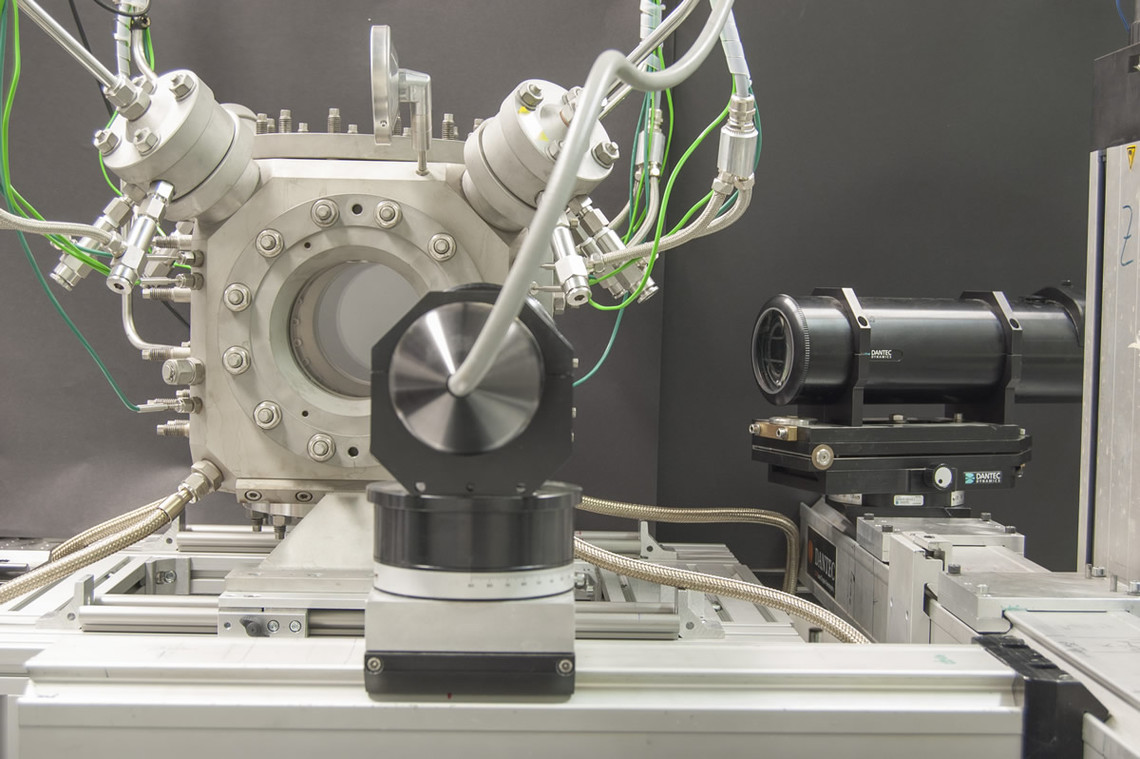
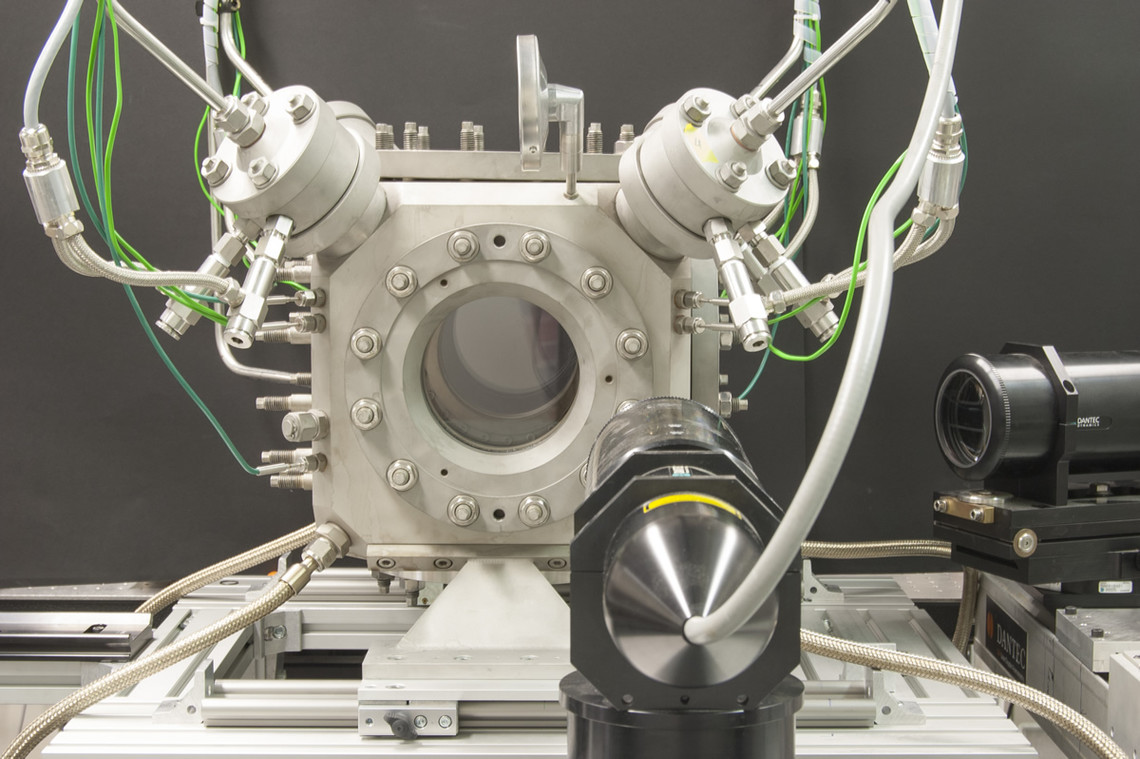
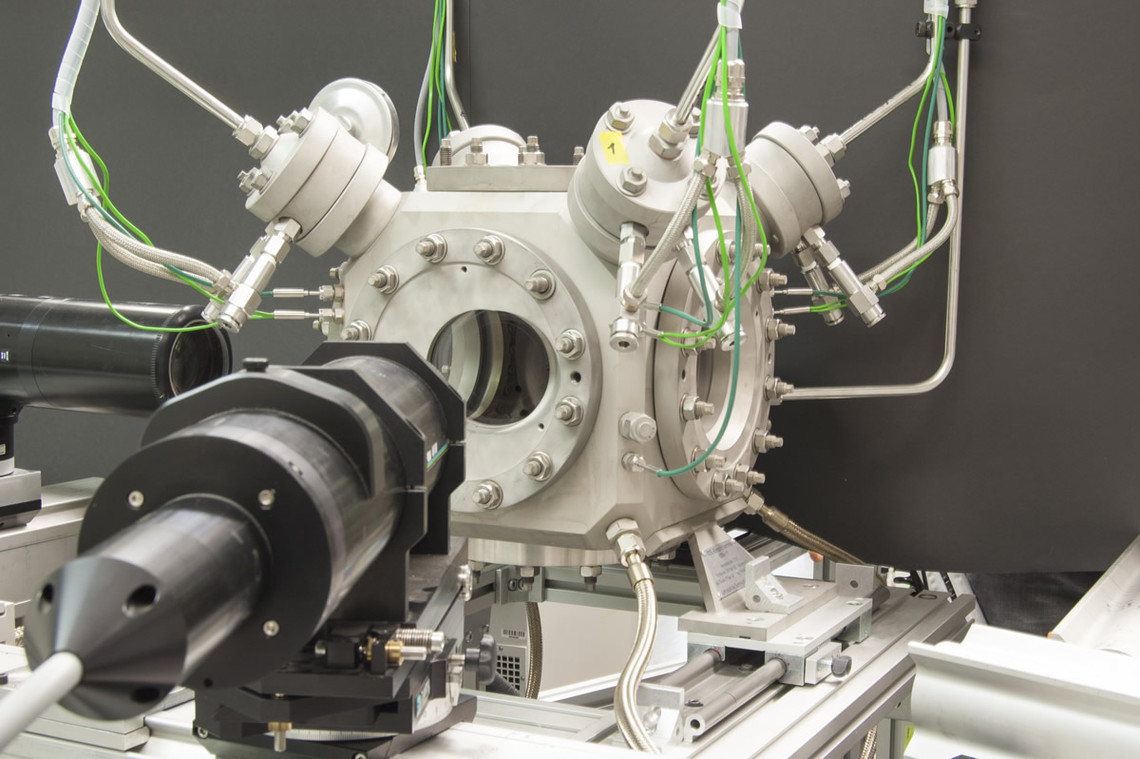
DFG Gerätegruppenschlüssel: 2860 Motoren- und Getriebeprüfstände, Verdichterprüfstände
Description
High-temperature/high-pressure chamber for the investigation of injection and combustion processes, especially in the petrol sector
maximum temperature: 600 K, maximum pressure 20 bar
5 large optical entrances, special alignment for LDA/PDA examinations
open, electrically heated system for high measuring frequency of 1-2 Hz => up to 16,000 examinations per day
Involved Person(s)
Organisation(s)
Debug: Alles
name_de: Spray- und Verbrennungskammer II
name_en: Spray and combustion vessel II
model: Benzineinspritzkammer
url:
manufacturer: FAU
year: 2011
location: 202160667
location_de: Erlangen
location_en: Erlangen
usage: 21197
usage_de: FAU intern
usage_en: FAU internal
description_de: Hochtemperatur-/Hochdruckkammer zur Untersuchung von Einspritz- und Verbrennungsvorgängen vor allem im Benzinbereich
- maximale Temperatur: 600 K, maximaler Druck 20 bar
- 5 große optische Zugänge, spezielle Ausrichtung für LDA/PDA-Untersuchungen
- offenes, elektrisch beheiztes System für hohe Messfrequenz von 1-2 Hz => bis 16.000 Untersuchungen je Tag
description_en: <p>High-temperature/high-pressure chamber for the investigation of injection and combustion processes, especially in the petrol sector<br /><br /> <br /><br /> maximum temperature: 600 K, maximum pressure 20 bar<br /> 5 large optical entrances, special alignment for LDA/PDA examinations<br /> open, electrically heated system for high measuring frequency of 1-2 Hz => up to 16,000 examinations per day<br /></p>
feature_de:
feature_en:
pictures: <QuerySet [<Picture: 229616624>, <Picture: 229616600>, <Picture: 229616576>]>
cards: <QuerySet [<Card: Card of Michael, Wensing: (True)>]>
funding_sources: <QuerySet []>
projects: <QuerySet [<Project: Active pre-chamber ignition systems for novel car combustion processes (LEANition), LEANition, , , <p>In the LEANition project, the possibilities and limits of a purged prechamber ignition in passenger car gasoline engines are to be demonstrated. The pre-chamber is a small ignition chamber around the spark plug, which is connected to the combustion chamber by transfer ducts and is actively supplied with a fuel-air mixture in addition to the charge exchange with the main combustion chamber. The application is based on the innovation of extracting the mixture required to supply the pre-chamber from the conventional petrol tank above the liquid level. The gas atmosphere there is very rich in fuel. The prechamber ignition shows the potential for significantly reduced fuel consumption in the partial load range while simultaneously reducing NOx emissions through the use of homogeneous lean mixtures (λ ≈ 2) or high to very high residual gas contents (EGR ≥ 30 %). The high ignition energy of the pre-chamber ensures the ignition of these mixtures which are unwilling to ignite. Active prechamber ignition is known for large gas engines, but cannot yet be implemented in passenger cars. The use of the fuel already available (in gaseous form) makes it possible to convert prechamber ignitions into car drives.<br />In the project the partners are striving to generate a deep understanding of the interactions of the prechamber ignition and thus to lay the foundation for the development of a combustion process that can implement the above-mentioned advantages in passenger car propulsion. This can be based on the results of the preliminary study carried out by the project partners, which proved that the enrichment of the pre-chamber through the use of the gas phase in the tank is possible.<br /></p>, , 2019-08-01, 2022-07-31, , 2022-07-31, Third party funded individual grant, True>, <Project: Reduction of particulate emissions from direct-injection gasoline engines (PN Reduktion), PN Reduktion, , , , , 2017-08-01, 2020-07-31, 2021-01-31, 2021-01-31, Third party funded individual grant, True>, <Project: TwinJet -- a new colliding jet atomization concept (TwinJet), TwinJet, , , <p>The research project AZ-1004-11 "TWIN-JET" comprised the two main objectives of a potential analysis of the atomization principle with novel double jet spray injectors on the one hand and the verification of pulsation dampers made of porous materials for modern common rail injection systems on the other hand. The project partners consisted of the two university institutes Chair of Process Machines and Plant Engineering (iPAT) and Chair of Technical Thermodynamics (LTT) of the Friedrich-Alexander-University Erlangen-Nuremberg. The industrial partners Bayerische Motoren Werke AG (BMW), Robert Bosch GmbH (Bosch), FMP Technology GmbH (FMP) and Geiger Fertigungstechnologie GmbH (Geiger) were also involved.<br />The task of the LTT was to investigate the spray properties of twin-jet sprays using optical measurement techniques in comparison to conventional free jet sprays. Investigations were carried out for a large number of different operating conditions that occur in gasoline direct injection. Furthermore, the group was responsible for the adaptation of the novel injectors to the transparent engine and the optical investigation of the mixture formation in the engine.<br /></p>, , 2012-06-01, 2014-11-30, , 2014-11-30, Third party funded individual grant, True>]>
publications: <QuerySet [<Publication: Investigation of Jet-to-Jet Interaction in Sprays for DISI Engines>, <Publication: Experimental and numerical analysis of iso-octane/ethanol sprays under gasoline engine conditions>, <Publication: Investigations on Gasoline Spray Propagation Behaviour Characteristic for Multihole Injectors>, <Publication: On the role of physiochemical properties on evaporation behavior of DISI biofuel sprays>, <Publication: Investigation of fuel atomization and evaporation of a DISI injector spray under homogeneous charge conditions>]>
fobes: <QuerySet []>
orgas: <QuerySet [<Organisation: Professur für Fluidsystemtechnik, , Erlangen, 91058, Cauerstraße, 2999-12-31, Department Chemie- und Bioingenieurwesen (CBI), True>]>
dfg_keys: <QuerySet [<DFGKey: 2860 Motoren- und Getriebeprüfstände, Verdichterprüfstände>]>
High-temperature/high-pressure chamber for the investigation of injection and combustion processes, especially in the petrol sector
maximum temperature: 600 K, maximum pressure 20 bar
5 large optical entrances, special alignment for LDA/PDA examinations
open, electrically heated system for high measuring frequency of 1-2 Hz => up to 16,000 examinations per day
Hochtemperatur-/Hochdruckkammer zur Untersuchung von Einspritz- und Verbrennungsvorgängen vor allem im Benzinbereich
- maximale Temperatur: 600 K, maximaler Druck 20 bar
- 5 große optische Zugänge, spezielle Ausrichtung für LDA/PDA-Untersuchungen
- offenes, elektrisch beheiztes System für hohe Messfrequenz von 1-2 Hz => bis 16.000 Untersuchungen je Tag