
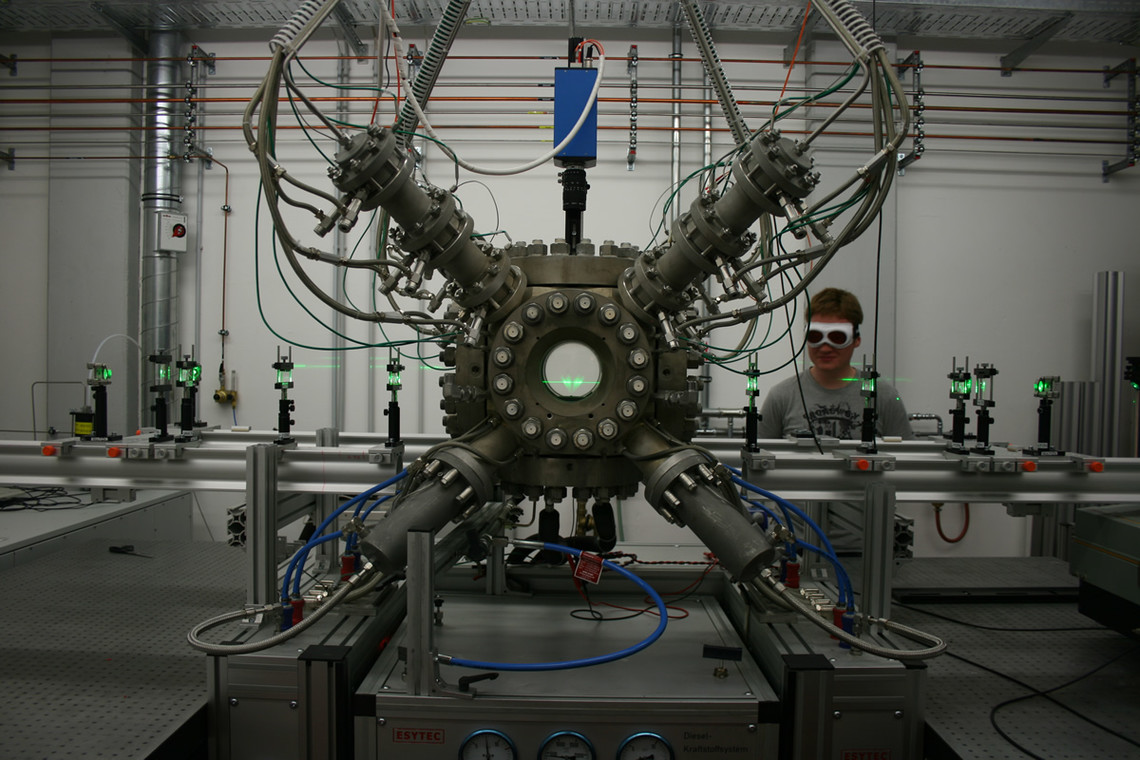
High-temperature/high-pressure injection and combustion vessel I (FAU)
Model: Diesel-Einspritzkammer
Manufacturer: FAU (2008)
Location: Nuremberg
Usage: FAU internal
Pictures
DFG Gerätegruppenschlüssel: 2860 Motoren- und Getriebeprüfstände, Verdichterprüfstände
Description
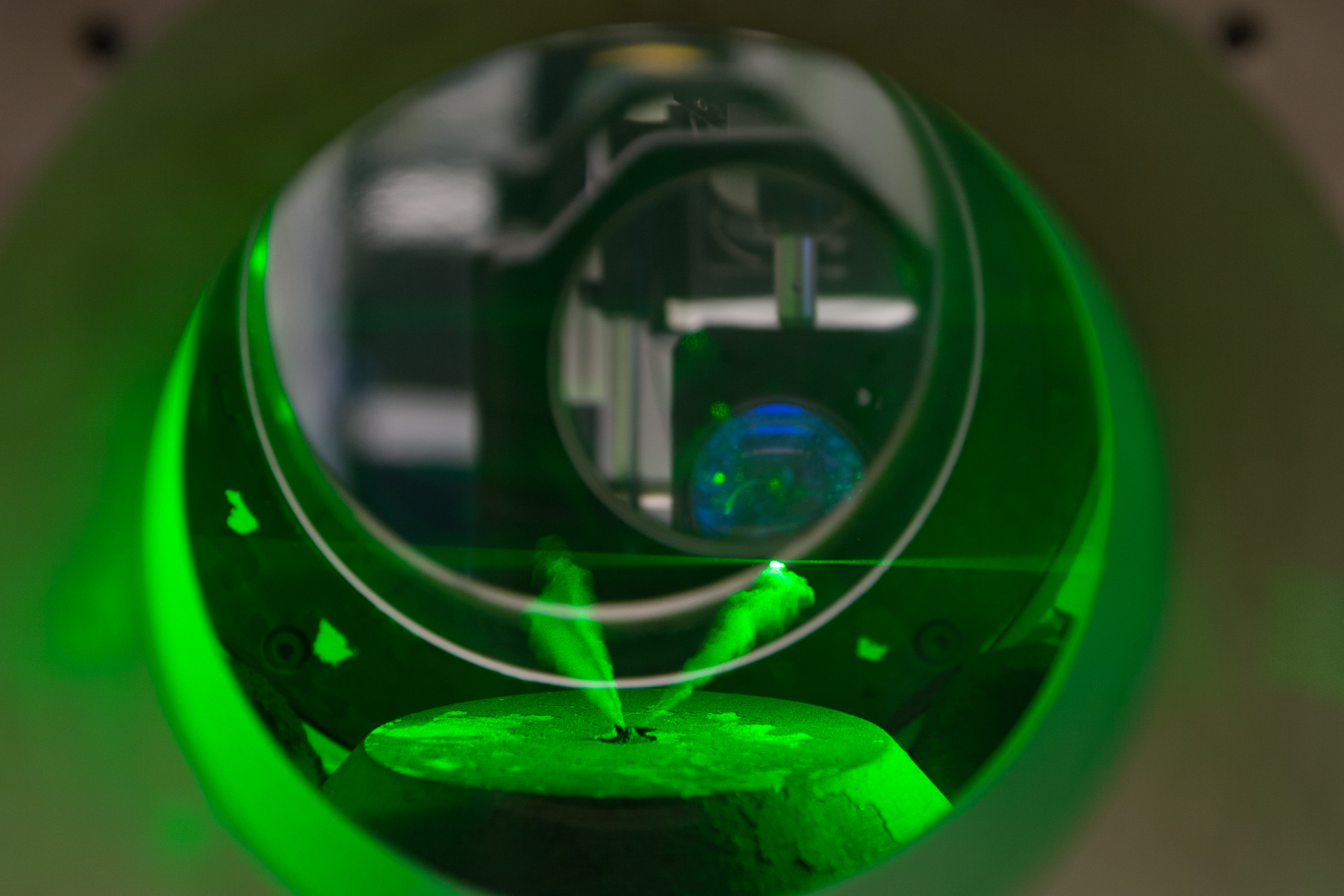
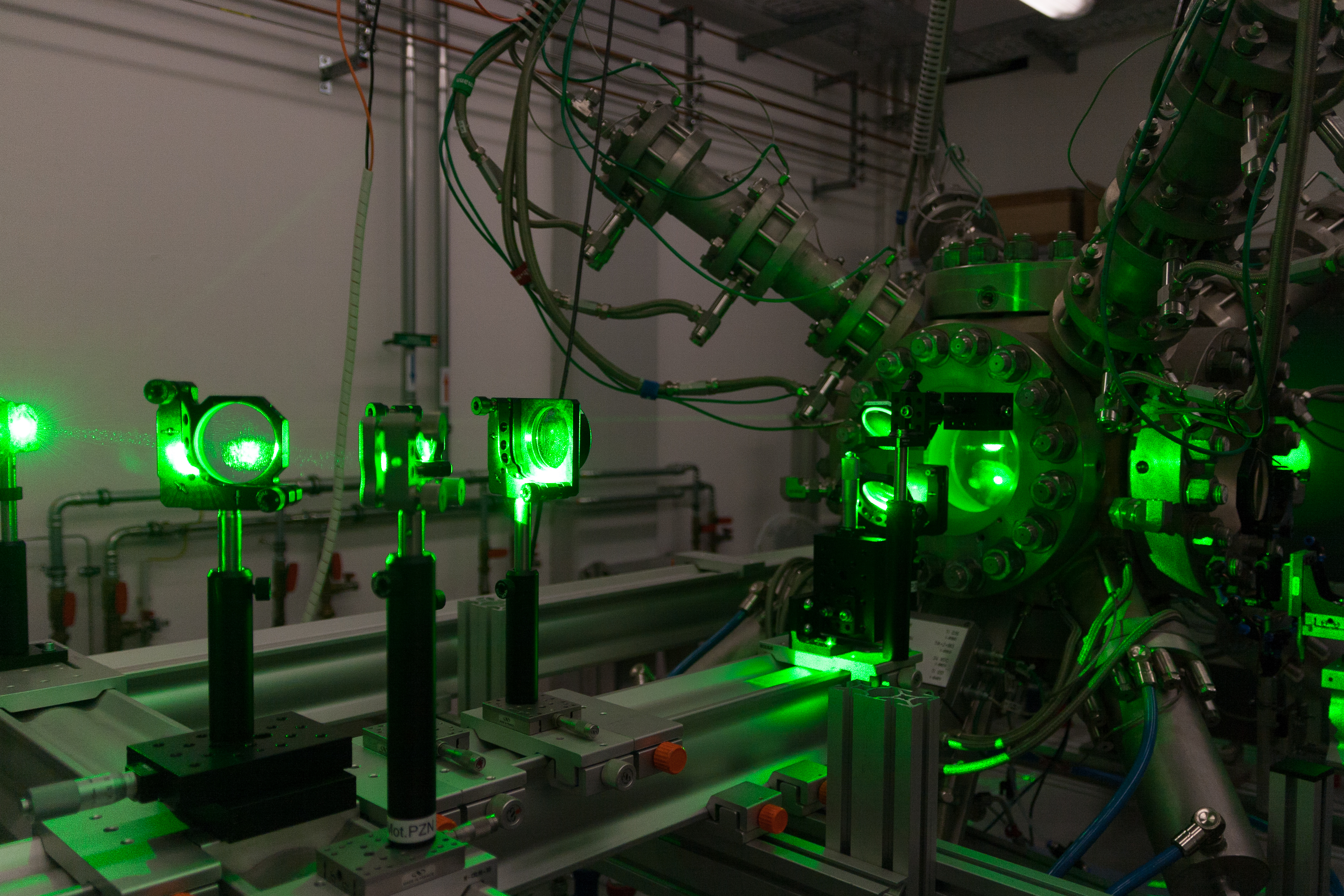
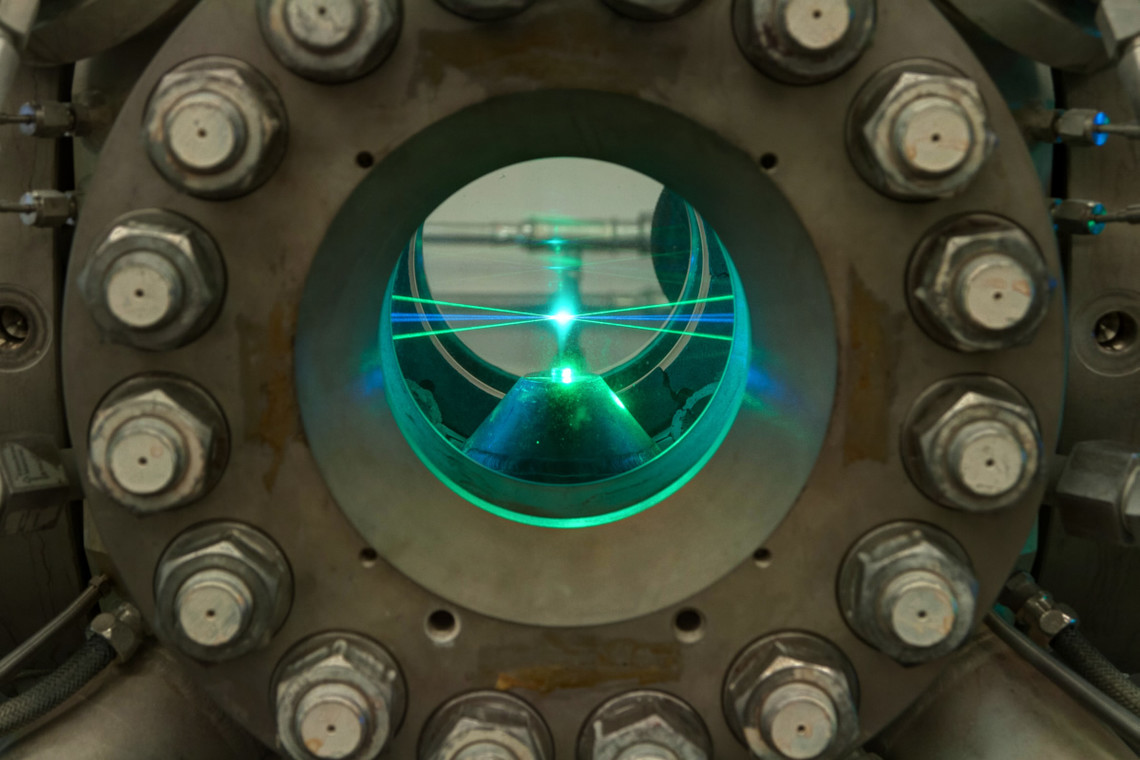
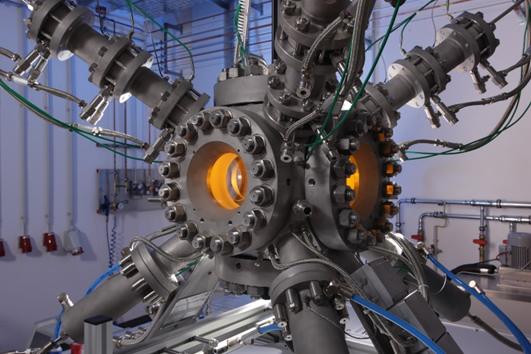
High-temperature/high-pressure chamber for (optical) investigation of spray and phase change processes under high pressures and temperatures.
Primarily used for the fundamental investigation of injection and combustion processes in the field of diesel injection and combustion.
- maximum temperature: 1000 K, maximum pressure 100 bar
- injection pressure of up to 4000 bar
- 5 large optical entrances,
- open, electrically heated system for high measuring frequency of 1-2 Hz => up to 16,000 examinations per day
Involved Person(s)
Organisation(s)
Funding Sources
Bayerisches Staatsministerium für Wirtschaft, Infrastruktur, Verkehr und Technologie (StMWIVT) (bis 09/2013)
EU - 6. RP / Strengthening the Foundation of the ERA
Debug: Alles
name_de: Spray- und Verbrennungskammer I "OptiVep"
name_en: High-temperature/high-pressure injection and combustion vessel I
model: Diesel-Einspritzkammer
url:
manufacturer: FAU
year: 2008
location: 202160671
location_de: Nürnberg
location_en: Nuremberg
usage: 21197
usage_de: FAU intern
usage_en: FAU internal
description_de:
High-temperature/high-pressure chamber for (optical) investigation of spray and phase change processes under high pressures and temperatures.
Primarily used for the fundamental investigation of injection and combustion processes in the field of diesel injection and combustion.
- maximum temperature: 1000 K, maximum pressure 100 bar
- injection pressure of up to 4000 bar
- 5 large optical entrances,
- open, electrically heated system for high measuring frequency of 1-2 Hz => up to 16,000 examinations per day
Einspritz- und Verbrennungskammer zur (optischen) Untersuchung von Spray- und Phasenwechselvorgängen unter hohen Drücken und Temperaturen.
Wird vor allem zur grundlegenden Untersuchung von Diesel-Einspritzvorgängen genutzt
- maximale Temperatur: 1000 K, maximaler Druck 100 bar
- Einspritzdrücke bis 4000 bar
- 5 große optische Zugänge,
- offenes, elektrisch beheiztes System für hohe Messfrequenz von 1-2 Hz => bis 16.000 Untersuchungen je Tag
description_en: <p>High-temperature/high-pressure chamber for (optical) investigation of spray and phase change processes under high pressures and temperatures.<br /><br />Primarily used for the fundamental investigation of injection and combustion processes in the field of diesel injection and combustion.<br /></p><ul><li> maximum temperature: 1000 K, maximum pressure 100 bar</li><li> injection pressure of up to 4000 bar<br /></li><li> 5 large optical entrances,</li><li> open, electrically heated system for high measuring frequency of 1-2 Hz => up to 16,000 examinations per day</li></ul>
feature_de:
feature_en:
pictures: <QuerySet [<Picture: 231094084>, <Picture: 231094108>, <Picture: 229614633>, <Picture: 229614657>, <Picture: 229614683>]>
cards: <QuerySet [<Card: Card of Andreas, Peter: (True)>, <Card: Card of Michael, Wensing: (True)>, <Card: Card of Sebastian, Rieß: (True)>]>
funding_sources: <QuerySet [<FundingSource: FundingSource: cris_id: 139455509, name: Bayerisches Staatsministerium für Wirtschaft, Infrastruktur, Verkehr und Technologie (StMWIVT) (bis 09/2013), abbreviation: >, <FundingSource: FundingSource: cris_id: 139457162, name: EU - 6. RP / Strengthening the Foundation of the ERA, abbreviation: >]>
projects: <QuerySet [<Project: Gemischbildung und Verbrennung von Alkoholen und anderer biogener Kraftstoffe in mischungskontrollierten Brennverfahren, , , , <p></p><p>Die erste Projektphase zu Bioethanol-haltigen Dieselkraftstoffen zeigte, dass die Luftbeimischung zu unter Motorbedingungen injiziertem Kraftstoff als unabhängig von seiner Zusammensetzung betrachtet werden kann. Für verschiedene Substanzen resultieren in der stationären Phase lokal gleiche Kraftstoff-Luft-Massenverhältnisse, die durch das Einspritzsystem gezielt eingestellt werden können. Ein Kraftstoffeinfluss kommt erst beim Übergang von physikalischer Gemischbildung zu chemischer Verbrennung zu tragen. Charakteristika wie ein (Biokraftstoff-typischer) Sauerstoffgehalt führen zu magereren Gemischen. Dies erlaubt bei Auswahl eines alternativen Stoffs die Fokussierung auf chemische Eigenschaften. Problemstellungen der Schadstoffemission und endlicher Ressourcen können so simultan und synergetisch behandelt werden: Durch Verwendung von Biokraftstoffen mit geeigneter chemischer Charakteristik wird der Verbrennungsverlauf gezielt so beeinflusst, dass geringe Emissionen entstehen.<br /></p><p>Neben dem Alkohol Ethanol sollen in der beantragten zweiten Projektphase HVO und 1-Octanol untersucht werden. Durch Analyse der Mischungshomogenität via Raman-Spektroskopie soll beurteilt werden, ob ein Kraftstoffeinfluss auf mikroskopischer Ebene besteht. Darauf aufbauend soll die Verbrennungsvorgang alternativer Kraftstoffe in Einspritzkammer, Rapid Compression Machine und Einzylindermotor analysiert und die Anwendungsnähe sukzessive maximiert werden. Ziel ist es Möglichkeiten und Grenzen einer optimalen Verbrennungsführung durch alternative Kraftstoffe für einen oder wenige Betriebspunkt(e) im realen Anwendungsfall aufzuzeigen. Um Erkenntnisse direkt nutzbar zu machen und den Transfer zwischen den Prüfstandssystemen zu optimierten, erfolgt ein stetiger Übertrag in die numerische Simulation. Hierzu erforderliche Stoffdaten werden projektimmanent via Raman-Spektroskopie bestimmt und geben eine aktuell benötigte Datenbasis über das Projekt hinaus. </p><p><br /><br /></p>, <p></p><p> </p><p>The first phase of the project regarding Diesel fuels with bio-ethanol content showed that air entrainment in fuel sprays at engine conditions can be regarded independent of the fuel composition. Equal fuel/air mass ratios are attained locally for different substances. This mixture situation can specifically be adjusted by means of the injection system. An influence of the fuel can be seen at first at the transition from the physical mixture formation to the chemical combustion process. Fuel characteristics like oxygen content – which is a typical feature of bio-fuels – lead to leaner mixtures. Selecting a fuel, the focus can thus be set on such chemical properties. Problems of pollutant emissions and finiteness of resources can be addressed simultaneously: Utilizing bio-fuels with a suitable set of chemical properties, the heat release rate is specifically influenced to lead to lower emissions.<br /></p><p>Besides the alcohol ethanol, the proposed second stage of the project includes HVO and 1-octanol as additional bio-fuels. Using Raman spectroscopy, a possible influence of the fuel on the mixture homogeneity at a molecular level is to be assessed. Subsequently, the combustion process of the alternative fuels will be investigated at a combustion chamber, a Rapid Compression Machine and a single-cylinder research engine, while gradually maximizing the real world application-orientation. Goal of the project is to point up possibilities and limits of an optimized combustion management based on alternative fuels at one or a few operating conditions in the real world engine application. To directly harness findings and optimize their transfer between the different testing facilities, the results will continuously be gathered by and integrated into numerical simulation. Substance properties necessary for this purpose will be determined within the project via Raman spectroscopy. This yields a currently needed data base beyond the proposed project. </p><p></p>, 2020-10-01, 2023-03-31, , 2023-03-31, Third party funded individual grant, True>, <Project: Injection, mixing, and autoignition of e-fuels for CI engines (eSpray), eSpray, , Injection, mixing, and autoignition of e-fuels for CI engines, <p>One part of sustainable future mobility will be e-fuels synthesized using regenerative energy. They provide chemical energy storage and are an important step on the way to controlled, clean, and efficient combustion. However, to convert them back into mechanical power, their physical-chemical behavior in the internal combustion engine needs to be understood and condensed into simulation tools for design. At the same time, certain classes of e-fuels promise to be much more conducive to clean and efficient engine combustion. The target of this project are oxygenated e-fuels for compression-ignition engines.<br />The project goal is to acquire a better understanding of the spray atomization and ignition of oxygenated e-fuels. Starting from a reference fuel that represents current diesel fuels, the proposed project will focus on oxygenated e-fuels and derived blends. With an array of experimental techniques, the species distribution and temperature field in free jets will be measured quantitatively. CFD simulations and chemical mechanism reduction are used to complement the experimental results. Experiments and simulation in an optically accessible engine then are used to tranfer these transfer to the much more complex boundary conditions of a running engine. Each project partner will perform experiments with the same injectors and boundary conditions, and will first use simple optical techniques to make sure that indeed the spray behaves as in the other laboratories. Based on this common experiment, each partner then contributes additional physical insight with the advanced optical diagnostics or simulation that are the specialty expertise of that research group (e.g., laser-induced fluorescence, Rayleigh and Raman scattering), such that a very complete picture of spray, mixing, and ignition can be assembled.<br />The research network consists of institutes with a expertise in combustion research using optical diagnostics and multidimensional simulations. The Institute of Engineering Thermodynamics at Friedrich-Alexander University (FAU/GER), the Combustion Research Facility at Sandia National Laboratories (SANDIA/USA), and the Institute for Combustion and Gas Dynamics at the University of Duisburg-Essen (UDE/GER) all will measure the temperature and species distribution in the fuel jet, but each with different optical methods to minimize overall experimental uncertainties. They will also image several indicators of cold-stage and hot-stage ignition. The Department of Mechanical Engineering at Shanghai Jiao Tong University (SJTU/CHN) will derive chemical kinetic models as an input for simulations at the Institute of Powertrains and Automotive Technology at Vienna University of Technology (TUW/AUT). Their CFD simulation will be validated against the experiment, but will also provide additional information that is not accessible by experiments. The project will be guided by an advisory board from industry with representatives from both SMEs and larger companies.<br />The main expected result is the promotion of innovations in the field of renewable-energy storage. Such innovations will create additional demand in chemical process engineering, catalysis, and process equipment for synthetic fuel design and production. The experimental and numerical methods developed in the proposed research project will help the R&D in high-tech companies specialized in measurement technologies, optical systems, and simulation of reactive flows. In these areas, major developments and market contributions are provided by small and medium size enterprises (SME).<br /></p>, , 2020-06-01, 2022-05-31, , 2022-05-31, Third Party Funds Group - Sub project, True>, <Project: Fundamental Study on Dual-fuel Engine Combustion Based on Fuel Design Concept, , , , <p>Diesel engines are widely used as power devices in commercial vehicles, engineering and agricultural machineries. However, recent social trends as well as the stringent emissions legislations referring to diesel engines are able to precipitate legislative actions for the partial substitution of diesel by cleaner fuels in the imminent future. China and Germany are both the primary countries of automobile production and sales, and have both joined the Paris Agreement to cope with the global climate change. Th erefore, both countries have the same demand in energy saving and emissions reduction in the transportation field, and the development of high efficiency and clean diesel engine combustion concept s , e.g. dual fuel compression ignition engines, is in line w ith their national strategies. The combustion process in the so called dual fuel engines refers to the compression ignition of the direct ly injected fuel in a premixed gaseous or liquid fuel/air environment. The underlying cause is that in a dual fuel combustion, most of the direct ly injected fuel is burned in the premixed combustion regime and soot formation from the diffusive burn could be significantly reduced. Furthermore, depending on the carbon content of the premixed and directly injected fuel, the d ual fuel operation mode can lead to significant decrease in carbon dioxide emission. The proposed joint research in this project will exploit the complementary facilities and expertise of Shanghai Jiao Tong University (SJTU) and Friedrich Alexander University of Erlangen Nuremberg (FAU) for the development<br />and optimization of dual fuel engines with low carbon fuels such as natural gas, methanol, dimethyl ether and polyoxymethylene dimethyl ethers. Based on the scientific problems to be addressed and techni ques to be used, FAU will focus on the characterization of the fuel injection , mixing and ignition processes in the dual fuel regime using an in house designed constant volume vessels which is able to provide an ultra high temperature and pressure<br />environment. T he findings will provide scientific and technical guidance for the development of controllable ignition and highly efficient low emissions combustion strategies for dual fuel engines, which will be conducted by the SJTU team. Additionally, the colla boration between SJTU and FAU will offer a unique training platform for PhD students and early career researchers from both sides. This unique training experience will equip them with skills, knowledge and international vision, contributing to their future careers and also enabling them to<br />propose possible solutions to global problems in the future. <br /></p>, <p>This collaboration project will conduct fundamental investigation on dual-fuel engines with different fuel combinations (port injection: natural gas or methanol, direct injection: e-fuels like dimethyl ether or polyoxymethylene dimethyl ethers). This project aims to reveal the in-cylinder mixing mechanism of different dual-fuel combinations, identify the effects of ambient conditions on the ignition limits of different dual-fuel mixtures, and clarify formation and quantity of combustion intermediate products at typical and extreme conditions. This research is also expected to develop methodologies for controllable ignition and combustion in dual-fuel engines and clarify the effects of engine intake and fuel supply strategies on their operation limits and combustion stability. Also, the collaboration is to analyze the energy conversion and distribution in the dual-fuel engine operation, and further provide a fuel efficiency optimization method in dual-fuel engines. Finally, reduction strategies for gaseous emissions and particulate number emissions of these low-carbon dual-fuel engines are to be studied and optimization strategies for efficiency improvement and emissions reduction are to be proposed.</p>, 2019-01-01, 2021-12-31, , 2021-12-31, Third party funded individual grant, True>, <Project: Stofftransport Quantifizierung, , , Gemischbildungsverhalten Bio-Ethanol-haltiger Kraftstoffe unter dieselrelevanten Bedingungen, , , 2016-03-01, 2018-02-28, , 2018-02-28, Third Party Funds Group - Sub project, True>, <Project: Gemischbildung Qualitativ, , , Gemischbildungsverhalten Bio-Ethanol-haltiger Kraftstoffe unter dieselrelevanten Bedingungen, <p>Ziel dieses Vorhabens war die quantitative Messung der Mischung von unter dieselmotorischen Bedin-gungen eingespritztem Kraftstoff (mit und ohne Bio-Ethanol-Anteil) mit der umgebenden Fluidat-mosphäre. Dieses Vorhaben reichte von der Beschreibung der Mischungsvorgänge in Modellen, über quantitative Messwerterfassung bis hin zur Simulation der Mischungsvorgänge am Rechner. Die ge-wonnenen Ergebnisse ermöglichen eine gezielte Optimierung der Gemischbildung in Dieselmotoren. Dabei steht der Kraftstoff im Fokus, wofür im Projekt neben Bio-Ethanol, auch der Reinstoff Dekan ver-wendet wurde. Für die Übertragung auf anwendbare Systeme wurden zusätzlich Realkraftstoffe wie Biodiesel (RME), Referenzdieselkraftstoff und Gas-to-Liquid (GtL) Diesel verwendet, sowie verschie-dene Gemische (Blends) der vorgenannten Kraftstoffe. Basierend auf Mie-Streulicht-, Schlieren- und quantitativen Messungen mittels Raman-Spektroskopie konnte festgestellt werden, dass das Air-Ent-rainment und die daraus resultierende Gemischverteilung weitestgehend kraftstoff-unabhängig sind. Die Gemischbildung ist nicht nur eine, wie oft in einschlägiger Literatur dargestellte Abfolge von Primärzer-fall und Sekundärzerfall, sondern wird maßgeblich vom initialen Kraftstoffimpuls dominiert.<br /></p>, , 2016-03-01, 2018-02-28, , 2018-02-28, Third Party Funds Group - Sub project, True>, <Project: Alternative erneuerbare Kraftstoffe aus Kunststoffabfall und ihre Verbrennungs- und Emissionseigenschaften in der Dieselmotorischen Verbrennung (Waste-to-Diesel), Waste-to-Diesel, , , , , 2015-07-01, 2017-06-30, , 2017-06-30, Third party funded individual grant, True>]>
publications: <QuerySet [<Publication: An Inside View on Diesel Sprays: From Quantitative 1D-Measurements to an In Depth 2D-Analysis of Mixture Composition>, <Publication: Investigation the Impact of Fuel Properties on Diesel Spray Phase Change>, <Publication: A simplified model for a diesel spray>, <Publication: An advanced optical metrology view on mixture formation in Diesel sprays>, <Publication: Air entrainment and mixture distribution in Diesel sprays investigated by optical measurement techniques>, <Publication: The liquid penetration of diesel substitutes>, <Publication: Investigation of Mixture Formation and Flammability of Natural Gas and Diesel under Dual Fuel Operating Conditions in the Limits of Flame-quenching and Knocking>, <Publication: Influence of Bio-Diesel and Ethanol on the Diesel Engine Process Chain Investigated by Optical Measurement Techniques>, <Publication: Transition of diesel spray to a supercritical state under engine conditions>, <Publication: A Comparison of Worldwide Fuels and their Effects on Combustion under Constant Volume Vessel Conditions>, <Publication: Influence of Exhaust Gas Recirculation on Ignition and Combustion of Diesel Fuel under Engine Conditions Investigated by Chemical Luminescence>, <Publication: Influence of the fuel quantity on the spray formation and ignition under current engine relevant conditions>, <Publication: Calculation and measurements of self-ignition nuclei in diesel combustion>]>
fobes: <QuerySet []>
orgas: <QuerySet [<Organisation: Professur für Fluidsystemtechnik, , Erlangen, 91058, Cauerstraße, 2999-12-31, Department Chemie- und Bioingenieurwesen (CBI), True>]>
dfg_keys: <QuerySet [<DFGKey: 2860 Motoren- und Getriebeprüfstände, Verdichterprüfstände>]>