
Nanomess- und positioniermaschine SIOS NMM-1 (SIOS)
Model: Nanomessmaschine NMM-1
Manufacturer: SIOS (2001)
Location: Erlangen
Usage: Internal only
Pictures
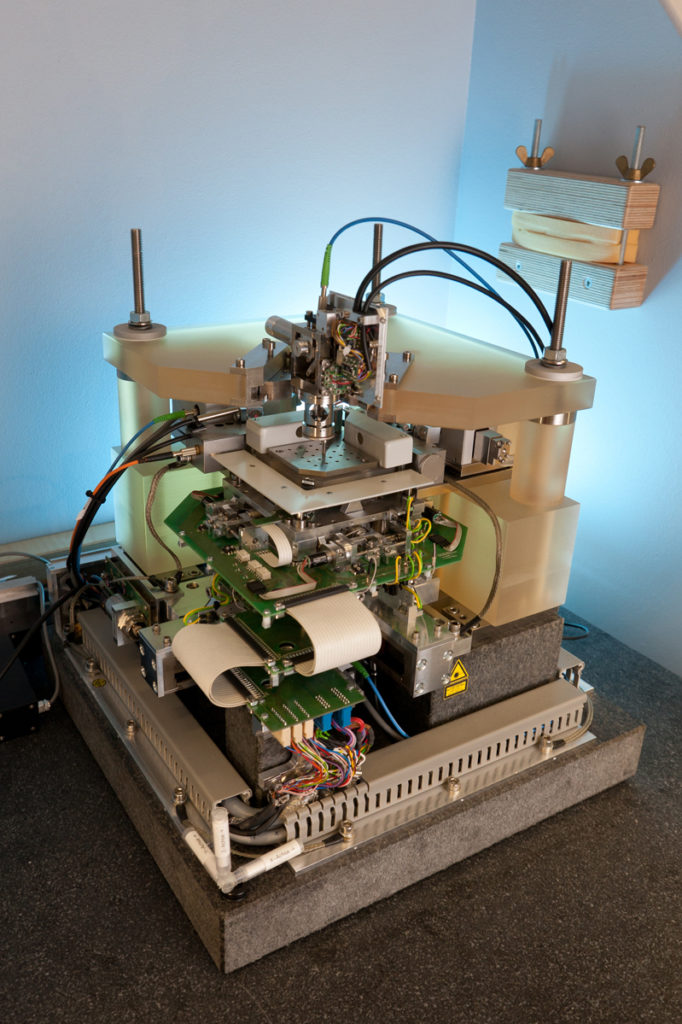
DFG Gerätegruppenschlüssel: 8700 Mechanisch abtastende Längen- und Dickenmeßgeräte, Meßmaschinen
Description
Das Oberflächen- und Koordinatenmesssystem NMM-1 hat einen Messbereich
von 25 mm x 25 mm x 5 mm und eine Auflösung von kleiner 0,1 nm. Dieses
Gerät dient zur Präzisionsmessung von Mikro- und Nanostrukturen,
insbesondere in der Mikro- und Optoelektronik. Das Messobjekt wird auf
eine Spiegelrecke mit verspiegelten Außenflächen, die als Messspiegel
dreier Laserinterferometer dienen, gebracht. Dieser Aufbau realisiert
das Abbe’sche Komparatorprinzip in allen drei Messachsen und ermöglich
somit hochgenaue Messungen. Durch Nutzung des Antastsensors als
Nullindikator wird der Messbereich des Sensors auf den
Positionierbereich des Geräts ausgeweitet.Das System kann mit
verschiedenen Antastsytemen ausgestattet und genutzt werden. Es stehen
ein Fix-Fokussensor, ein Weißlichtinterferometer sowie taktile und
elektrische 3-D-Mikrotaster als Antastsensoren zur Verfügung. Es wird
zusätzlich an weiteren Sensoren (Konfokalsensor, AFM-Sensoren)
gearbeitet, welche die Nutzungs- und Messmöglichkeiten erweitern sollen.
Messbereich: 25 mm x 25 mm x 5 mm
Auflösung: < 0,1 nm
Involved Person(s)
Organisation(s)
Research Areas
Debug: Alles
name_de: Nanomess- und Positioniermaschine SIOS NMM-1
name_en: Nanomess- und positioniermaschine SIOS NMM-1
model: Nanomessmaschine NMM-1
url:
manufacturer: SIOS
year: 2001
location: 202160667
location_de: Erlangen
location_en: Erlangen
usage: 21196
usage_de: Nur organisationsintern
usage_en: Internal only
description_de:
Das Oberflächen- und Koordinatenmesssystem NMM-1 hat einen Messbereich von 25 mm x 25 mm x 5 mm und eine Auflösung von kleiner 0,1 nm. Dieses Gerät dient zur Präzisionsmessung von Mikro- und Nanostrukturen, insbesondere in der Mikro- und Optoelektronik. Das Messobjekt wird auf eine Spiegelrecke mit verspiegelten Außenflächen, die als Messspiegel dreier Laserinterferometer dienen, gebracht. Dieser Aufbau realisiert das Abbe’sche Komparatorprinzip in allen drei Messachsen und ermöglich somit hochgenaue Messungen. Durch Nutzung des Antastsensors als Nullindikator wird der Messbereich des Sensors auf den Positionierbereich des Geräts ausgeweitet.Das System kann mit verschiedenen Antastsytemen ausgestattet und genutzt werden. Es stehen ein Fix-Fokussensor, ein Weißlichtinterferometer sowie taktile und elektrische 3-D-Mikrotaster als Antastsensoren zur Verfügung. Es wird zusätzlich an weiteren Sensoren (Konfokalsensor, AFM-Sensoren) gearbeitet, welche die Nutzungs- und Messmöglichkeiten erweitern sollen.
Messbereich: 25 mm x 25 mm x 5 mm
Auflösung: < 0,1 nm

Das Oberflächen- und Koordinatenmesssystem NMM-1 hat einen Messbereich von 25 mm x 25 mm x 5 mm und eine Auflösung von kleiner 0,1 nm. Dieses Gerät dient zur Präzisionsmessung von Mikro- und Nanostrukturen, insbesondere in der Mikro- und Optoelektronik. Das Messobjekt wird auf eine Spiegelrecke mit verspiegelten Außenflächen, die als Messspiegel dreier Laserinterferometer dienen, gebracht. Dieser Aufbau realisiert das Abbe’sche Komparatorprinzip in allen drei Messachsen und ermöglich somit hochgenaue Messungen. Durch Nutzung des Antastsensors als Nullindikator wird der Messbereich des Sensors auf den Positionierbereich des Geräts ausgeweitet.Das System kann mit verschiedenen Antastsytemen ausgestattet und genutzt werden. Es stehen ein Fix-Fokussensor, ein Weißlichtinterferometer sowie taktile und elektrische 3-D-Mikrotaster als Antastsensoren zur Verfügung. Es wird zusätzlich an weiteren Sensoren (Konfokalsensor, AFM-Sensoren) gearbeitet, welche die Nutzungs- und Messmöglichkeiten erweitern sollen.
Messbereich: 25 mm x 25 mm x 5 mm
Auflösung: < 0,1 nm
description_en:
feature_de:
feature_en:
pictures: <QuerySet [<Picture: 228733285>]>
cards: <QuerySet [<Card: Card of Tino, Hausotte: (True)>, <Card: Card of Ulrich, Grömme: (True)>]>
funding_sources: <QuerySet []>
projects: <QuerySet [<Project: Rückführbarer taktiler, aktiver, kraft- und momentmessender Koordinatenmesssystem-Messkopf (TracForceProbe), TracForceProbe, , , <p>The planned project involves the conception and design, the realisation and verification of a novel tactile, active, force and torque measuring coordinate measuring system-measuring head as well as accompanying fundamental investigations including the traceability of the measurement of the probing force and deflection of the stylus. The innovations of measuring head are the omission of elastic spring systems and the levitation of the probe, the probing force generation completely with Lorentz forces, the in situ force calibration according to the Kibble principle as well as the special arrangement of the actuators as parallel kinematics and of the position sensors as parallel metrology. In addition to the position and force measurement, the additional measurement of the orientation and occurring torques at the stylus changing plate should enable the investigation of new correction approaches to reduce the measurement uncertainty for measurements with projecting and long styli. The shortened traceability of the force and torque measurement and the intended low measurement uncertainty of the probing force should allow to vary the probing force over several orders of magnitude in a targeted way with new probing strategies to be developed. On the one hand, this should enable a significant reduction of the minimum probing sphere diameter and accurate measurements of objects made of aluminium or plastic as well as with sensitive surfaces in conventional coordinate measuring machines on the other hand. The generation and traceable measurement of probing forces up to 2 N with uncertainties of 20 micro N + measured value·0.0001 as well as the calibration of the probing forces without additional, external force calibration devices shall be made possible. The changing plate with stylus is to be coupled to a levitating flotor (derived from fly and rotor) and its position and orientation controlled using the signals from three 2D optoelectronic position sensors to be researched as parallel metrology and at least six voice coil actuators as parallel kinematics. The actuators serve both to maintain the levitation state of the flotor and to measure the forces and torques acting on the stylus and the levitating flotor, which occur in case of a probing or scanning on a measuring object surface. The primary measurement of the probing force according to the Kibble principle enables traceability to fundamental constants in accordance to the new SI system of units, valid since May 2019. The traceability of the measurement of the position and orientation shall be done via the primary laser interferometric length measurement of the coordinate measuring system used for the investigations and displacement calibration. Special challenges are posed to the measurement data acquisition and controller concept in order to keep the flotor in equilibrium of forces and torques, even during probing, and to be able to perform open-loop, closed-loop and free-form scans. </p>, , 2024-01-01, 2026-12-31, , 2026-12-31, Third party funded individual grant, True>, <Project: Traceable industrial 3D roughness and dimensional measurement using optical 3D microscopy and optical distance sensors (TracOptic), TracOptic, https://www.ptb.de/empir2021/tracoptic/home/, Traceable industrial 3D roughness and dimensional measurement using optical 3D microscopy and optical distance sensors, <p></p><p>To remain competitive European manufacturers strive to make constant improvements in their manufacturing processes. The surface topography of a component part can have a profound effect on the function of the part. This is true across a wide range of industries (such as precision engineering, automotive and medical). It is estimated that surface effects cause 10 % of manufactured parts to fail which has financial implications. Optical measuring systems are widespread in surface and coordinate metrology as they are fast, with high resolution, and contactless (aspects that are essential for the factory of the future). Unfortunately, optical measurements are not often used in industry as they are not traceable. This is due to the complexity of the interaction between the object’s surface and measuring system. This project aims to improve the traceability of 3D roughness and dimensional measurements using optical 3D microscopy and optical distance sensors. Data evaluation, and uncertainty estimation methods will be developed, and be made accessible to industry by good practice guides, publications, training courses etc.</p><p></p>, , 2021-06-01, 2024-05-31, , 2024-05-31, Third Party Funds Group - Sub project, True>, <Project: Geometric measuring and testing technologies for Additive Manufacturing (C4) (SFB 814 (C4)), SFB 814 (C4), https://www.crc814.research.fau.eu/projekte/c-bauteile/teilprojekt-c4/, CRC 814 - Additive Manufacturing (SFB 814), <p>The aim of this project is to achieve the metrological traceability of geometric pore measurements with computed tomography (CT) to increase the relevance of CT for nondestructive testing with regard to process failures. While in a first step this will be achieved for transparent measurement standards using high-resolution optical tomography, the transferability to additively manufactured parts will be ensured by experimental and simulation based investigations. In this way, concrete statements regarding measurement uncertainties are enabled.</p>, <p>The aim of this project is to achieve the metrological traceability of geometric pore measurements with computed tomography (CT) to increase the relevance of CT for nondestructive testing with regard to process failures. While in a first step this will be achieved for transparent measurement standards using high-resolution optical tomography, the transferability to additively manufactured parts will be ensured by experimental and simulation based investigations. In this way, concrete statements regarding measurement uncertainties are enabled.</p> <br />, 2011-07-01, 2023-06-30, , 2023-06-30, Third Party Funds Group - Sub project, True>, <Project: Metrology and measurement data evaluation for the geometrical product verification within a holistic tolerance management (FORTol), FORTol, , FOR 2271: Prozessorientiertes Toleranzmanagement mit virtuellen Absicherungsmethoden (FORTol), The research group FOR 2271 is investigating from a fundamental research point of view, how a holistic approach and efficient tools for the management of geometric deviations during product development needs to be designed. The findings are verified using a model factory. The subproject 3 participates in the research group by the determination the form deviations and the associated measurement uncertainty as well as the usage of this information within a function-oriented tolerance specification. During the first funding phase, the subproject aimed at developing suitable approaches to provide the associated single point uncertainties (SPU) for given measurement data, using various tactile, optical and tomographic measurement methods. Based on these findings, methods for the description and correction of the systematic form deviations were developed. Furthermore, fusion and regression algorithms considering the SPU as weighting factors were designed. These contributions combined with the provision of the SPU of the deviation representation and the supply of the uncertainty of single features as well as the metrological set-up for validating the demonstrator complement the input of the subproject towards the research group.Based on the knowledge gained during the first funding phase, necessary data processing operations along the measurement chain will be optimized during the second funding phase with the aim of reducing the measurement uncertainty associated with every measurement during the determination of the form deviations of tolerated work pieces. Here, algorithms that are more complex will be used to generate an exploitable information yield, while the substantially increased resulting computational demand will be compensated by the consequent implementation of GPGPU-programing techniques. A reduction of the measurement uncertainty of the geometric characterisation usually enables the possibility of defining smaller tolerances. The planned project also includes metrological examinations of tooth flanks topography measurements of the influence of the expected wear and tear onto the tolerance specification. Additionally, approaches aimed at optimising the algorithms used for the weighted geometric registration of measurement data against nominal and reference data will be examined. Thus, the influence of the registration routine on the data processing and consequently the local measurement uncertainty of tolerated geometry elements will be characterised and reduced. Within a collective effort with the project collaborates, the transferability of the determination of the SPU of geometry elements onto edge regions will be examined in order to assess the influence of the hereby occurring measurement uncertainty on the associated tolerance specification. The cooperation will be complemented by the standardised geometrical characterisation of the mechanical components of the X-ray aperture test stand. <br />, In der zweiten Förderperiode sollen aufbauend auf den bisherigen Ergebnissen weitere Erkenntnisse erzielt werden, um die mit einer Messung assoziierte Messunsicherheit, mit der die Gestaltabweichungen von tolerierten Bauteilen ermittelt werden, durch Optimierung notwendiger Datenverarbeitungsoperationen entlang der Messkette zu reduzieren. Dabei soll durch komplexere Algorithmen ein nutzbarer Informationsgewinn generiert werden, wobei der daraus resultierende deutlich gesteigerte Berechnungsaufwand durch konsequente Anwendung von GPGPU-Programmiertechniken<br />kompensiert werden soll. Die Reduzierung der Messunsicherheit der geometrischen Charakterisierung bewirkt im Allgemeinen direkt die Möglichkeit zur Vergabe von engeren Toleranzen, da die Messunsicherheit die kleinstmögliche Toleranz durch die Formulierung der „Goldenen Regel“ der Messtechnik direkt beeinflusst. Letzteres stellt eine wichtige Voraussetzung für die Realisierung von hochfunktionalen, mechanischen und optischen Komponenten<br />dar. Durch die genauere Bestimmung der lokalen Messunsicherheit und der systematischen Gestaltabweichungen im Rahmen der Zusammenarbeit mit Fertigern und Konstrukteuren wird a priori eine ökonomisch optimierte Toleranzvergabe bereits während der Entwurfsphase des Bauteils ermöglicht, wodurch der Aufwand für nachträgliche Änderungen minimiert wird. Die wissenschaftlichen Teilziele des Teilprojekts sind:<br />• Bereitstellung einer Methodik zur optischen Bestimmung der Zahnflankentopografie, um Verschleißvolumen und Oberflächentextur inkl. der auftretenden Messunsicherheiten als Eingangsparameter für eine angepasste Toleranzsimulation zur Verfügung zu stellen.<br />• Berücksichtigung von verschiedenen Definitionen von Werkstückkanten bei der Bestimmung der EPU, um die GPS-Operatoren „Zerlegung“ und „Assoziation“ für die Auswertung von funktionskritischen Bauteiloberflächen zu verbessern.<br />• Optimierung von Algorithmen zur geometrischen Registrierung von gemessenen Oberflächen an Nominal- / Referenzdaten mit Hilfe geeigneten Gewichtungsfaktoren aus entwickelten geometrischen Ähnlichkeitsparametern von Polygonnetzen und lokalen Qualitätskennwerten aus CT-Messungen, um den Fehlereinfluss der Registrierung auf die Datenauswertung zu charakterisieren und zu reduzieren.<br /><br /><br />, 2020-04-01, 2023-04-01, , 2023-04-01, Third Party Funds Group - Sub project, True>, <Project: Strategies for function-oriented optical inspection of formed precision components (A06) (TR 73 - A06), TR 73 - A06, https://www.tr-73.de/, TRR 73: Manufacturing of complex functional components with variants by using a new sheet metal forming process - Sheet-Bulk Metal Forming, <p> Sheet-bulk metal forming parts require proper inspection systems and strategies cause of their high demands on measurement accuracy and time. Basic principles of inspection techniques and strategies were the main research interests in the first phase. Their further development towards a production-related inspection process, which requires no user, is done in the second phase. Therefore the hardware as well as the software of the multi-scale multi-component fringe projection system has to be adapted to autonomous operations, just as appropriate interfaces for the integration of other measurement systems has to be created.</p>, <p> </p> <p>Mit der Blechmassivumformung wird ein neues Fertigungsverfahren bereitgestellt, welches im Vergleich zur spanenden Fertigung die Herstellung von Präzisionsbauteilen in einer wesentlich kürzeren Taktzeit und mit geringerem Ressourcenbedarf ermöglicht. Zusätzlich sind die Fertigung komplexerer Bauteile und damit die Integration filigraner, funktionstragender Geometrieelemente erreichbar. Da einerseits eine hohe Genauigkeit – vergleichbar mit spanend gefertigten Präzisionsteilen – gefordert ist, andererseits aufgrund der hohen Integrationsdichte mehr Geometrieelemente in kürzerer Zeit zu prüfen sind als bei konventioneller Fertigung, steigen die Anforderungen an eine taktzeitgerechte Prüfung.</p>, 2009-01-01, 2012-12-31, 2020-12-31, 2020-12-31, Third Party Funds Group - Sub project, True>, <Project: Focus distance modulated fibre-coupled confocal sensor for surface metrology (MoKoSens), MoKoSens, , , <div>Miniaturization and micro-structuring of complex components and accordingly even closer manufacturing tolerances put new challenges on dimensional metrology. Using special micro or nano coordinate measuring systems, it is already possible to realize highly accurate, three-dimensional relative motions between sensor and measuring object in range of a few millimetres and with resolutions in the nanometre or sub-nanometre range. However, there is still demand for high-precision sensors for probing of the measuring objects which are suitable for these challenging measuring tasks. The goal of this research project consists of investigations on the fundamentals, the development and evaluation of a robust, precise, high frequency focus distance modulated confocal point sensor and the integration and validation of this sensor into a nano coordinate measuring system. To achieve this, while maintaining the known advantages of the confocal measurement principle, an innovative combination of a fibre-coupled confocal illumination and detection, a tuneable, acoustically driven gradient-index fluid lens (TAG lens) for modulation of the focus distance and a novel signal processing, applying a lock-in amplifier, shall be used for the stage-scanning mode in a nano coordinate measuring system to significantly increase the accuracy and to reduce the measurement uncertainty and the measurement time. </div>, , 2016-05-01, 2019-04-30, 2019-11-30, 2019-11-30, Third party funded individual grant, True>, <Project: Traceable three-dimensional nanometrology (3DNano), 3DNano, https://www.ptb.de/emrp/15sib09-home.html, Traceable three-dimensional nanometrology, <p> The overall goal of this project is to meet current and future requirements for traceable 3 dimensional (3D) metrology at the nanometre level with measurement uncertainties below 1 nm. To achieve this requires new routes for traceability, further developments of existing instruments and validated 3D measurement procedures. Additionally, new calibration artefacts must be developed and made available to industry as traceable reference standards to enable valid comparison of fabrication and measurement results, and establish a robust basis for design of objects with traceable nanoscale dimensions and tolerances.<br /> Scanning Probe Microscopes (SPMs) available in national metrology institutes (NMIs) have low uncertainties, are traceable to the SI-metre and significantly outperform commercial SPMs in accuracy. However, there is a large gap between SPMs and the rest of 3D metrology. Conventional 3D metrology is based on coordinate measuring machines (CMMs) that have been significantly improved in recent decades e.g. micro CMMs, therefore they can reach almost nanometre level uncertainties. SPM technology has the potential to offer even lower uncertainties. However, the measuring principle, measurand definitions and current written standards are still very far from what could be used for 3D measurements, which explains the use of the term 2.5D for SPM techniques. The aim of the project is to further develop SPM instrumentation, measurement procedures, data interpretation and reference materials to bridge this gap, as proper understanding of probe-sample interactions is crucial for the reduction of measurement uncertainty.</p>, <p> The overall goal of this project is to meet current and future requirements for traceable 3 dimensional (3D) metrology at the nanometre level with measurement uncertainties below 1 nm. To achieve this requires new routes for traceability, further developments of existing instruments and validated 3D measurement procedures. Additionally, new calibration artefacts must be developed and made available to industry as traceable reference standards to enable valid comparison of fabrication and measurement results, and establish a robust basis for design of objects with traceable nanoscale dimensions and tolerances.<br /> Scanning Probe Microscopes (SPMs) available in national metrology institutes (NMIs) have low uncertainties, are traceable to the SI-metre and significantly outperform commercial SPMs in accuracy. However, there is a large gap between SPMs and the rest of 3D metrology. Conventional 3D metrology is based on coordinate measuring machines (CMMs) that have been significantly improved in recent decades e.g. micro CMMs, therefore they can reach almost nanometre level uncertainties. SPM technology has the potential to offer even lower uncertainties. However, the measuring principle, measurand definitions and current written standards are still very far from what could be used for 3D measurements, which explains the use of the term 2.5D for SPM techniques. The aim of the project is to further develop SPM instrumentation, measurement procedures, data interpretation and reference materials to bridge this gap, as proper understanding of probe-sample interactions is crucial for the reduction of measurement uncertainty.</p>, 2016-10-01, 2019-09-30, , 2019-09-30, Third Party Funds Group - Sub project, True>, <Project: Dreidimensionale elektrische Antastung für die Mikro- und Nanokoordinatenmesstechnik - 3-D-Tunnelstromtaster (3-D-Tunnelstromtaster), 3-D-Tunnelstromtaster, , , <p> Die messtechnische Erfassung von Bauteilen der Mikrosystemtechnik und Komponenten mit Mikrostrukturen erfordert Nanometer-aufgelöste 3-D-fähige Messverfahren. Optische Systeme zeigen beugungsbedingt und bei hohen Aspektverhältnissen Einschränkungen. Mikrotaktile Verfahren weisen Defizite bei Auflösung, Messgeschwindigkeit und Tastersteifigkeit auf. Ziel des Forschungsvorhabens ist ein universell einsetzbares, aktives Messsystem mit 3-D-richtungssensitivem und berührungsfreiem Antastverhalten bei Subnanometer-Auflösung, welches mit elektrischer Wechselwirkung im Nahfeldbereich arbeitet. Die Bestimmung des 3-D-Antastvektors ist für Freiformscans und eine aktive Sensornachführung erforderlich und soll mittels mechanischer Modulation erfolgen. Die aktive Sensornachführung dient zur Steigerung der Systemdynamik. Das fundierte Verständnis der Wechselwirkung und der erfassten elektrischen Oberfläche soll durch mathematisch-physikalische Modellierung und über eine simulationsgestützte experimentelle Systemanalyse erlangt werden. Eine antastrichtungsabhängige Formabweichungskorrektur der sphärischen Sonden soll zur Erhöhung der Genauigkeit bei den miniaturisierten Sonden dienen. Modellunterstützt erfolgen eine messtechnische Charakterisierung und eine Unsicherheitsermittlung. Experimentelle Vergleiche mit anderen Antastverfahren der Mikro- und Nanomesstechnik an Demonstratorbauteilen sollen die erzielten Ergebnisse verifizieren.</p>, , 2013-01-01, 2017-03-01, , 2017-03-01, Third party funded individual grant, True>, <Project: Multi-sensor metrology for microparts in innovative industrial products (Microparts), Microparts, https://www.ptb.de/emrp/microparts-home.html, Multi-sensor metrology for microparts in innovative industrial products, <p> The overall goal of the Joint Research Project is a significant improvement of state-of-the-art measurement capabilities of multi-sensor coordinate measuring machines (CMMs) for microparts used, e.g. in automotive, medical and optical applications. The project will address the specific problems related to dimensional measurements of small complex features at high accuracy and all forms of sensors used for the measurement of microparts will be included. These specific problems have a strong influence on measurement uncertainties. The project will also address the issue of traceability, comparability, handling and fusion of measurement data from multiple sensors, which are important issues for the industrial application of multi-sensor coordinate metrology.</p>, , 2013-09-01, 2016-05-31, , 2016-05-31, Third Party Funds Group - Sub project, True>, <Project: Metrology to assess the durability and function of engineered surfaces (MADES), MADES, , Metrology to assess the durability and function of engineered surfaces, <p> MADES aims to develop a holistic, model-driven approach to improve the current practice in the development of embedded systems. The proposed approach covers all phases, from design to code generation and deployment. Design activities will exploit a dedicated language developed as an extension to OMG's MARTE Profile intended to eventually become industry standards, and will foster the reuse of components proposing special means on components sharing including associated models, properties and constraints in order to enforce overall consistency when building a new system. Validation activities play a key role and will include the verification of key properties on designed artefacts, closed-loop simulation based on detailed models of the environment, and the verification of designed transformations. Code generation addresses both hardware description languages and conventional programming languages with features for compile-time virtualisation of common hardware architecture features, including accelerators, memory, multiprocessor and inter-processor communication channels, to cope with the fact that hardware platforms are getting more and more complex. Expected Impact MADES technologies are expected to reduce development costs of complex embedded systems for the Aerospace, Defence and other key European industries, while enabling a next generation of highly complex embedded systems to be developed that are more reliable, yet costing less to maintain and evolve as industry needs change and hardware capabilities increase. New market opportunities for European industries, including SME size technology companies, will appear as companies relying on design and integration of embedded systems in their products are more competitive in global markets through lower costs and improved abilities to deliver new or enhanced products faster to market.</p>, , 2011-08-01, 2014-07-31, , 2014-07-31, Third Party Funds Group - Sub project, True>]>
publications: <QuerySet [<Publication: Effect of a Misidentified Centre of a Type ASG Material Measure on the Determined Topographic Spatial Resolution of an Optical Point Sensor>, <Publication: Atomic Force Microscope with an Adjustable Probe Direction and Integrated Sensing and Actuation>, <Publication: Redesigned Sensor Holder for an Atomic Force Microscope with an Adjustable Probe Direction>, <Publication: A metrological atomic force microscope system>, <Publication: Investigations on the measurement precision of an atomic force microscope with an adjustable probe direction>, <Publication: Stitched open-loop measurements with a focal-distance-modulated confocal sensor>, <Publication: Bidirectional confocal measurement of a microsphere>, <Publication: Investigation of a metrological atomic force microscope system with a combined cantilever position, bending and torsion detection system>, <Publication: Measurement of the Beruforge 152DL thin-film lubricant using a developed thin-film thickness standard>, <Publication: Large range closed-loop scans with a focal-distance-modulated confocal sensor>, <Publication: Atomic force microscope with an adjustable probe direction and piezoresistive cantilevers operated in tapping-mode>, <Publication: Evaluation und Korrektur thermischer Driften eines hochfrequent fokusabstandsmodulierten, fasergekoppelten konfokalen Punktsensors>, <Publication: Bestimmung des Brechungsindex des Schmiermittels Beruforge 152DL unter Verwendung eines dafür entwickelten Dünnschichtnormals>, <Publication: Evaluation und Justierung eines neuartigen, hochfrequent fokusabstandsmodulierten, fasergekoppelten, konfokalen Punktsensors für axial geregelte Oberflächenmessungen mit einem Nanokoordinatenmessgerät>, <Publication: Evaluation of the optical performance of a novel high-speed focal-distance-modulated fibre-coupled confocal sensor>, <Publication: Kontinuierliche laterale Abtastung von Oberflächen durch axiale Regelung des Arbeitsabstandes in einem Nanokoordinatenmessgerät mit einem hochfrequent fokusabstandsmodulierten, fasergekoppelten, konfokalen Punktsensor>, <Publication: High-speed focal-distance-modulated fiber-coupled confocal sensor for coordinate measuring systems>]>
fobes: <QuerySet [<ResearchArea: Research Area: Title: | Koordinaten- und Oberflächenmesstechnik, Description: | <p>Koordinaten- und Oberflächenmesstechnik in diversen Forschungsprojekten und mit taktiler, optischer und elektrischer Sensorik sowie Rasterkraftsensorik und diversen Messsystemen.<br /></p>, Classification: Field of Research | Forschungsbereich >]>
orgas: <QuerySet [<Organisation: Lehrstuhl für Fertigungsmesstechnik (FMT), <p>Am Lehrstuhl für Fertigungsmesstechnik erforschen, verbessern und validieren wir neue Prinzipien, Methoden, Verfahren, Mittel, Geräte und Systeme, welche im industriellen Entstehungsprozess von Produkten zur Qualitätssicherung erforderlich sind. Mit unseren Forschungs- und Lehraktivitäten schaffen wir die Grundlagen für innovative Messverfahren für die Qualitätssicherung.</p>, Erlangen, 91052, Nägelsbachstraße, 2999-12-31, Department Maschinenbau, True>]>
dfg_keys: <QuerySet [<DFGKey: 8700 Mechanisch abtastende Längen- und Dickenmeßgeräte, Meßmaschinen>]>