
FEI Titan Themis 300 (FEI)
Model: Titan Themis 300
Manufacturer: FEI (2014)
URL: https://www.em.tf.fau.de/research/equipment/fei-titan-themis-300/
Location: Erlangen
Usage: For external users too
Pictures
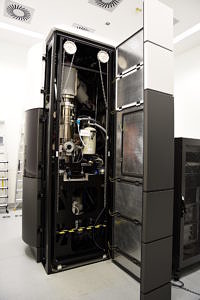
DFG Gerätegruppenschlüssel: 5100 Elektronenmikroskope (Transmission)
Feature(s)
- Emitter X-FEG
- High tension: 60-300 kV
- Monochromator, energy resolution 0.2 eV
- Cs probe corrector (CEOS, DCOR)
- Image-side Cs corrector (CEOS, CESCOR)
- Gatan imaging filter (GIF Quantum)
- HAADF detector for Z-contrast (Fishione)
- ADF/ABF/BF detectors (FEI)
- Videocamera (Flucam)
- 4k CMOS camera (Ceta 16M)
- High-efficiency Super-X detector (EDX)
- Tomography sample holder and software
- Special TEM holders
Description
The Titan Themis3 300 is our
high-end TEM providing high-resolution imaging as well as high
performance analytical investigation capabilities. This
double-aberration-corrected TEM corrects both the image and the probe
forming system enabling high-resolution imaging in TEM as well as
scanning TEM (STEM) mode resulting in resolution limits below 1 Å for
both modes for all high tensions between 60 kV and 300 kV. The high
brightness electron gun (X-FEG) equipped with a monochromator to improve
the energy resolution in combination with a high-sensitivity SDD X-ray
spectrometer (Super-X) and a high-resolution post-column energy filter
(GIF Quantum) creates a high performance analytical instrument perfectly
suited for the nanoanalytical characterization of all kinds of
materials and devices. Energy filtered TEM (EFTEM) imaging,
high-resolution electron energy-loss spectroscopy (EELS) as well as
energy-dispersive X-ray spectroscopy (EDXS) yield chemical, elemental as
well as bonding information even down to the atomic scale. Additionally
information about local band gaps and plasmonics are gained by
monochromated low-loss EELS investigations. Furthermore the Titan Themis3
300 is used to perform advanced in situ experiments using special TEM
specimen holders. A further advanced method available at the Titan
Themis3 300 is electron tomography enabling the analytical
characterization of materials and devices in 3 dimensions. This high-end
analytical TEM is used to answer the most complex questions regarding
materials science.
Involved Person(s)
Johannes Will
Contact person
Mingjian Wu
Contact person
Stefanie Rechberger
Responsible and Contact person
Erdmann Spiecker
Responsible person
Benjamin Apeleo Zubiri
Contact person
Organisation(s)
Research Areas
Funding Sources
Debug: Alles
name_de: FEI Titan Themis 300
name_en: FEI Titan Themis 300
model: Titan Themis 300
url: https://www.em.tf.fau.de/research/equipment/fei-titan-themis-300/
manufacturer: FEI
year: 2014
location: 202160667
location_de: Erlangen
location_en: Erlangen
usage: 21198
usage_de: Auch für externe Nutzer
usage_en: For external users too
description_de: The Titan Themis3 300 is our high-end TEM providing high-resolution imaging as well as high performance analytical investigation capabilities. This double-aberration-corrected TEM corrects both the image and the probe forming system enabling high-resolution imaging in TEM as well as scanning TEM (STEM) mode resulting in resolution limits below 1 Å for both modes for all high tensions between 60 kV and 300 kV. The high brightness electron gun (X-FEG) equipped with a monochromator to improve the energy resolution in combination with a high-sensitivity SDD X-ray spectrometer (Super-X) and a high-resolution post-column energy filter (GIF Quantum) creates a high performance analytical instrument perfectly suited for the nanoanalytical characterization of all kinds of materials and devices. Energy filtered TEM (EFTEM) imaging, high-resolution electron energy-loss spectroscopy (EELS) as well as energy-dispersive X-ray spectroscopy (EDXS) yield chemical, elemental as well as bonding information even down to the atomic scale. Additionally information about local band gaps and plasmonics are gained by monochromated low-loss EELS investigations. Furthermore the Titan Themis3 300 is used to perform advanced in situ experiments using special TEM specimen holders. A further advanced method available at the Titan Themis3 300 is electron tomography enabling the analytical characterization of materials and devices in 3 dimensions. This high-end analytical TEM is used to answer the most complex questions regarding materials science.
description_en: The Titan Themis<sup>3</sup> 300 is our
high-end TEM providing high-resolution imaging as well as high
performance analytical investigation capabilities. This
double-aberration-corrected TEM corrects both the image and the probe
forming system enabling high-resolution imaging in TEM as well as
scanning TEM (STEM) mode resulting in resolution limits below 1 Å for
both modes for all high tensions between 60 kV and 300 kV. The high
brightness electron gun (X-FEG) equipped with a monochromator to improve
the energy resolution in combination with a high-sensitivity SDD X-ray
spectrometer (Super-X) and a high-resolution post-column energy filter
(GIF Quantum) creates a high performance analytical instrument perfectly
suited for the nanoanalytical characterization of all kinds of
materials and devices. Energy filtered TEM (EFTEM) imaging,
high-resolution electron energy-loss spectroscopy (EELS) as well as
energy-dispersive X-ray spectroscopy (EDXS) yield chemical, elemental as
well as bonding information even down to the atomic scale. Additionally
information about local band gaps and plasmonics are gained by
monochromated low-loss EELS investigations. Furthermore the Titan Themis<sup>3</sup>
300 is used to perform advanced in situ experiments using special TEM
specimen holders. A further advanced method available at the Titan
Themis<sup>3</sup> 300 is electron tomography enabling the analytical
characterization of materials and devices in 3 dimensions. This high-end
analytical TEM is used to answer the most complex questions regarding
materials science.
feature_de: - Emitter X-FEG
- High tension: 60-300 kV
- Monochromator, energy resolution 0.2 eV
- Cs probe corrector (CEOS, DCOR)
- Image-side Cs corrector (CEOS, CESCOR)
- Gatan imaging filter (GIF Quantum)
- HAADF detector for Z-contrast (Fishione)
- ADF/ABF/BF detectors (FEI)
- Videocamera (Flucam)
- 4k CMOS camera (Ceta 16M)
- High-efficiency Super-X detector (EDX)
- Tomography sample holder and software
- Special TEM holders
feature_en: <ul><li>Emitter X-FEG</li><li>High tension: 60-300 kV</li><li>Monochromator, energy resolution 0.2 eV</li><li>Cs probe corrector (CEOS, DCOR)</li><li>Image-side Cs corrector (CEOS, CESCOR)</li><li>Gatan imaging filter (GIF Quantum)</li><li>HAADF detector for Z-contrast (Fishione)</li><li>ADF/ABF/BF detectors (FEI)</li><li>Videocamera (Flucam)</li><li>4k CMOS camera (Ceta 16M)</li><li>High-efficiency Super-X detector (EDX)</li><li>Tomography sample holder and software</li><li>Special TEM holders</li></ul>
pictures: <QuerySet [<Picture: 222897915>]>
cards: <QuerySet [<Card: Card of Johannes, Will: (True)>, <Card: Card of Mingjian, Wu: (True)>, <Card: Card of Stefanie, Rechberger: (True)>, <Card: Card of Erdmann, Spiecker: (True)>, <Card: Card of Benjamin, Apeleo Zubiri: (True)>]>
funding_sources: <QuerySet [<FundingSource: FundingSource: cris_id: 139454987, name: DFG / Exzellenzcluster (EXC), abbreviation: EXC>]>
projects: <QuerySet [<Project: Center for Nanoanalysis and Electron Microscopy (CENEM), CENEM, , , <div>The Center for Nanoanalysis and
Electron Microscopy (CENEM) is a facility featuring cutting-edge
instrumentation, techniques and expertise required for microscopic and
analytical characterization of materials and devices down to the atomic
scale. CENEM focuses on several complementary analysis techniques, which
closely work together: Electron Microscopy, X-ray Microscopy, Cryo-TEM,
Scattering Methods, Scanning Probes and Atom Probe Microscopy. With the
combination of these methods new materials, particles, structures and
devices are characterized not only microscopically and analytically on
all length scales even down to the atomic scale but also by various in
situ investigations and 3D methods. The knowledge gained through the
versatile characterization methods is then used to further develop and
improve materials and devices.</div>
<p>
</p><div>CENEM was established in 2010 to
provide a forefront research center for the versatile characterization
of materials and devices with state-of-the-art instrumentation and
expertise and to intensify the interdisciplinary research. The big CENEM
network represents the strong collaborations within the University of
Erlangen-Nürnberg as well as the collaboration with other universities,
dedicated research institutes and industry.</div>
<p>
</p><p>The support of the core facility CENEM by the German Science
Foundation (DFG) and the Cluster of Excellence EXC 315 “Engineering of
Advanced Materials” is gratefully acknowledged.</p>, , 2010-01-01, 2038-03-03, , 2038-03-03, FAU own research funding: EFI / IZKF / EAM ..., True>, <Project: 3D-deformation behavior of nanoporous metals and nanocomposites (GRK1896-B4), GRK1896-B4, , In-situ Characterization of Nanomaterials with Electrons, X-rays/Neutrons and Scanning Probes (GRK 1896), <p>Project B4 will be realigned during the second funding phase to
introduce the possibilities of the high-resolution X-ray microscope and
to use it for a cross-scale investigation of mechanical size effects.
The project focuses on the new X-ray microscope Zeiss Xradia Ultra 810,
which complements the already established tomography techniques in CENEM
(360 ° ET, 3D-FIB, APT) across scales. The device currently has the
highest spatial resolution of a laboratory device (<50 nm) and is
equipped with a micromechanical in situ loading unit. This allows
correlated mechanical and structural 3D analyzes, which are established
in cooperation with Project Z. D The 3D data obtained from X-ray
tomography are used to elucidate the deformation behavior for
cross-scale correlative simulations (FEM / MD). In addition to the
tomographic examinations, further methods of electron microscopy and
X-ray scattering are used to elucidate the structure. </p>, , 2013-10-01, 2017-09-30, 2022-09-30, 2022-09-30, Third Party Funds Group - Sub project, True>, <Project: Hybride semiconductors – metal nanowire composites for opto-electronic devices (GRK1896-A6), GRK1896-A6, , In-situ Characterization of Nanomaterials with Electrons, X-rays/Neutrons and Scanning Probes (GRK 1896), <p>Project A6 combines the findings from the first funding period, which
investigated the transport properties of metallic nanowires as well as
inorganic nanoparticles as a function of microstructure and
microstructure with c-AFM and electron microscopy methods. The follow-up
project will address the electrical and optical properties of
nanoparticle-filled nanowire composites. The focus of the investigations
is on the microscopic understanding of the charge carrier transport
between the semiconducting matrix and the metallically conductive
nanowires. In situ X-ray spectroscopy under light (c-AFM and STM) should
provide insight into the electrical processes at the interfaces.</p>, , 2013-10-01, 2017-09-30, 2022-09-30, 2022-09-30, Third Party Funds Group - Sub project, True>, <Project: Structural changes in nanoparticles under pressure loading (GRK1896-B2), GRK1896-B2, , In-situ Characterization of Nanomaterials with Electrons, X-rays/Neutrons and Scanning Probes (GRK 1896), <p>The adhesion and friction of particles is of enormous importance in
numerous technological applications. At the same time, the physical
processes of contact between particles and substrates, in particular
in the lower nm range, are often not completely understood. Contact
forces of particles on surfaces and between particles strongly depend on
the local contact geometry, in particular the local roughness. These
nanostructures in the range <100 nm strongly variable in size. They
determine the acting adhesive forces which change as the roughness
changes due to elastic and inelastic deformation. The description of
these deformations, however, is largely incomplete and is therefore
studied in this project.</p>, , 2013-10-01, 2017-09-30, 2022-09-30, 2022-09-30, Third Party Funds Group - Sub project, True>, <Project: Mechanical properties and fracture behavior of thin layers (GRK1896-B3), GRK1896-B3, , In-situ Characterization of Nanomaterials with Electrons, X-rays/Neutrons and Scanning Probes (GRK 1896), <p>The mechanical properties of metals are strongly affected by interfaces.
Within this project area micromechanical testing methods such as micro
tensile testing, bulge testing and nanoindentation are applied to
metallic thin films or micropillars.In situ electron microscopy and
atomic force microscopy are used to analyze the resulting deformation
processes. The goal is to understand how grain boundaries and surfaces
influence the strength and fracture toughness of metals.</p>, , 2013-10-01, 2017-09-30, 2022-09-30, 2022-09-30, Third Party Funds Group - Sub project, True>, <Project: In-situ Characterization of Nanomaterials with Electrons, X-rays/Neutrons and Scanning Probes (GRK 1896), GRK 1896, , , <p>
Research into innovative nanostructured materials is of fundamental importance for Germanys technological competitiveness and in addressing global challenges, like the development of renewable energy sources. Nanostructured materials are controlled by size and interfaces, which give rise to enhanced mechanical properties and new physical effects leading in turn to new functionalities. The design of novel nanostructured materials and devices such as flexible electronics demands state-of-the-art nanocharacterisation tools. In particular, methods based on short-wave radiation (electrons, X-rays/neutrons) or scanning probes are ideally suited to analyse materials at the nanometer and atomic scale. Recently developed in situ capabilities and the use of complementary characterisation methods allow unique insights into the structure formation, functionality and deformation behaviour of complex nanostructures. These new in situ techniques will be the future key tools for the development of new materials and devices. The doctoral programme combines, for the first time, these three pillars of nanocharacterisation into a structured Research Training Group. The main objective of this programme is to provide the next generation of scientists and engineers with comprehensive, method-spanning and interdisciplinary training in the application of cutting-edge nanocharacterisation tools to materials and device development. Within the programme, the in situ methods will be further developed and used to address fundamental questions regarding the growth, stability and functionality of complex nanostructures and interfaces. Project area A "Functional Nanostructures and Networks" will address the properties of individual nano-objects and how these translate into functionality when assembled to nano-networks. In Project area B "Mechanical Properties of Interfaces" various kinds of interfaces with different bonding characteristics and morphologies will be studied in well-defined loading scenarios. This parallel, complementary study of both functional and mechanical materials properties over several length scales by multiple in situ methods is unprecedented. Our PhD candidates will be well-positioned in a network of international collaborations and highly trained in multiple, complementary techniques, providing them with an essential foundation for a successful career in the field of advanced materials and devices development.</p>, , 2013-10-01, 2022-09-30, , 2022-09-30, Third Party Funds Group - Overall project, True>, <Project: Growth and stability of anisotropic nanoparticles in liquids (GRK1896-A2), GRK1896-A2, https://www.grk1896.forschung.fau.de/, In-situ Characterization of Nanomaterials with Electrons, X-rays/Neutrons and Scanning Probes (GRK 1896), <p>
Liquid cell transmission electron microscopy (LCTEM) is a novel, highly attractive method for <em>in situ</em> studies into dynamic processes of nanoparticulate systems in liquid environment excluding influences of drying effects. For this purpose a small volume of the fluid under investigation is confined between two electron transparent membranes to prevent vaporization in the ultra-high vacuum of an electron microscope. In the context of this project innovative liquid cell architectures are developed and fabricated. Furthermore, these liquid cells are applied to elucidate growth and degradation processes of nanomaterials for getting deeper insights into structure formation, stability and the structure-property relationship of various material systems.</p>, , 2013-10-01, 2017-09-30, 2022-09-30, 2022-09-30, Third Party Funds Group - Sub project, True>, <Project: Structure-property relations of individual nanowires (GRK1896-A1), GRK1896-A1, , In-situ Characterization of Nanomaterials with Electrons, X-rays/Neutrons and Scanning Probes (GRK 1896), <p>
Silver nanowire networks are very promising as flexible electrode for organic (opto)electronics. They fulfill the requirement of a low sheet resistance combined with high transmittance and macroscopic bending tests show excellent performance. In order to understand failure mechanisms and prospectively optimize the deformation behavior of AgNW electrodes <em>in situ</em> mechanical testing in the TEM is conducted. <em>In situ</em> tensile tests of single Ag NWs as well as Ag NW networks are conducted in this project in order to perform scale bridging failure analysis</p>, , 2013-10-01, 2017-09-30, 2022-09-30, 2022-09-30, Third Party Funds Group - Sub project, True>, <Project: Growth and characterization of thin single crystalline layers for molecular electronics (GRK1896-A4), GRK1896-A4, https://www.grk1896.forschung.fau.de/teaching/project-areas/project-area-a/a4-geometric-and-electronic-structure-of-metal-organi, In-situ Characterization of Nanomaterials with Electrons, X-rays/Neutrons and Scanning Probes (GRK 1896), <p>
Metal-organic charge-transfer complexes based on TCNQ shows exciting electrical or photochemical switching properties, which involves modification of the valence state of TCNQ (TCNQ-/TCNQ°). We use complementary microspectroscopic tools to investigate in-situ the switching behaviour of individual Ag-TCNQ nanocrystals. Structural probes like Nano-XRD and electron diffraction are considered to offer insight into potential structural modifications upon electrical switching.</p>, , 2013-10-01, 2017-09-30, 2022-09-30, 2022-09-30, Third Party Funds Group - Sub project, True>, <Project: CENEM Core Facility (CENEM), CENEM, , , <p>
Das Erlanger Center for Nanoanalysis and Electron Microscopy (CENEM) bietet komplementäre Ex-pertisen und Großgeräte für die Nanomaterialcharakterisierung und spielt als interdisziplinäre Einrich-tung im Forschungsschwerpunkt Materialien und Prozesse der Universität eine wichtige Rolle. Ge-gründet als Teil des Exzellenzclusters Engineering of Advanced Materials übernimmt es eine zentrale Funktion für die Materialforschung in Erlangen und ist in koordinierte Forschungsprogramme einge-bunden. Die Universitätsleitung hat das CENEM mit seinen Bereichen Elektronenmikroskopie, Streumethoden und Sondenmikroskopie durch gezielte Berufungen gestärkt und bei der Beschaffung von Großgeräten unterstützt. So betreibt das CENEM exzellente Großgeräte mit weiter Sichtbarkeit über die Universität hinaus, darunter ein aberrationskorrigiertes Titan3 80-300 TEM und ein weltweit einmaliges Großkammer-REM mit Möglichkeiten der mechanischen in situ Prüfung. Aufbauend auf der stark nachgefragten Elektronenmikroskopie User Facility soll im Rahmen dieses Projektes eine deutschlandweit einmalige Core Facility aufgebaut werden, die Wissenschaftlern aus Forschung und Industrie die Expertisen und Großgeräte aller drei Bereiche zugänglich macht. Das vorgelegt Konzept zielt darauf ab, die Core Facility als hochattraktive Anlaufstation für Fragen der Nanocharakterisierung von Materialien zu etablieren und eine effiziente Nutzung der Geräte zu realisieren.</p>, , 2012-03-01, , , 2015-03-01, Third party funded individual grant, True>, <Project: SFB 953: Synthetic Carbon Allotropes (SFB 953), SFB 953, , , <div>
Synthetic carbon allotropes such as fullerenes, carbon nanotubes and graphene currently represent one of the most promising materials families with enormous potential for high-performance applications in the fields of nanoelectronics, optoelectonics, hydrogen storage, sensors and reinforcements of polymers based on their unprecedented electronic, optical, mechanical and chemical properties. Because of the almost limitless possibilities of constructing both discrete and extended networks of sp-, sp2- and sp3-hybridised C-atoms, many additional and so far unknown modifications with remarkable properties can be imagined and have been predicted. Tapping these exciting possibilities fully, however, still requires overcoming a number of significant hurdles such as high-yield production methods, sorting and separation, developing synthesis protocols for new carbon allotropes, controlled doping with heteroelements, solubilisation, chemical functionalisation, hierarchically ordered architectures and layer (single and multiple) formation. Hence tremendous interdisciplinary efforts are required that systematically combine the expertise of chemists, physicists, engineers and theoreticians, together with the contributions of high-end analytical instrumentation. The University of Erlangen-Nürnberg hosts probably the largest and most productive pioneering community in Europe or even worldwide at the forefront of carbon allotrope research. As a consequence Erlangen is the ideal place for the Collaborative Research Centre. The programme is structured according to three research areas and two central projects. Research area A "Synthesis and Functionalisation" provides the materials basis of the programme. Chemical functionalisation of existing synthetic carbon allotropes and development of new carbon modifications both lie at the forefront of this effort. The next level within the process chain is the systematic investigation of physical and materials properties and the development of concepts for device fabrication. This is guaranteed by the close interaction with research area B "Electronic, Optical and Structural Properties" and the two scientific central projects on high-resolution electron microscopy and tandem mass spectrometry. This highly integrated and interdisciplinary approach of the Collaborative Research Centre also necessitates a close connection with research area C "Theory". Both classical and quantum mechanical calculations provide the basis for an in-depth understanding of reaction mechanisms, stability as well as electronic, optical, structural and mechanical properties of synthetic carbon allotropes and their derivatives. Moreover, theory will provide some of the most valuable design principles for the exploration of hitherto unknown forms of carbon.</div>, , 2012-01-01, , , 2015-01-01, Third Party Funds Group - Overall project, True>, <Project: High resolution transmission electron microscopy investigation of the atomic structure of defects and interfaces in single crystal superalloys (A07) (TRR 103), TRR 103, , TRR 103: Vom Atom zur Turbinenschaufel - wissenschaftliche Grundlagen für eine neue Generation einkristalliner Superlegierungen, <p>
Das Projekt A7 nutzt die neuen Möglichkeiten der aberrationskorrigierten hochauflösenden TEM für Untersuchungen der atomaren Struktur und Chemie von Grenzflächen und Defekten in der γ/γ’-Mikrostruktur und deren Bedeutung für die Elementarprozesse bei der Hochtemperaturverformung. Die Relevanz der lokalen Analysen wird durch neue Verfahren der Zielpräparation sowie eine enge Zusammenarbeit mit den Projekten, die sich mit komplementären mikroskopischen Verfahren, den mechanischen Eigenschaften und der Modellierung befassen, sichergestellt. Das Projekt übernimmt zudem alle weiteren hochauflösenden TEM-Analysen im SFB.</p>, , 2012-01-01, , , 2015-01-01, Third Party Funds Group - Sub project, True>]>
publications: <QuerySet [<Publication: Influence of substrate polarity on thermal stability, grain growth and atomic interface structure of Au thin films on ZnO surfaces>, <Publication: Microscopic mechanism of the L12–D019 phase transformation in a Co-base single crystal superalloy>, <Publication: Localized phase transformation strengthening in CoNi-based superalloys>, <Publication: Unambiguous Stacking Fault Analysis for Unraveling Shearing Mechanisms and Shear-Based Transformations in the L12-Ordered γ′ Phase>, <Publication: Tailoring the Reaction Pathway for Control of Size and Composition of Silver-Gold Alloy Nanoparticles>, <Publication: Enhanced Photostability of Lead Halide Perovskite Nanocrystals with Mn3+ Incorporation>, <Publication: Polymer-acid-metal quasi-ohmic contact for stable perovskite solar cells beyond a 20,000-hour extrapolated lifetime>, <Publication: Influence of Au alloying on solid state dewetting kinetics and texture evolution of Ag and Ni thin films>, <Publication: Segregation-induced strength anomalies in complex single-crystalline superalloys>, <Publication: Catalyst Supraparticles: Tuning the Structure of Spray-Dried Pt/SiO2 Supraparticles via Salt-Based Colloidal Manipulation to Control their Catalytic Performance>, <Publication: Structural Evolution of GaOx-Shell and Intermetallic Phases in Ga-Pt Supported Catalytically Active Liquid Metal Solutions>, <Publication: Photodeposition-Based Synthesis of TiO2@IrOx Core–Shell Catalyst for Proton Exchange Membrane Water Electrolysis with Low Iridium Loading>, <Publication: Combined continuous nanoparticle synthesis with chromatographic size classification>, <Publication: Increasing Activity of Trimetallic Oxygen Reduction PtNiMo/C Catalysts Through Initial Conditioning>, <Publication: Dewetting of Pt Nanoparticles Boosts Electrocatalytic Hydrogen Evolution Due to Electronic Metal-Support Interaction>, <Publication: Solution-Growth Liquid-Phase Epitaxy of CsPbBr3 on NaCl by Optimizing the Substrate Dissolution>, <Publication: Population balance modeling of InP quantum dots: Experimentally enabled global optimization to identify unknown material parameters>, <Publication: Preparation of atom probe tips from (nano)particles in dispersion using (di)electrophoresis and electroplating>, <Publication: Reliable identification of the complex or superlattice nature of intrinsic and extrinsic stacking faults in the L12 phase by high-resolution imaging>, <Publication: Controlled Self-Assembly of Gold Nanotetrahedra into Quasicrystals and Complex Periodic Supracrystals>, '...(remaining elements truncated)...']>
fobes: <QuerySet [<ResearchArea: Research Area:
Title: Functional Nanostructures and Networks | Functional Nanostructures and Networks,
Description: <p>
The research subject include six sub-project as the following:</p>
<ul class="children">
<li class="page_item page-item-230">
A1: Structure-property relations of individual nanowires</li>
<li class="page_item page-item-233">
A2: Growth and stability of anisotropic nanoparticles in liquids</li>
<li class="page_item page-item-245">
A3: Nucleation, growth and degradation of anisotropic nanoparticles</li>
<li class="page_item page-item-256">
A4: Geometric and electronic structure of metal-organic nanowires</li>
<li class="page_item page-item-258">
A5: Electrical properties of nanowires and nanowire networks</li>
<li class="page_item page-item-260">
A6: Local leakage currents in nanoparticulate films</li>
</ul>
<div class="span8 span-sm-8">
<div class="page-nosubtitle">
</div>
</div>
<p>
</p> | <p>
The research subject include six sub-project as the following:</p>
<ul class="children">
<li class="page_item page-item-230">
A1: Structure-property relations of individual nanowires</li>
<li class="page_item page-item-233">
A2: Growth and stability of anisotropic nanoparticles in liquids</li>
<li class="page_item page-item-245">
A3: Nucleation, growth and degradation of anisotropic nanoparticles</li>
<li class="page_item page-item-256">
A4: Geometric and electronic structure of metal-organic nanowires</li>
<li class="page_item page-item-258">
A5: Electrical properties of nanowires and nanowire networks</li>
<li class="page_item page-item-260">
A6: Local leakage currents in nanoparticulate films</li>
</ul>
<p>
</p>,
Classification: Field of Research | Forschungsbereich
>, <ResearchArea: Research Area:
Title: PostDoc Projects | PostDoc Projects,
Description: <p>
In-situ microscopy with electrons, X-rays and scanning probes</p> | <p>
In-situ microscopy with electrons, X-rays and scanning probes</p>,
Classification: Field of Research | Forschungsbereich
>]>
orgas: <QuerySet [<Organisation: Lehrstuhl für Werkstoffwissenschaften (Mikro- und Nanostrukturforschung), , Erlangen, 91058, Cauerstraße, 2999-12-31, Department Werkstoffwissenschaften, True>]>
dfg_keys: <QuerySet [<DFGKey: 5100 Elektronenmikroskope (Transmission)>]>
- Emitter X-FEG
- High tension: 60-300 kV
- Monochromator, energy resolution 0.2 eV
- Cs probe corrector (CEOS, DCOR)
- Image-side Cs corrector (CEOS, CESCOR)
- Gatan imaging filter (GIF Quantum)
- HAADF detector for Z-contrast (Fishione)
- ADF/ABF/BF detectors (FEI)
- Videocamera (Flucam)
- 4k CMOS camera (Ceta 16M)
- High-efficiency Super-X detector (EDX)
- Tomography sample holder and software
- Special TEM holders
The Titan Themis3 300 is our
high-end TEM providing high-resolution imaging as well as high
performance analytical investigation capabilities. This
double-aberration-corrected TEM corrects both the image and the probe
forming system enabling high-resolution imaging in TEM as well as
scanning TEM (STEM) mode resulting in resolution limits below 1 Å for
both modes for all high tensions between 60 kV and 300 kV. The high
brightness electron gun (X-FEG) equipped with a monochromator to improve
the energy resolution in combination with a high-sensitivity SDD X-ray
spectrometer (Super-X) and a high-resolution post-column energy filter
(GIF Quantum) creates a high performance analytical instrument perfectly
suited for the nanoanalytical characterization of all kinds of
materials and devices. Energy filtered TEM (EFTEM) imaging,
high-resolution electron energy-loss spectroscopy (EELS) as well as
energy-dispersive X-ray spectroscopy (EDXS) yield chemical, elemental as
well as bonding information even down to the atomic scale. Additionally
information about local band gaps and plasmonics are gained by
monochromated low-loss EELS investigations. Furthermore the Titan Themis3
300 is used to perform advanced in situ experiments using special TEM
specimen holders. A further advanced method available at the Titan
Themis3 300 is electron tomography enabling the analytical
characterization of materials and devices in 3 dimensions. This high-end
analytical TEM is used to answer the most complex questions regarding
materials science.
Involved Person(s)
Johannes Will
Contact person
Mingjian Wu
Contact person
Stefanie Rechberger
Responsible and Contact person
Erdmann Spiecker
Responsible person
Benjamin Apeleo Zubiri
Contact person
Organisation(s)
Research Areas

Funding Sources
Debug: Alles
name_de: FEI Titan Themis 300name_en: FEI Titan Themis 300
model: Titan Themis 300
url: https://www.em.tf.fau.de/research/equipment/fei-titan-themis-300/
manufacturer: FEI
year: 2014
location: 202160667
location_de: Erlangen
location_en: Erlangen
usage: 21198
usage_de: Auch für externe Nutzer
usage_en: For external users too
description_de: The Titan Themis3 300 is our high-end TEM providing high-resolution imaging as well as high performance analytical investigation capabilities. This double-aberration-corrected TEM corrects both the image and the probe forming system enabling high-resolution imaging in TEM as well as scanning TEM (STEM) mode resulting in resolution limits below 1 Å for both modes for all high tensions between 60 kV and 300 kV. The high brightness electron gun (X-FEG) equipped with a monochromator to improve the energy resolution in combination with a high-sensitivity SDD X-ray spectrometer (Super-X) and a high-resolution post-column energy filter (GIF Quantum) creates a high performance analytical instrument perfectly suited for the nanoanalytical characterization of all kinds of materials and devices. Energy filtered TEM (EFTEM) imaging, high-resolution electron energy-loss spectroscopy (EELS) as well as energy-dispersive X-ray spectroscopy (EDXS) yield chemical, elemental as well as bonding information even down to the atomic scale. Additionally information about local band gaps and plasmonics are gained by monochromated low-loss EELS investigations. Furthermore the Titan Themis3 300 is used to perform advanced in situ experiments using special TEM specimen holders. A further advanced method available at the Titan Themis3 300 is electron tomography enabling the analytical characterization of materials and devices in 3 dimensions. This high-end analytical TEM is used to answer the most complex questions regarding materials science.
description_en: The Titan Themis<sup>3</sup> 300 is our high-end TEM providing high-resolution imaging as well as high performance analytical investigation capabilities. This double-aberration-corrected TEM corrects both the image and the probe forming system enabling high-resolution imaging in TEM as well as scanning TEM (STEM) mode resulting in resolution limits below 1 Å for both modes for all high tensions between 60 kV and 300 kV. The high brightness electron gun (X-FEG) equipped with a monochromator to improve the energy resolution in combination with a high-sensitivity SDD X-ray spectrometer (Super-X) and a high-resolution post-column energy filter (GIF Quantum) creates a high performance analytical instrument perfectly suited for the nanoanalytical characterization of all kinds of materials and devices. Energy filtered TEM (EFTEM) imaging, high-resolution electron energy-loss spectroscopy (EELS) as well as energy-dispersive X-ray spectroscopy (EDXS) yield chemical, elemental as well as bonding information even down to the atomic scale. Additionally information about local band gaps and plasmonics are gained by monochromated low-loss EELS investigations. Furthermore the Titan Themis<sup>3</sup> 300 is used to perform advanced in situ experiments using special TEM specimen holders. A further advanced method available at the Titan Themis<sup>3</sup> 300 is electron tomography enabling the analytical characterization of materials and devices in 3 dimensions. This high-end analytical TEM is used to answer the most complex questions regarding materials science.
feature_de:
- Emitter X-FEG
- High tension: 60-300 kV
- Monochromator, energy resolution 0.2 eV
- Cs probe corrector (CEOS, DCOR)
- Image-side Cs corrector (CEOS, CESCOR)
- Gatan imaging filter (GIF Quantum)
- HAADF detector for Z-contrast (Fishione)
- ADF/ABF/BF detectors (FEI)
- Videocamera (Flucam)
- 4k CMOS camera (Ceta 16M)
- High-efficiency Super-X detector (EDX)
- Tomography sample holder and software
- Special TEM holders
feature_en: <ul><li>Emitter X-FEG</li><li>High tension: 60-300 kV</li><li>Monochromator, energy resolution 0.2 eV</li><li>Cs probe corrector (CEOS, DCOR)</li><li>Image-side Cs corrector (CEOS, CESCOR)</li><li>Gatan imaging filter (GIF Quantum)</li><li>HAADF detector for Z-contrast (Fishione)</li><li>ADF/ABF/BF detectors (FEI)</li><li>Videocamera (Flucam)</li><li>4k CMOS camera (Ceta 16M)</li><li>High-efficiency Super-X detector (EDX)</li><li>Tomography sample holder and software</li><li>Special TEM holders</li></ul>
pictures: <QuerySet [<Picture: 222897915>]>
cards: <QuerySet [<Card: Card of Johannes, Will: (True)>, <Card: Card of Mingjian, Wu: (True)>, <Card: Card of Stefanie, Rechberger: (True)>, <Card: Card of Erdmann, Spiecker: (True)>, <Card: Card of Benjamin, Apeleo Zubiri: (True)>]>
funding_sources: <QuerySet [<FundingSource: FundingSource: cris_id: 139454987, name: DFG / Exzellenzcluster (EXC), abbreviation: EXC>]>
projects: <QuerySet [<Project: Center for Nanoanalysis and Electron Microscopy (CENEM), CENEM, , , <div>The Center for Nanoanalysis and Electron Microscopy (CENEM) is a facility featuring cutting-edge instrumentation, techniques and expertise required for microscopic and analytical characterization of materials and devices down to the atomic scale. CENEM focuses on several complementary analysis techniques, which closely work together: Electron Microscopy, X-ray Microscopy, Cryo-TEM, Scattering Methods, Scanning Probes and Atom Probe Microscopy. With the combination of these methods new materials, particles, structures and devices are characterized not only microscopically and analytically on all length scales even down to the atomic scale but also by various in situ investigations and 3D methods. The knowledge gained through the versatile characterization methods is then used to further develop and improve materials and devices.</div> <p> </p><div>CENEM was established in 2010 to provide a forefront research center for the versatile characterization of materials and devices with state-of-the-art instrumentation and expertise and to intensify the interdisciplinary research. The big CENEM network represents the strong collaborations within the University of Erlangen-Nürnberg as well as the collaboration with other universities, dedicated research institutes and industry.</div> <p> </p><p>The support of the core facility CENEM by the German Science Foundation (DFG) and the Cluster of Excellence EXC 315 “Engineering of Advanced Materials” is gratefully acknowledged.</p>, , 2010-01-01, 2038-03-03, , 2038-03-03, FAU own research funding: EFI / IZKF / EAM ..., True>, <Project: 3D-deformation behavior of nanoporous metals and nanocomposites (GRK1896-B4), GRK1896-B4, , In-situ Characterization of Nanomaterials with Electrons, X-rays/Neutrons and Scanning Probes (GRK 1896), <p>Project B4 will be realigned during the second funding phase to introduce the possibilities of the high-resolution X-ray microscope and to use it for a cross-scale investigation of mechanical size effects. The project focuses on the new X-ray microscope Zeiss Xradia Ultra 810, which complements the already established tomography techniques in CENEM (360 ° ET, 3D-FIB, APT) across scales. The device currently has the highest spatial resolution of a laboratory device (<50 nm) and is equipped with a micromechanical in situ loading unit. This allows correlated mechanical and structural 3D analyzes, which are established in cooperation with Project Z. D The 3D data obtained from X-ray tomography are used to elucidate the deformation behavior for cross-scale correlative simulations (FEM / MD). In addition to the tomographic examinations, further methods of electron microscopy and X-ray scattering are used to elucidate the structure. </p>, , 2013-10-01, 2017-09-30, 2022-09-30, 2022-09-30, Third Party Funds Group - Sub project, True>, <Project: Hybride semiconductors – metal nanowire composites for opto-electronic devices (GRK1896-A6), GRK1896-A6, , In-situ Characterization of Nanomaterials with Electrons, X-rays/Neutrons and Scanning Probes (GRK 1896), <p>Project A6 combines the findings from the first funding period, which investigated the transport properties of metallic nanowires as well as inorganic nanoparticles as a function of microstructure and microstructure with c-AFM and electron microscopy methods. The follow-up project will address the electrical and optical properties of nanoparticle-filled nanowire composites. The focus of the investigations is on the microscopic understanding of the charge carrier transport between the semiconducting matrix and the metallically conductive nanowires. In situ X-ray spectroscopy under light (c-AFM and STM) should provide insight into the electrical processes at the interfaces.</p>, , 2013-10-01, 2017-09-30, 2022-09-30, 2022-09-30, Third Party Funds Group - Sub project, True>, <Project: Structural changes in nanoparticles under pressure loading (GRK1896-B2), GRK1896-B2, , In-situ Characterization of Nanomaterials with Electrons, X-rays/Neutrons and Scanning Probes (GRK 1896), <p>The adhesion and friction of particles is of enormous importance in numerous technological applications. At the same time, the physical processes of contact between particles and substrates, in particular in the lower nm range, are often not completely understood. Contact forces of particles on surfaces and between particles strongly depend on the local contact geometry, in particular the local roughness. These nanostructures in the range <100 nm strongly variable in size. They determine the acting adhesive forces which change as the roughness changes due to elastic and inelastic deformation. The description of these deformations, however, is largely incomplete and is therefore studied in this project.</p>, , 2013-10-01, 2017-09-30, 2022-09-30, 2022-09-30, Third Party Funds Group - Sub project, True>, <Project: Mechanical properties and fracture behavior of thin layers (GRK1896-B3), GRK1896-B3, , In-situ Characterization of Nanomaterials with Electrons, X-rays/Neutrons and Scanning Probes (GRK 1896), <p>The mechanical properties of metals are strongly affected by interfaces. Within this project area micromechanical testing methods such as micro tensile testing, bulge testing and nanoindentation are applied to metallic thin films or micropillars.In situ electron microscopy and atomic force microscopy are used to analyze the resulting deformation processes. The goal is to understand how grain boundaries and surfaces influence the strength and fracture toughness of metals.</p>, , 2013-10-01, 2017-09-30, 2022-09-30, 2022-09-30, Third Party Funds Group - Sub project, True>, <Project: In-situ Characterization of Nanomaterials with Electrons, X-rays/Neutrons and Scanning Probes (GRK 1896), GRK 1896, , , <p> Research into innovative nanostructured materials is of fundamental importance for Germanys technological competitiveness and in addressing global challenges, like the development of renewable energy sources. Nanostructured materials are controlled by size and interfaces, which give rise to enhanced mechanical properties and new physical effects leading in turn to new functionalities. The design of novel nanostructured materials and devices such as flexible electronics demands state-of-the-art nanocharacterisation tools. In particular, methods based on short-wave radiation (electrons, X-rays/neutrons) or scanning probes are ideally suited to analyse materials at the nanometer and atomic scale. Recently developed in situ capabilities and the use of complementary characterisation methods allow unique insights into the structure formation, functionality and deformation behaviour of complex nanostructures. These new in situ techniques will be the future key tools for the development of new materials and devices. The doctoral programme combines, for the first time, these three pillars of nanocharacterisation into a structured Research Training Group. The main objective of this programme is to provide the next generation of scientists and engineers with comprehensive, method-spanning and interdisciplinary training in the application of cutting-edge nanocharacterisation tools to materials and device development. Within the programme, the in situ methods will be further developed and used to address fundamental questions regarding the growth, stability and functionality of complex nanostructures and interfaces. Project area A "Functional Nanostructures and Networks" will address the properties of individual nano-objects and how these translate into functionality when assembled to nano-networks. In Project area B "Mechanical Properties of Interfaces" various kinds of interfaces with different bonding characteristics and morphologies will be studied in well-defined loading scenarios. This parallel, complementary study of both functional and mechanical materials properties over several length scales by multiple in situ methods is unprecedented. Our PhD candidates will be well-positioned in a network of international collaborations and highly trained in multiple, complementary techniques, providing them with an essential foundation for a successful career in the field of advanced materials and devices development.</p>, , 2013-10-01, 2022-09-30, , 2022-09-30, Third Party Funds Group - Overall project, True>, <Project: Growth and stability of anisotropic nanoparticles in liquids (GRK1896-A2), GRK1896-A2, https://www.grk1896.forschung.fau.de/, In-situ Characterization of Nanomaterials with Electrons, X-rays/Neutrons and Scanning Probes (GRK 1896), <p> Liquid cell transmission electron microscopy (LCTEM) is a novel, highly attractive method for <em>in situ</em> studies into dynamic processes of nanoparticulate systems in liquid environment excluding influences of drying effects. For this purpose a small volume of the fluid under investigation is confined between two electron transparent membranes to prevent vaporization in the ultra-high vacuum of an electron microscope. In the context of this project innovative liquid cell architectures are developed and fabricated. Furthermore, these liquid cells are applied to elucidate growth and degradation processes of nanomaterials for getting deeper insights into structure formation, stability and the structure-property relationship of various material systems.</p>, , 2013-10-01, 2017-09-30, 2022-09-30, 2022-09-30, Third Party Funds Group - Sub project, True>, <Project: Structure-property relations of individual nanowires (GRK1896-A1), GRK1896-A1, , In-situ Characterization of Nanomaterials with Electrons, X-rays/Neutrons and Scanning Probes (GRK 1896), <p> Silver nanowire networks are very promising as flexible electrode for organic (opto)electronics. They fulfill the requirement of a low sheet resistance combined with high transmittance and macroscopic bending tests show excellent performance. In order to understand failure mechanisms and prospectively optimize the deformation behavior of AgNW electrodes <em>in situ</em> mechanical testing in the TEM is conducted. <em>In situ</em> tensile tests of single Ag NWs as well as Ag NW networks are conducted in this project in order to perform scale bridging failure analysis</p>, , 2013-10-01, 2017-09-30, 2022-09-30, 2022-09-30, Third Party Funds Group - Sub project, True>, <Project: Growth and characterization of thin single crystalline layers for molecular electronics (GRK1896-A4), GRK1896-A4, https://www.grk1896.forschung.fau.de/teaching/project-areas/project-area-a/a4-geometric-and-electronic-structure-of-metal-organi, In-situ Characterization of Nanomaterials with Electrons, X-rays/Neutrons and Scanning Probes (GRK 1896), <p> Metal-organic charge-transfer complexes based on TCNQ shows exciting electrical or photochemical switching properties, which involves modification of the valence state of TCNQ (TCNQ-/TCNQ°). We use complementary microspectroscopic tools to investigate in-situ the switching behaviour of individual Ag-TCNQ nanocrystals. Structural probes like Nano-XRD and electron diffraction are considered to offer insight into potential structural modifications upon electrical switching.</p>, , 2013-10-01, 2017-09-30, 2022-09-30, 2022-09-30, Third Party Funds Group - Sub project, True>, <Project: CENEM Core Facility (CENEM), CENEM, , , <p> Das Erlanger Center for Nanoanalysis and Electron Microscopy (CENEM) bietet komplementäre Ex-pertisen und Großgeräte für die Nanomaterialcharakterisierung und spielt als interdisziplinäre Einrich-tung im Forschungsschwerpunkt Materialien und Prozesse der Universität eine wichtige Rolle. Ge-gründet als Teil des Exzellenzclusters Engineering of Advanced Materials übernimmt es eine zentrale Funktion für die Materialforschung in Erlangen und ist in koordinierte Forschungsprogramme einge-bunden. Die Universitätsleitung hat das CENEM mit seinen Bereichen Elektronenmikroskopie, Streumethoden und Sondenmikroskopie durch gezielte Berufungen gestärkt und bei der Beschaffung von Großgeräten unterstützt. So betreibt das CENEM exzellente Großgeräte mit weiter Sichtbarkeit über die Universität hinaus, darunter ein aberrationskorrigiertes Titan3 80-300 TEM und ein weltweit einmaliges Großkammer-REM mit Möglichkeiten der mechanischen in situ Prüfung. Aufbauend auf der stark nachgefragten Elektronenmikroskopie User Facility soll im Rahmen dieses Projektes eine deutschlandweit einmalige Core Facility aufgebaut werden, die Wissenschaftlern aus Forschung und Industrie die Expertisen und Großgeräte aller drei Bereiche zugänglich macht. Das vorgelegt Konzept zielt darauf ab, die Core Facility als hochattraktive Anlaufstation für Fragen der Nanocharakterisierung von Materialien zu etablieren und eine effiziente Nutzung der Geräte zu realisieren.</p>, , 2012-03-01, , , 2015-03-01, Third party funded individual grant, True>, <Project: SFB 953: Synthetic Carbon Allotropes (SFB 953), SFB 953, , , <div> Synthetic carbon allotropes such as fullerenes, carbon nanotubes and graphene currently represent one of the most promising materials families with enormous potential for high-performance applications in the fields of nanoelectronics, optoelectonics, hydrogen storage, sensors and reinforcements of polymers based on their unprecedented electronic, optical, mechanical and chemical properties. Because of the almost limitless possibilities of constructing both discrete and extended networks of sp-, sp2- and sp3-hybridised C-atoms, many additional and so far unknown modifications with remarkable properties can be imagined and have been predicted. Tapping these exciting possibilities fully, however, still requires overcoming a number of significant hurdles such as high-yield production methods, sorting and separation, developing synthesis protocols for new carbon allotropes, controlled doping with heteroelements, solubilisation, chemical functionalisation, hierarchically ordered architectures and layer (single and multiple) formation. Hence tremendous interdisciplinary efforts are required that systematically combine the expertise of chemists, physicists, engineers and theoreticians, together with the contributions of high-end analytical instrumentation. The University of Erlangen-Nürnberg hosts probably the largest and most productive pioneering community in Europe or even worldwide at the forefront of carbon allotrope research. As a consequence Erlangen is the ideal place for the Collaborative Research Centre. The programme is structured according to three research areas and two central projects. Research area A "Synthesis and Functionalisation" provides the materials basis of the programme. Chemical functionalisation of existing synthetic carbon allotropes and development of new carbon modifications both lie at the forefront of this effort. The next level within the process chain is the systematic investigation of physical and materials properties and the development of concepts for device fabrication. This is guaranteed by the close interaction with research area B "Electronic, Optical and Structural Properties" and the two scientific central projects on high-resolution electron microscopy and tandem mass spectrometry. This highly integrated and interdisciplinary approach of the Collaborative Research Centre also necessitates a close connection with research area C "Theory". Both classical and quantum mechanical calculations provide the basis for an in-depth understanding of reaction mechanisms, stability as well as electronic, optical, structural and mechanical properties of synthetic carbon allotropes and their derivatives. Moreover, theory will provide some of the most valuable design principles for the exploration of hitherto unknown forms of carbon.</div>, , 2012-01-01, , , 2015-01-01, Third Party Funds Group - Overall project, True>, <Project: High resolution transmission electron microscopy investigation of the atomic structure of defects and interfaces in single crystal superalloys (A07) (TRR 103), TRR 103, , TRR 103: Vom Atom zur Turbinenschaufel - wissenschaftliche Grundlagen für eine neue Generation einkristalliner Superlegierungen, <p> Das Projekt A7 nutzt die neuen Möglichkeiten der aberrationskorrigierten hochauflösenden TEM für Untersuchungen der atomaren Struktur und Chemie von Grenzflächen und Defekten in der γ/γ’-Mikrostruktur und deren Bedeutung für die Elementarprozesse bei der Hochtemperaturverformung. Die Relevanz der lokalen Analysen wird durch neue Verfahren der Zielpräparation sowie eine enge Zusammenarbeit mit den Projekten, die sich mit komplementären mikroskopischen Verfahren, den mechanischen Eigenschaften und der Modellierung befassen, sichergestellt. Das Projekt übernimmt zudem alle weiteren hochauflösenden TEM-Analysen im SFB.</p>, , 2012-01-01, , , 2015-01-01, Third Party Funds Group - Sub project, True>]>
publications: <QuerySet [<Publication: Influence of substrate polarity on thermal stability, grain growth and atomic interface structure of Au thin films on ZnO surfaces>, <Publication: Microscopic mechanism of the L12–D019 phase transformation in a Co-base single crystal superalloy>, <Publication: Localized phase transformation strengthening in CoNi-based superalloys>, <Publication: Unambiguous Stacking Fault Analysis for Unraveling Shearing Mechanisms and Shear-Based Transformations in the L12-Ordered γ′ Phase>, <Publication: Tailoring the Reaction Pathway for Control of Size and Composition of Silver-Gold Alloy Nanoparticles>, <Publication: Enhanced Photostability of Lead Halide Perovskite Nanocrystals with Mn3+ Incorporation>, <Publication: Polymer-acid-metal quasi-ohmic contact for stable perovskite solar cells beyond a 20,000-hour extrapolated lifetime>, <Publication: Influence of Au alloying on solid state dewetting kinetics and texture evolution of Ag and Ni thin films>, <Publication: Segregation-induced strength anomalies in complex single-crystalline superalloys>, <Publication: Catalyst Supraparticles: Tuning the Structure of Spray-Dried Pt/SiO2 Supraparticles via Salt-Based Colloidal Manipulation to Control their Catalytic Performance>, <Publication: Structural Evolution of GaOx-Shell and Intermetallic Phases in Ga-Pt Supported Catalytically Active Liquid Metal Solutions>, <Publication: Photodeposition-Based Synthesis of TiO2@IrOx Core–Shell Catalyst for Proton Exchange Membrane Water Electrolysis with Low Iridium Loading>, <Publication: Combined continuous nanoparticle synthesis with chromatographic size classification>, <Publication: Increasing Activity of Trimetallic Oxygen Reduction PtNiMo/C Catalysts Through Initial Conditioning>, <Publication: Dewetting of Pt Nanoparticles Boosts Electrocatalytic Hydrogen Evolution Due to Electronic Metal-Support Interaction>, <Publication: Solution-Growth Liquid-Phase Epitaxy of CsPbBr3 on NaCl by Optimizing the Substrate Dissolution>, <Publication: Population balance modeling of InP quantum dots: Experimentally enabled global optimization to identify unknown material parameters>, <Publication: Preparation of atom probe tips from (nano)particles in dispersion using (di)electrophoresis and electroplating>, <Publication: Reliable identification of the complex or superlattice nature of intrinsic and extrinsic stacking faults in the L12 phase by high-resolution imaging>, <Publication: Controlled Self-Assembly of Gold Nanotetrahedra into Quasicrystals and Complex Periodic Supracrystals>, '...(remaining elements truncated)...']>
fobes: <QuerySet [<ResearchArea: Research Area: Title: Functional Nanostructures and Networks | Functional Nanostructures and Networks, Description: <p> The research subject include six sub-project as the following:</p> <ul class="children"> <li class="page_item page-item-230"> A1: Structure-property relations of individual nanowires</li> <li class="page_item page-item-233"> A2: Growth and stability of anisotropic nanoparticles in liquids</li> <li class="page_item page-item-245"> A3: Nucleation, growth and degradation of anisotropic nanoparticles</li> <li class="page_item page-item-256"> A4: Geometric and electronic structure of metal-organic nanowires</li> <li class="page_item page-item-258"> A5: Electrical properties of nanowires and nanowire networks</li> <li class="page_item page-item-260"> A6: Local leakage currents in nanoparticulate films</li> </ul> <div class="span8 span-sm-8"> <div class="page-nosubtitle"> </div> </div> <p> </p> | <p> The research subject include six sub-project as the following:</p> <ul class="children"> <li class="page_item page-item-230"> A1: Structure-property relations of individual nanowires</li> <li class="page_item page-item-233"> A2: Growth and stability of anisotropic nanoparticles in liquids</li> <li class="page_item page-item-245"> A3: Nucleation, growth and degradation of anisotropic nanoparticles</li> <li class="page_item page-item-256"> A4: Geometric and electronic structure of metal-organic nanowires</li> <li class="page_item page-item-258"> A5: Electrical properties of nanowires and nanowire networks</li> <li class="page_item page-item-260"> A6: Local leakage currents in nanoparticulate films</li> </ul> <p> </p>, Classification: Field of Research | Forschungsbereich >, <ResearchArea: Research Area: Title: PostDoc Projects | PostDoc Projects, Description: <p> In-situ microscopy with electrons, X-rays and scanning probes</p> | <p> In-situ microscopy with electrons, X-rays and scanning probes</p>, Classification: Field of Research | Forschungsbereich >]>
orgas: <QuerySet [<Organisation: Lehrstuhl für Werkstoffwissenschaften (Mikro- und Nanostrukturforschung), , Erlangen, 91058, Cauerstraße, 2999-12-31, Department Werkstoffwissenschaften, True>]>
dfg_keys: <QuerySet [<DFGKey: 5100 Elektronenmikroskope (Transmission)>]>